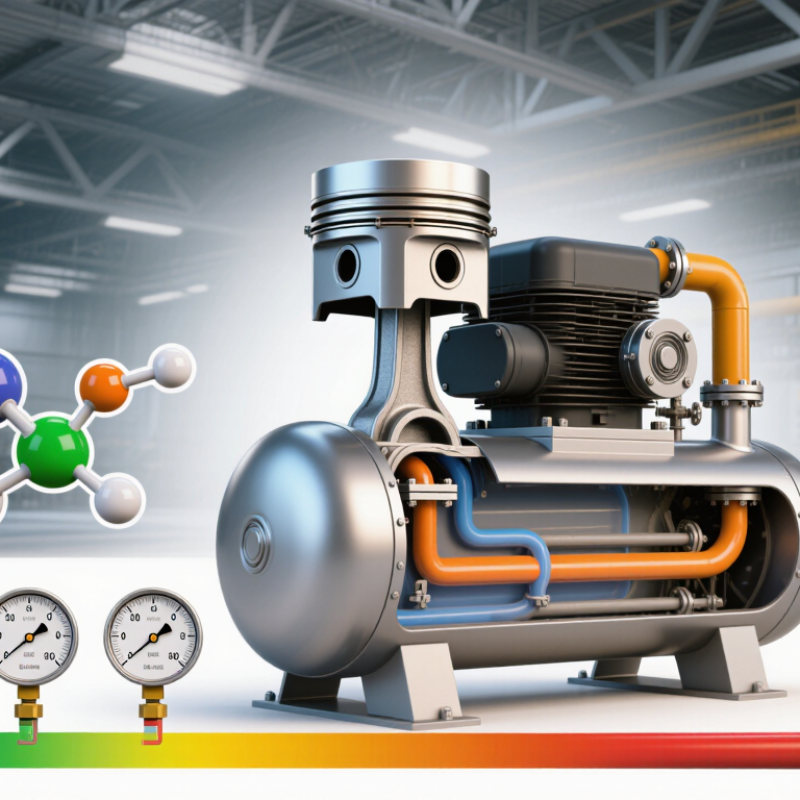
| Compression principle | A crank-driven piston draws gas into a cylinder, compresses it, and discharges it through valves. Multiple cylinders or stages can be used. | Confirm the required pressure ratio, number of stages, cylinder arrangement, and operating speed with the compressor designer. |
| Common applications | Gas gathering, pipeline and storage service, fuel-gas boosting, gas processing, and industrial gas transfer. | Match the package to the actual duty cycle, required turndown, available utilities, and site operating conditions. |
| Capacity and flow | Capacity depends on cylinder displacement, speed, clearance, pressure ratio, gas properties, and the selected configuration. | Provide minimum, normal, and maximum flow in stated standard or actual volume units, with the reference temperature and pressure specified. |
| Pressure and staging | Higher overall pressure ratios are commonly handled with multiple compression stages and intercooling to manage discharge temperature and power demand. | Specify minimum and maximum suction pressure, target discharge pressure, pressure fluctuations, and allowable discharge temperature. |
| Gas composition | Molecular weight, compressibility, moisture, heavier hydrocarbons, carbon dioxide, and hydrogen sulfide can affect performance, materials, and sealing requirements. | Supply a representative gas analysis and identify contaminants, liquid carryover risks, and expected composition changes. |
| Lubrication and gas cleanliness | Cylinder designs may be lubricated or non-lubricated. The appropriate choice depends on gas service, contamination limits, materials, and maintenance requirements. | Establish acceptable oil carryover, lubrication arrangements, filtration, and any downstream gas-quality requirements. |
| Cooling and temperature control | Interstage cooling is often used in multistage service. Cooling also affects gas density, condensate formation, and overall package performance. | Check cooling-medium availability, ambient extremes, gas dew point, separator needs, and the consequences of condensate formation. |
| Load control and turndown | Capacity control can use methods such as clearance pockets, unloaders, speed control, or combinations, subject to the machine and application design. | Define the required flow range, control response, startup frequency, and expected time at reduced load. |
| Reliability and maintenance | Pistons, rings, valves, packing, bearings, and lubrication systems are typical inspection or maintenance items. Actual intervals depend on service and operating conditions. | Review service access, spare-parts availability, monitoring provisions, maintenance staffing, and the cost of planned downtime. |
| Safety and package design | A complete installation may require gas detection, pressure protection, ventilation, shutdown systems, pulsation control, and hazardous-area electrical equipment. | Confirm applicable local codes, site safety requirements, pressure-vessel requirements, noise limits, and any project-specific engineering standards. |
| Best-fit decision | A reciprocating compressor is often considered when the duty calls for positive-displacement compression, flexible pressure capability, or operation across changing process conditions. | Compare lifecycle cost, energy use, reliability, noise, footprint, and maintainability against other compressor types using the same defined duty. |



 © Copyright 2020 Tianjin Tanghaidongyang Valve Co., Ltd. All Rights Reserved.