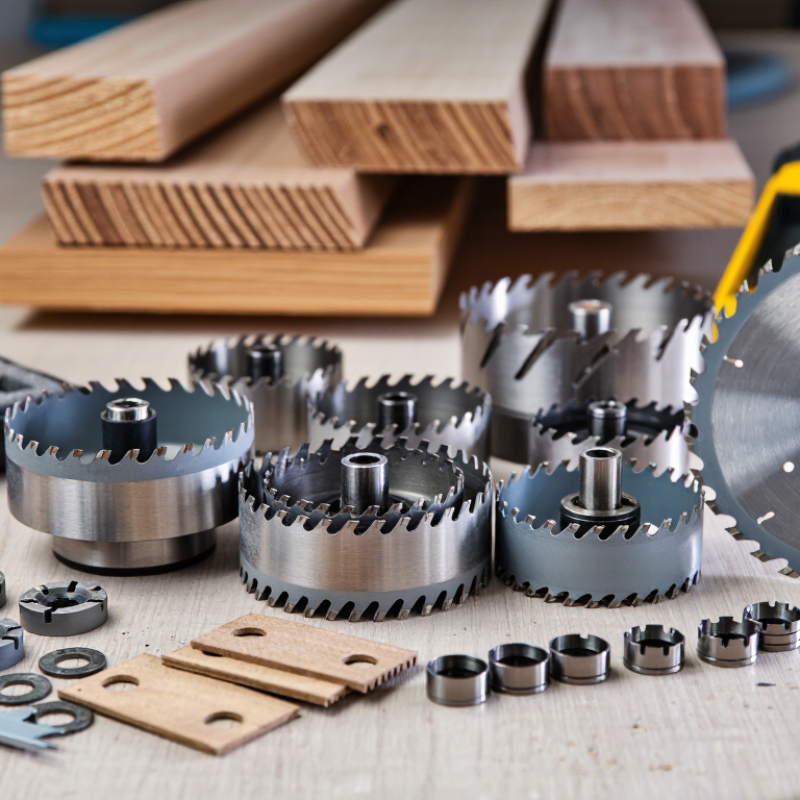
| Stacked Dado Set | Two outside blades combined with chipper blades and spacers | Solid wood, plywood, MDF, particleboard, and many veneered panels | Usually adjustable from approximately 6 mm to 25 mm | High; flat-bottom cuts are achievable when properly aligned | Precise width adjustment, efficient stock removal, and consistent repeatability | Requires compatible arbor length, correct assembly, and a saw approved for dado use | Shelving, cabinet joinery, dados, rabbets, tenons, and box joints |
| Wobble Dado Blade | A single blade mounted at an adjustable angle to create a wider groove | Softwood, hardwood, plywood, and some composite boards | Commonly adjustable from approximately 6 mm to 20 mm | Moderate; the bottom may be slightly concave or uneven | Simple setup, lower purchase cost, and broad width adjustment | More vibration, less accurate flat bottoms, and potentially rougher sidewalls | General-purpose grooves, utility shelving, and non-critical joinery |
| Adjustable Grooving Set | Matched cutters or multiple thin blades combined with precision spacers | Plywood, MDF, melamine-faced panels, laminates, and solid wood | Often adjustable in fine increments across approximately 3 mm to 20 mm | High when cutters are balanced and spacers are accurately selected | Fine width control and suitability for repeated production dimensions | More components to manage; setup accuracy directly affects the final fit | Drawer bottoms, panel grooves, spline joints, and precision cabinet work |
| Thin-Kerf Dado Set | Reduced-body blades or compact stacked components designed for narrower cuts | Plywood, solid wood, MDF, and lightweight panel materials | Typically approximately 3 mm to 13 mm, depending on the configuration | Good to high for narrow grooves and small joinery | Lower material waste, reduced motor load, and compatibility with some shorter arbors | Limited maximum width and less suitable for deep, wide dadoes | Thin plywood grooves, backs, dividers, splines, and small furniture components |
| Scoring or Anti-Chip Dado Set | Primary cutters combined with scoring teeth or specialized edge geometry | Veneered plywood, melamine, laminates, MDF, and coated panels | Generally approximately 6 mm to 20 mm | Very high on brittle or coated surfaces when feed and height are correct | Reduces edge breakout, chipping, and visible damage on decorative panels | Higher setup complexity and usually a higher maintenance requirement | High-appearance cabinetry, laminated panels, and furniture-grade sheet goods |
| Carbide-Tipped Dado Set | Steel body with brazed carbide teeth or carbide cutting edges | Hardwood, plywood, MDF, particleboard, and abrasive engineered panels | Commonly approximately 6 mm to 25 mm, depending on the set | High and generally more durable than comparable high-speed-steel tooling | Longer edge life, better wear resistance, and improved performance in engineered boards | Carbide edges are brittle and can be damaged by impact, improper storage, or metal contact | Frequent professional use, hardwood joinery, and abrasive panel processing |
| High-Speed-Steel Dado Set | Steel cutting edges or blades intended for lighter-duty woodworking | Softwood, non-abrasive hardwood, and occasional plywood use | Usually approximately 6 mm to 20 mm | Moderate; edge sharpness decreases faster in abrasive materials | Lower initial cost and relatively easy sharpening in some configurations | Shorter service life and lower resistance to heat and abrasive sheet goods | Intermittent workshop use, softwood projects, and budget-sensitive purchasing |



 © Copyright 2020 Tianjin Tanghaidongyang Valve Co., Ltd. All Rights Reserved.