2026 Best Fuel Pump Motor Commutator Suppliers
Choosing a supplier for a fuel pump motor component requires more than comparing prices or catalog claims. The Fuel Pump Motor Commutator transfers current through the brush interface, so material consistency and dimensional accuracy matter. Copper grade, segment spacing, insulation quality, and surface finish can all affect operation. Small variations may become noticeable under heat, vibration, and repeated starts.
A useful supplier review begins with the motor’s actual design and operating conditions. Ask about production tolerances, inspection methods, batch traceability, and experience with comparable pump applications. Request material specifications and test data where available, then confirm that sample parts match the production process. A clean sample alone is not proof of stable manufacturing.
Look closely at how suppliers manage defects. Do they document corrective actions? Can they explain how they control commutator runout and segment alignment? Clear answers are more useful than broad promises. Still, supplier documents cannot replace engineering validation in the intended motor assembly. That detail is easy to overlook.
The best choice depends on fit, reliability targets, order volume, and support—not a universal ranking. This 2026 guide examines suppliers through practical criteria, including technical capability, quality controls, customization, and communication. It also recognizes a limitation: published information may not reveal every production condition. Compare evidence carefully, test representative samples, and keep the requirements specific. That makes supplier selection more grounded and helps reduce surprises after qualification.
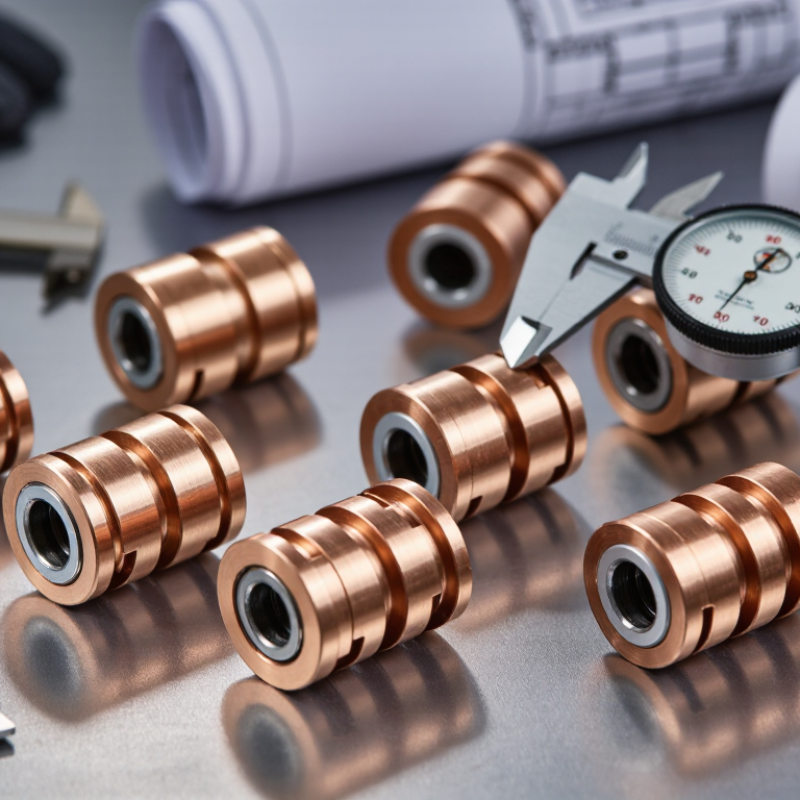
Fuel-Pump Commutators: Function, Materials, and Segment Design
A fuel-pump commutator transfers current from stationary brushes to the rotating armature. Its copper bars must maintain low-resistance contact while turning at speed inside a compact, warm housing. The IACS conductivity benchmark rates annealed copper at 100% at 20°C; real commutator alloys may trade some conductivity for strength and wear resistance. Material choice should match current, temperature, brush grade, and expected duty cycle—not conductivity alone.
Segment design shapes how smoothly current switches between armature coils. Bar count, spacing, insulation, and surface finish all matter. Mica between segments must insulate reliably, while precise undercutting helps brushes contact the copper evenly. Poor geometry can cause sparking, heat, and uneven wear. OICA reported about 92.5 million motor vehicles produced worldwide in 2024, underscoring the scale of automotive component demand, but that figure does not predict any single pump’s operating conditions. Bench testing still matters. Paper calculations can miss real brush behavior.
Tips: Check runout, bar-to-bar insulation, and brush contact after assembly. Record temperature and wear during endurance tests; a design that looks sound may still need refinement.
12 V DC Motor Loads: Current, Speed, and Commutator Wear Metrics
2026 Best Fuel Pump Motor Commutator Suppliers
For a 12 V DC fuel pump motor, judge a commutator supplier under realistic load, not voltage alone. Record voltage at the motor terminals, steady current, startup peak, and shaft speed. A pump test with the correct fluid and outlet pressure gives more useful data than an unloaded bench spin. Compare samples at the same temperature and test duration. Small setup differences matter.
Commutator wear should be tracked over repeated cycles. Inspect surface color, scoring, brush dust, and segment edges under consistent lighting. Note current drift and speed loss alongside each inspection; neither metric identifies wear by itself. Supplier reports should state test conditions, materials, and tolerances clearly. Ask for repeatability data across multiple parts. One tidy sample proves little. Even careful testing can miss real-world vibration, so leave room for field feedback.
Tips: Log startup current separately from running current, and keep the wiring length consistent. Photograph the commutator before and after testing. A simple record often catches patterns that memory misses. Don’t overinterpret one noisy reading.
Supplier Specifications: Segment Count, Runout, Resistance, and Brush Life
2026 Best Fuel Pump Motor Commutator Suppliers
A useful supplier specification starts with the commutator’s segment count, matched to the motor’s winding layout and switching requirements. Ask for the drawing revision and inspection record, not just a number on a quotation. Small errors matter. A missing or uneven segment can affect brush contact and create inconsistent operation. In practice, confirm that samples and production parts follow the same specification.
Runout should be reported as total indicated runout at the finished commutator diameter, with the measurement setup clearly stated. Support method and measurement location can change the result. Ask for actual readings across several parts, plus the permitted tolerance. A neat average may conceal one outlier. That detail is easy to miss.
Resistance data also needs context: specify the measurement points, temperature, and test method. Segment-to-segment readings can reveal uneven connections, but only when the procedure is repeatable.
Brush life should be supported by test conditions, including load, speed, duty cycle, and brush material. Request wear measurements and failure notes, not only hours achieved. Supplier claims are more useful when they include traceable test records.
A datasheet alone is not proof; review it alongside samples and incoming inspection results.
Automotive Qualification: IATF 16949, ISO 16750, and Traceability
2026 Best Fuel Pump Motor Commutator Suppliers
Automotive qualification depends on evidence, not just certificates. IATF 16949 supports controlled processes, risk-based planning, corrective action, and consistent production records. Ask how incoming copper, segment forming, insulation, and final inspection are monitored. A reliable answer points to control plans, calibrated gauges, and recent corrective-action records. Small details matter. For example, a slot-width measurement should connect to a clear acceptance limit and the production lot it came from.
ISO 16750 describes environmental tests for road-vehicle electrical and electronic equipment. Suppliers should explain which relevant stresses they assess, such as temperature cycling, vibration, or humidity. They should also explain why each test suits the commutator and its intended assembly. Traceability should link each production lot to material batches, tooling, process settings, inspection results, and shipment records. Request a sample lot history and check whether a defect can be traced quickly. Paperwork may look complete while a handoff still hides a process change. That deserves scrutiny. Qualification is not a one-time gate; changes and field feedback should trigger documented review.
2026 Best Fuel Pump Motor Commutator Suppliers — Automotive Qualification: IATF 16949, ISO 16750, and Traceability
Qualification framework for evaluating supplier evidence. The chart shows ISO 16750 part numbers by subject; the numbers are identifiers, not test severity or supplier scores.
How to use this framework: Verify that the supplier’s IATF 16949 certificate covers the relevant manufacturing site and scope. Select applicable ISO 16750 tests according to component installation conditions and customer requirements; ISO 16750 is a test-standard series, not a supplier certification. Confirm traceability links commutator lots to relevant material, production, inspection, and test records at the extent required by the customer.
Reference: ISO 16750 series for electrical and electronic equipment in road vehicles. Applicability and test conditions depend on the vehicle application and customer specifications.
Comparing 2026 Suppliers by Capacity, Test Data, and Quality Performance
2026 Best Fuel Pump Motor Commutator Suppliers
Comparing suppliers in 2026 takes more than checking monthly output. Ask for rated capacity, current lead times, and evidence that production can handle your forecast. A high nominal capacity means little if delivery dates shift or batch sizes vary. Review commutator dimensions, copper material details, and inspection records alongside price.
Tips: Request recent test data. Check sample traceability. Compare like with like.
Useful supplier data should show how electrical resistance, runout, and segment condition are measured. Ask for test methods, sample sizes, and results from multiple production lots. One polished sample is not enough. A tidy scorecard can still hide inconsistent batches, especially when the supplier reports averages without ranges. That is easy to miss.
Quality performance is clearer when defects, corrective actions, and repeat findings are tracked over time. Ask how nonconforming parts are contained and how process changes are documented. For capacity checks, compare actual output with planned output during peak demand, not just stated maximums. Request a small pilot lot when practical, then inspect fit and finish under your own acceptance criteria. No single metric settles the choice; the evidence should agree across capacity, test data, and quality records.



 © Copyright 2020 Tianjin Tanghaidongyang Valve Co., Ltd. All Rights Reserved.