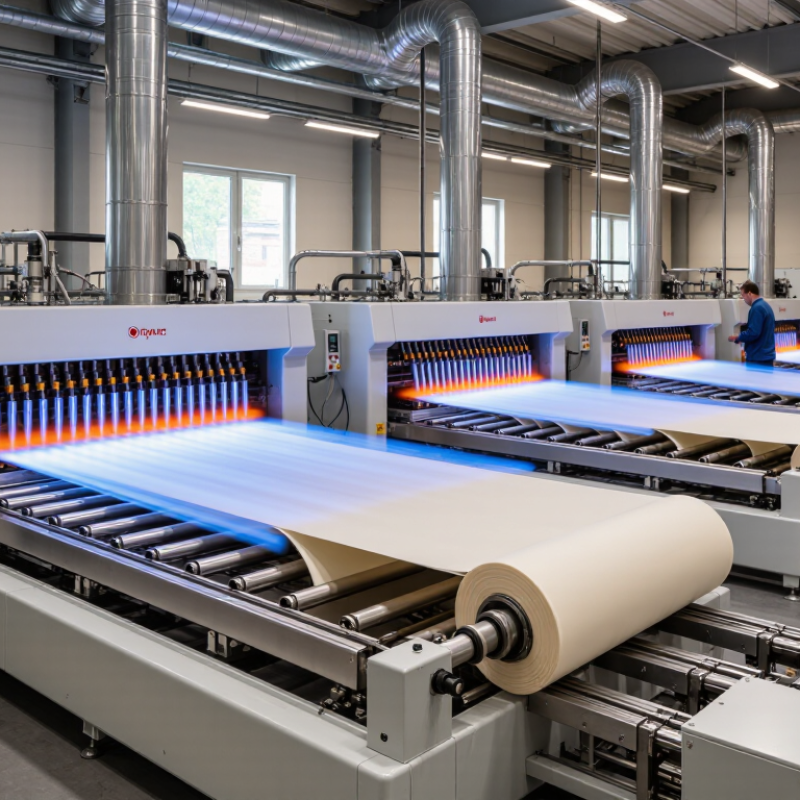
| 1 | Wide Twin-Burner Automotive Laminator | Automotive roof liners, door panels, trunk trim, and large interior fabrics | 1,600–2,200 mm | 8–35 m/min | Polyurethane foam, polyester or polyamide textiles, nonwovens, knitted fabrics, automotive carpeting | 3–30 mm | Two independently controlled burners for balanced treatment across the web | Automatic edge guiding, load-cell tension control, heated pressure roll, chilled pull roll, automatic roll change option | Natural gas or propane; approximately 12–35 Nm³/h, depending on width and output | High-width uniformity and stable bonding on large automotive components | ★★★★★ |
| 2 | Compact Single-Side Foam Laminator | Furniture upholstery, mattress panels, protective padding, and short production runs | 1,000–1,600 mm | 5–25 m/min | Flexible polyurethane foam, polyester fleece, cotton blends, spacer fabrics | 5–35 mm | Single atmospheric burner with adjustable flame height and lateral positioning | Manual unwind stands, pneumatic nip adjustment, basic web alignment, servo-driven take-up | Natural gas or propane; approximately 7–20 Nm³/h | Lower capital cost and straightforward operation for flexible foam products | ★★★★☆ |
| 3 | High-Speed Textile-to-Foam Line | High-volume sportswear padding, bedding, filtration media, and technical textiles | 1,400–2,000 mm | 15–60 m/min | Polyester, polyamide, polypropylene, polyurethane foam, flame-retardant textile constructions | 2–20 mm | High-output ribbon burner with closed-loop gas and air regulation | Servo unwind and rewind, dancer-controlled tension, automatic splice table, recipe-based speed synchronization | Natural gas or propane; approximately 15–40 Nm³/h | High throughput with repeatable surface activation at elevated web speeds | ★★★★☆ |
| 4 | Heavy-Duty Nonwoven and Carpet Laminator | Vehicle carpets, acoustic insulation, floor coverings, and thick nonwoven assemblies | 1,800–2,600 mm | 4–20 m/min | Needlepunch nonwovens, polyester felt, polypropylene carpet, polyurethane and melamine foams | 8–45 mm | Reinforced burner housing with extended flame-control zone and protected burner face | High-torque unwind, reinforced nip frame, wide cooling roll, edge-trim collection, heavy-roll handling | Natural gas or propane; approximately 18–45 Nm³/h | Handles bulky webs and demanding roll weights without excessive web distortion | ★★★★☆ |
| 5 | Precision Narrow-Web Flame Laminator | Medical textiles, shoe components, narrow automotive strips, and sample development | 600–1,200 mm | 3–30 m/min | Thin polyurethane foam, technical fabrics, elastic textiles, coated or laminated textile webs | 1–15 mm | Low-output precision burner with fine lateral adjustment and independent pilot monitoring | Low-tension unwind, compact nip, web-centering guides, digital pressure and speed control | Natural gas or propane; approximately 4–14 Nm³/h | Accurate control of narrow webs and low-basis-weight materials | ★★★★☆ |
| 6 | Double-Pass Reversible Flame Laminator | Two-sided laminates, reversible assemblies, and products requiring controlled treatment of both surfaces | 1,200–1,800 mm | 4–25 m/min | Polyurethane foam, polyester batting, fleece, mesh, knitted textiles, and multilayer interior fabrics | 3–25 mm | Opposed burner modules arranged for sequential or reversible surface treatment | Reversible web path, dual nip stations, closed-loop tension control, programmable dwell time, inspection access | Natural gas or propane; approximately 10–28 Nm³/h | Flexible process control for complex multilayer and two-sided constructions | ★★★★☆ |
| 7 | Modular Pilot-Scale Flame Lamination Cell | Product development, laboratory trials, custom laminate validation, and small-batch production | 500–1,000 mm | 1–15 m/min | Flexible foams, textiles, nonwovens, acoustic materials, spacer fabrics, and automotive trim samples | 1–25 mm | Interchangeable compact burner cassette with adjustable flame width | Quick-change unwind shafts, compact pressure nip, manual or servo take-up, accessible inspection zone | Natural gas or propane; approximately 3–10 Nm³/h | Fast changeovers and economical testing of new material combinations | ★★★☆☆ |



 © Copyright 2020 Tianjin Tanghaidongyang Valve Co., Ltd. All Rights Reserved.