| 1 | Product and defect profile | Confirm that the sorter can identify the required quality defects, including discoloration, broken spears, foreign material, and abnormal shape. | Use representative samples covering green, white, or purple asparagus; different diameters; wet and dry surfaces; and acceptable versus defective product. | Run a blinded sample test with known defect counts. Record detection rate, false-reject rate, and product damage separately for each defect category. |
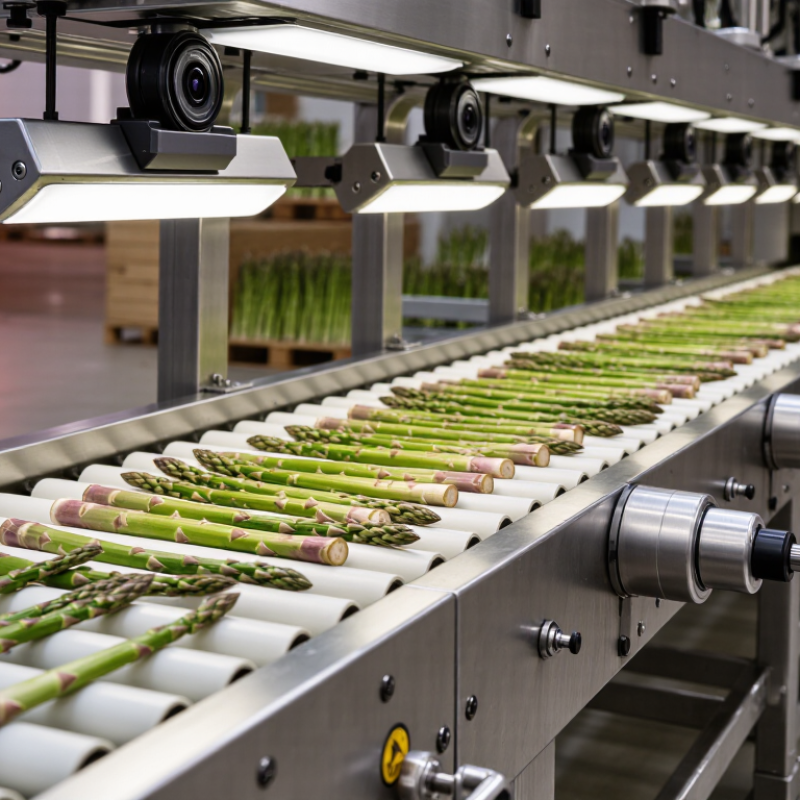
| 2 | Optical and mechanical configuration | Check camera type, lighting arrangement, viewing angles, conveyor or roller design, feed width, and the number of sorting lanes. | A suitable configuration should provide full visibility of the spear body and tip, stable product spacing, controlled speed, and sufficient resolution for the smallest defect that must be removed. | Verify that no product is hidden, overlapped, or rotated into an uninspected position during normal throughput. Inspect both the top and side areas when shape or tip damage matters. |
| 3 | Capacity and product handling | Compare rated capacity with actual line requirements, including peak harvest volumes, product density, and the size range being processed. | Capacity should be evaluated in kilograms per hour or pieces per minute under the same product size, moisture, spacing, and quality settings expected in production. | Test at normal and peak operating rates. Confirm that accuracy, gentle handling, and ejection timing remain stable without excessive bridging, bouncing, or product accumulation. |
| 4 | Cleaning and hygienic design | Review food-contact materials, drainage, access panels, removable parts, cable protection, seals, and the cleaning method approved for the equipment. | Common hygienic features include smooth accessible surfaces, corrosion-resistant construction, limited dirt traps, sloped areas for drainage, and components that can be removed without special tools. | Request a documented cleaning procedure. Time the full cleaning cycle, check inaccessible areas with visual inspection, and confirm that electrical and optical components are protected according to the operating instructions. |
| 5 | Operating controls and recipe management | Verify touchscreen usability, language options, user permissions, product recipes, alarm messages, speed control, and reject sensitivity adjustment. | The control system should allow separate settings for product type, size, color, defect threshold, conveyor speed, and reject timing, while recording the active recipe and major changes. | Ask an operator unfamiliar with the machine to load a recipe, change a permitted setting, respond to an alarm, and return to production without assistance. |
| 6 | Ejection accuracy and product protection | Examine reject mechanism type, air pressure requirements, valve response, reject confirmation, and the separation between acceptable and rejected product. | The ejection system should be synchronized with product position and should remove targeted spears without excessive impact, cross-contamination, or unnecessary loss of good product. | Use a counted test batch and inspect both outlets. Calculate good-product carryover into rejects, defective-product carryover into the good stream, and visible bruising after sorting. |
| 7 | Maintenance, data, and validation support | Check calibration procedures, spare parts, diagnostic tools, production data export, preventive maintenance intervals, training, and remote or on-site technical support. | Useful records include throughput, reject counts, alarm history, recipe changes, inspection results, and cleaning or maintenance completion. Critical replacement parts should have defined lead times. | Request a sample inspection report and a preventive-maintenance schedule. Confirm that operators can identify calibration drift and that quality personnel can verify performance using retained test samples. |


 © Copyright 2020 Tianjin Tanghaidongyang Valve Co., Ltd. All Rights Reserved.