| Light source | LED is the most common choice in new installations. | Commercial flood lights are designed to provide broad, high-intensity illumination for outdoor or large-area applications. | Look for a fixture with documented photometric data and replaceable or serviceable components where maintenance access matters. |
| Luminous output | About 5,000–60,000 lumens, depending on fixture size and application. | Lumens measure the total visible light produced by the fixture. | Choose output based on mounting height, area size, required illuminance, and a lighting layout—not wattage alone. |
| Efficacy | Roughly 100–150 lumens per watt for many commercial LED fixtures. | Efficacy indicates how much light is produced for each watt of electricity used. | Compare tested fixture efficacy alongside light distribution, glare control, and expected operating conditions. |
| Beam distribution | Common distributions range from narrow beams around 10°–30° to wide beams around 60°–120°. | Beam angle and optical distribution determine where light is directed and how evenly an area is covered. | Use narrower optics for long-distance or targeted lighting and wider optics for broad coverage; verify aiming and spill-light limits. |
| Ingress protection | IP65 is common; IP66 is used where stronger water-jet resistance is needed. | The IP rating describes protection against dust and water under specified test conditions. | For exposed outdoor locations, confirm the rating is for the complete assembled fixture and suits the actual cleaning and weather conditions. |
| Impact resistance | IK08 or IK10 may be specified for fixtures exposed to impact risks. | The IK rating indicates resistance to mechanical impact; higher numbers indicate greater tested impact resistance. | Consider a higher rating for sports facilities, public spaces, loading areas, or locations where equipment may be struck. |
| Color temperature | Common options are 3000 K, 4000 K, and 5000 K. | Correlated color temperature describes whether the light appears warmer or cooler. | Choose a consistent color temperature across the site and consider local requirements for outdoor lighting and light pollution. |
| Color rendering | CRI 70 or higher is common for general outdoor applications; CRI 80 or higher may suit color-critical tasks. | CRI describes how accurately colors appear under a light source compared with a reference source. | Use a higher CRI where workers need to distinguish colors, inspect surfaces, or identify objects accurately. |
| Electrical supply | Commercial models may support 120–277 V or 277–480 V, depending on the fixture. | Input-voltage compatibility determines whether the fixture can connect to the site’s electrical system. | Check the full input-voltage range, local electrical code, driver compatibility, and available circuit before ordering. |
| Controls and dimming | Options may include 0–10 V dimming, photocells, occupancy controls, or networked controls. | Controls can reduce energy use and adjust lighting to schedules, daylight, or occupancy. | Confirm control protocols and sensor compatibility; not every fixture includes controls as standard. |
| Surge protection | Protection levels vary by design; some fixtures specify internal surge protection in kilovolts. | Surge protection helps reduce damage from transient voltage events, including some lightning-related surges. | Review the rated protection level and consider additional site-level protection where exposure or electrical risk is high. |
| Service life | Many LED fixtures publish an estimated L70 life in the range of 50,000–100,000 hours. | L70 is the estimated operating time until light output reaches 70% of its initial level under stated conditions. | Check the test basis, ambient temperature, driver life, and warranty terms; rated life is not a guarantee of failure-free operation. |
| Thermal and environmental limits | Operating-temperature limits are model-specific and often cover sub-zero to hot outdoor conditions. | Thermal design affects performance and service life, particularly in enclosed or high-temperature locations. | Verify the fixture’s stated ambient-temperature range for the actual installation site and mounting arrangement. |
| Mounting and aiming | Common arrangements include yoke, slipfitter, and wall or pole mounting options. | Mounting hardware determines how securely the fixture attaches and how accurately it can be aimed. | Check pole or wall compatibility, wind exposure, adjustment range, and the fixture’s weight before installation. |
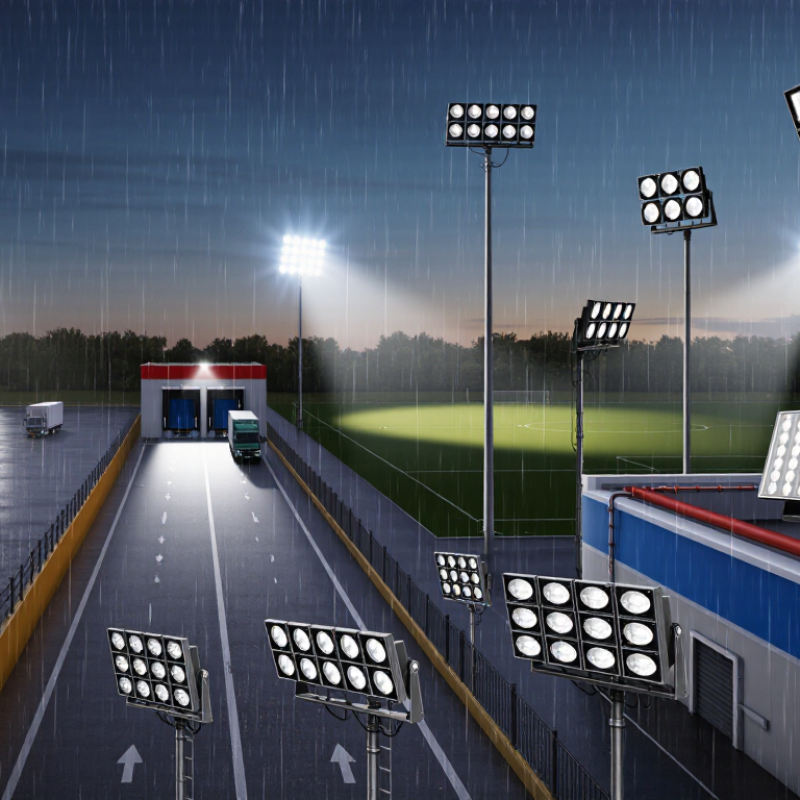
| Best-fit applications | Parking lots, building facades, loading areas, sports grounds, yards, and security perimeters. | A commercial fixture is selected for the required coverage, durability, operating schedule, and site conditions. | The best option is the one that meets the project’s lighting design, safety, energy, environmental, and maintenance requirements. |



 © Copyright 2020 Tianjin Tanghaidongyang Valve Co., Ltd. All Rights Reserved.