| Electronic Measurement Accuracy | Choose a model rated at approximately ±0.1° to ±0.2° | About ±1.7 to ±3.5 mm per metre at level | Provides reliable alignment for cabinetry, framing, shelving, and equipment installation. |
| Measurement Resolution | 0.05° or 0.1° display resolution | Common angle increments: 0.05° or 0.1° | Makes small changes in slope easier to identify and correct. |
| Measurement Range | At least 0° to 90° for general construction work | Level, plumb, and common slope measurements; some models read up to 360° | Supports horizontal, vertical, inclined, and full-angle measurements. |
| Selectable Units | Degrees, percentage, millimetres per metre, and inches per foot | Typical slope formats include 0.0°, 0.0%, mm/m, and in/ft | Allows readings to match architectural drawings, building standards, and job-site practices. |
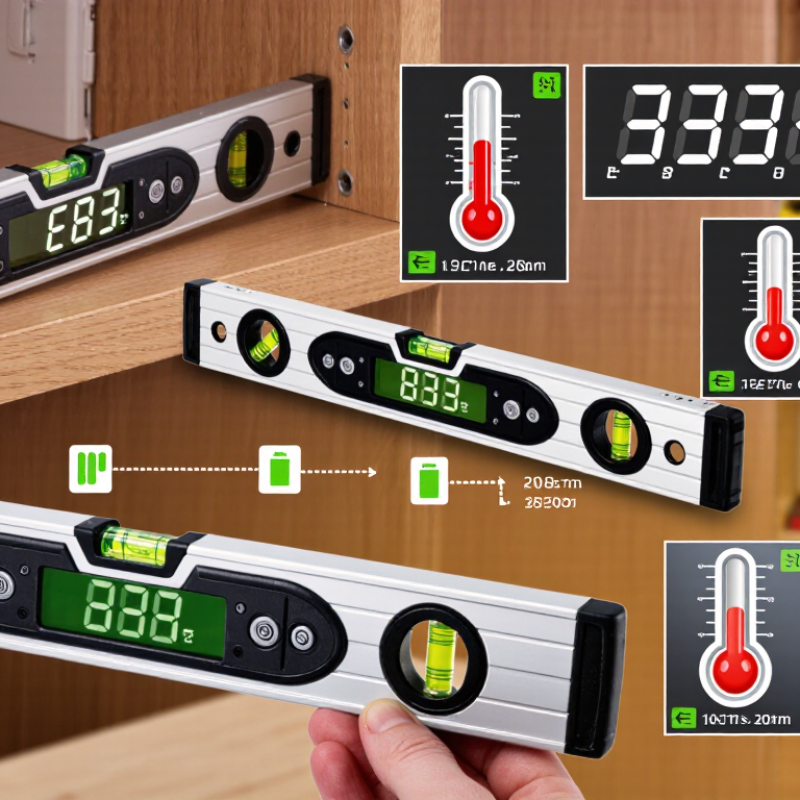
| Digital Display | High-contrast LCD with backlight and clear symbols | Usually includes angle value, direction arrows, unit indicator, and low-battery symbol | Improves readability in dim areas and reduces interpretation errors. |
| Audible Alignment Alert | Tone that changes near zero or 90° | Many designs provide a continuous or intermittent tone when aligned | Enables hands-free positioning when the display is difficult to see. |
| Calibration Function | User calibration with a flat reference surface | Common procedures use a 180° flip or two-point calibration | Helps compensate for minor changes caused by transport, impact, or temperature. |
| Automatic Shut-Off | Power-off after approximately 3 to 10 minutes of inactivity | The exact delay depends on the instrument design | Extends battery life when the tool is left on unintentionally. |
| Operating Temperature | A range close to 0°C to 40°C for indoor and general site use | Some professional models support wider ranges, such as approximately -10°C to 50°C | Maintains dependable readings across common workshop and construction conditions. |
| Protection Against Dust and Water | At least basic splash and dust resistance for job-site use | Protection ratings vary; IP54 indicates limited dust ingress and water splashes from any direction | Reduces the risk of inaccurate readings or damage in dusty and damp environments. |
| Measuring Surface | Rigid, machined base with smooth contact edges | Longer bodies generally improve stability; common lengths range from approximately 230 mm to 600 mm | Creates more consistent contact with the workpiece and reduces rocking during measurement. |
| Magnetic Base | Integrated magnets for ferrous surfaces, with a secure non-slip fit | Useful on steel framing, machinery, pipes, and metal structures | Keeps the tool positioned during hands-free checks without replacing visual verification. |
| Battery and Runtime | Replaceable batteries or rechargeable power with a low-battery indicator | Runtime depends on display brightness, alarm use, and battery capacity | Reduces interruptions and helps prevent measurements taken with insufficient power. |
| Verification Before Use | Check against a known level reference before critical measurements | Compare the reading, rotate the tool 180°, and confirm consistent results | Detects calibration drift and helps maintain measurement confidence over time. |
| Best Use Cases | Installation, woodworking, masonry, equipment setup, and maintenance | Suitable for horizontal, vertical, and slope alignment tasks | Combines fast digital feedback with the practical stability of a traditional level body. |
| Important Limitation | Use the tool according to its stated accuracy and environmental limits | Accuracy can be affected by drops, dirt on the base, temperature changes, and weak batteries | Encourages proper verification instead of treating every digital reading as laboratory-grade data. |



 © Copyright 2020 Tianjin Tanghaidongyang Valve Co., Ltd. All Rights Reserved.