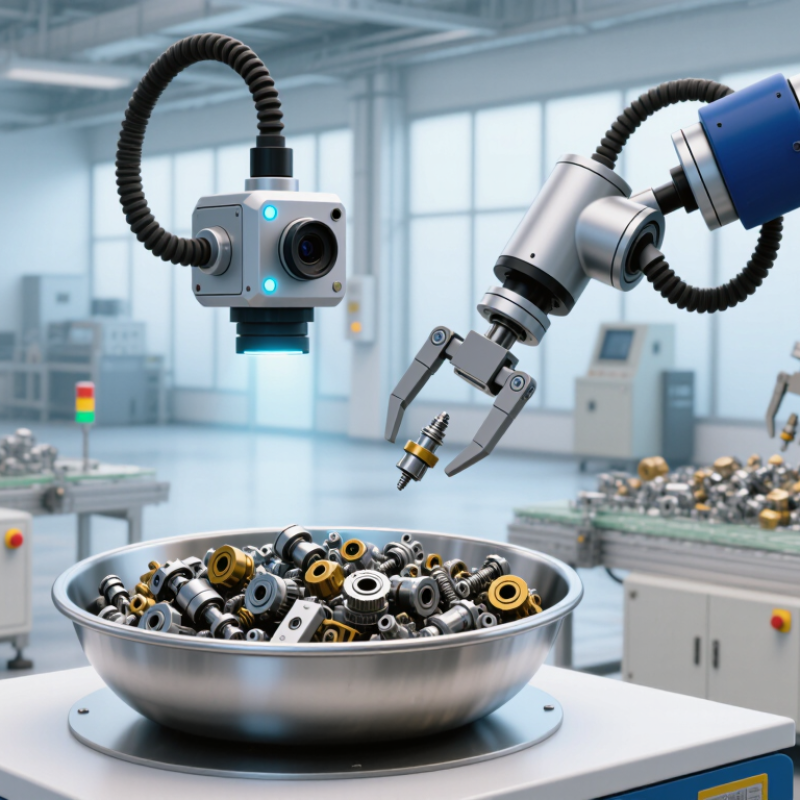
| Flexible feeder with vision guidance | A feeder spreads parts on a surface; a camera identifies suitable parts and provides pickup coordinates to a robot. | Often suited to mixed, randomly oriented parts within the feeder, camera, and robot’s operating limits. | High when recipes, vision tools, and robot programs can be changed digitally. | Can reduce the need for a dedicated mechanical track for every part type; supports part picking from a spread-out presentation. | Performance depends on part visibility, surface properties, camera setup, robot reach, and how well parts separate. | Production involving multiple part types or frequent product changes. |
| Vibratory bowl feeder | Vibration moves parts along a bowl track, where tooling guides them into a consistent orientation. | Usually designed around a specific part family and a defined orientation. | Low to moderate; changing parts may require track or tooling adjustments, or a separate bowl. | Can provide continuous, oriented part supply for established, repeatable production. | Custom tooling can make frequent product changes costly; noise, part wear, and track jams should be considered. | High-volume applications with stable part designs and orientation requirements. |
| Centrifugal feeder | A rotating disk moves parts outward toward a discharge area, where guides and controls help orient them. | Works with suitable parts that can be separated and guided reliably; compatibility is application-specific. | Moderate; adjustments or dedicated guides may be needed for different parts. | Can deliver parts at high rates in a compact footprint for suitable applications. | Part shape, surface, and orientation requirements affect performance; parts must be tested with the intended setup. | Consistent production where a suitable part can be separated and oriented at speed. |
| Step feeder | Moving steps lift parts from a bulk supply and transfer them to a downstream track or conveyor. | Best for parts that can be lifted and transferred without excessive entanglement or damage. | Low to moderate; part-specific guides or transfer tooling may be required. | Provides a controlled feed and can be gentler than some bulk-feeding methods. | May require custom tooling and careful assessment of part geometry and orientation needs. | Applications needing a steady supply of parts that are difficult to handle in a vibratory bowl. |
| Linear vibratory track feeder | A vibrating track advances parts from an upstream supply toward a machine or pick point. | Typically handles a defined part type or family presented in a consistent way. | Low to moderate; track width, guides, and controls may need adjustment for a new part. | Useful for buffering and transporting already oriented parts between process steps. | It generally transports parts rather than solving complex orientation needs on its own. | Linking a feeder, assembly station, or inspection process. |
| Manual kitting or tray presentation | An operator places parts into trays or kits in a known arrangement for manual or automated pickup. | Can accommodate a wide variety of parts if the trays and work instructions are suitable. | High; a new layout or work instruction can often be introduced without rebuilding a feeder. | Simple to adapt for prototypes, low volumes, and frequently changing product mixes. | Requires operator time and consistent loading; labor, ergonomics, and presentation accuracy matter. | Low-volume production, pilot runs, or applications where automation tooling is not justified. |



 © Copyright 2020 Tianjin Tanghaidongyang Valve Co., Ltd. All Rights Reserved.