| Freight elevator | A powered lift serving multiple floors, with a car designed for freight handling. | Warehouses, factories, distribution centres, and multi-storey commercial or industrial buildings. | Can serve several landings and accommodate pallets, trolleys, or other unit loads when the car and doors are sized accordingly. | Requires suitable shaft space, structural planning, landing access, and installation coordination. Confirm rated load, car and doorway dimensions, loading method, traffic demand, and applicable local requirements. | Operations moving substantial or frequent loads between multiple fixed levels. |
| Goods-only lift | A lift intended to carry goods, generally with loading and unloading managed by trained personnel in accordance with the design and local rules. | Industrial buildings and back-of-house areas where freight movement is separate from passenger transport. | Separates goods flow from passenger lift traffic and can be configured around the operation’s load and handling equipment. | Check whether people may ride in the lift under the relevant local code and equipment classification. Verify access controls, loading procedures, guarding, and permitted use. | Sites that need dedicated freight movement and can manage goods loading under controlled procedures. |
| Hydraulic goods lift | A hydraulic system raises and lowers the lift platform or car; the exact arrangement depends on the design. | Low- to mid-rise industrial or commercial applications, including buildings with moderate travel requirements. | May suit installations where a hydraulic configuration fits the site and required travel; equipment can be designed for specific load and platform needs. | Assess travel height, operating frequency, machine-room or equipment-space needs, temperature conditions, maintenance access, and local energy and safety requirements. Performance varies by system design. | Projects where the building layout and duty cycle are compatible with a hydraulic system. |
| Traction goods elevator | Uses a motor-driven traction system to move a lift car, typically with counterbalancing components. | Multi-storey buildings with regular freight movement and greater travel requirements. | Can be appropriate for longer travel and sustained service, depending on the selected equipment and operating profile. | Compare rated load, travel, speed, expected starts per hour, energy use, equipment-room arrangement, and maintenance capability. Actual suitability depends on the specific design. | Buildings where travel height, traffic, and duty requirements favour a traction system. |
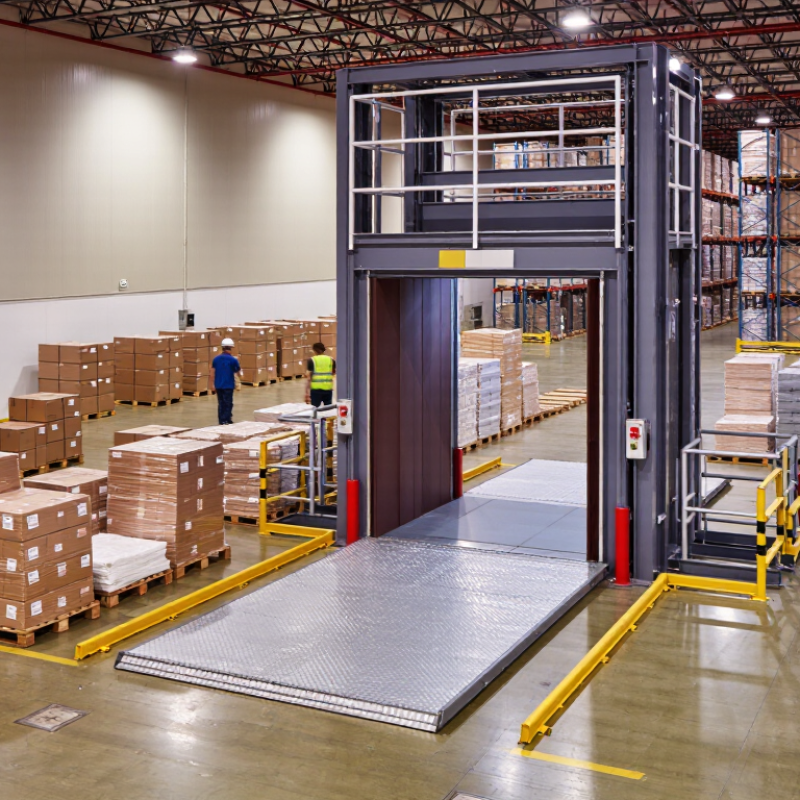
| Vertical reciprocating conveyor (VRC) | Moves materials vertically on a platform or carrier between designated levels; it is generally material-handling equipment rather than a passenger lift. | Factories, warehouses, mezzanines, and production lines transferring palletised or unitised goods. | Can provide a direct vertical transfer point and may fit material-flow layouts where goods are loaded and unloaded at fixed levels. | Do not assume it can carry people. Confirm guarding, access gates, loading arrangement, load stability, travel, and the applicable machinery or building regulations. | Controlled goods transfer between fixed levels where passenger access is not required. |
| Goods platform lift | Raises a platform carrying goods, often over a relatively short vertical distance. | Retail stockrooms, workshops, service areas, and small level changes between floors or platforms. | May be suitable where a full passenger-style lift installation is unnecessary and the goods transfer route is straightforward. | Check platform size, edge protection, access gates, loading position, travel, and whether the intended use is permitted by local regulations. A platform lift is not automatically suitable for transporting people. | Short, defined goods transfers with simple loading and unloading requirements. |
| Service lift / dumbwaiter | A compact lift transfers small items between floors through a small car or compartment. | Restaurants, hotels, clinics, libraries, and other buildings moving meals, documents, or supplies. | Provides a dedicated route for small goods and can reduce staff carrying items on stairs. | Car opening and internal dimensions limit the size of items. Confirm the rated load, door arrangement, cleaning needs, and that the intended goods fit safely. | Small, frequent item transfers rather than pallet or bulky-load handling. |
| Scissor lift table | A powered scissor mechanism raises or lowers a work platform, usually over a limited vertical range. | Loading bays, assembly areas, ergonomic workstations, and vehicle or conveyor interfaces. | Can bring loads to a more useful working or transfer height and integrate with a defined work process. | Usually serves a local height-adjustment task, not multi-floor transport. Check platform dimensions, rated load, guarding, pinch-point protection, and floor conditions. | Single-area lifting, loading, and height adjustment rather than vertical transport between storeys. |



 © Copyright 2020 Tianjin Tanghaidongyang Valve Co., Ltd. All Rights Reserved.