| Compact handheld controls | Low-profile, momentary tact switch; commonly normally open | Integrated single-color LED or a separate nearby indicator | Short travel is common; force options vary by series | Surface-mount or through-hole versions, depending on the design | Uses little panel space and provides a clear click or tactile response | Check actuator height, PCB clearance, operating force, and whether the LED needs a separate electrical connection |
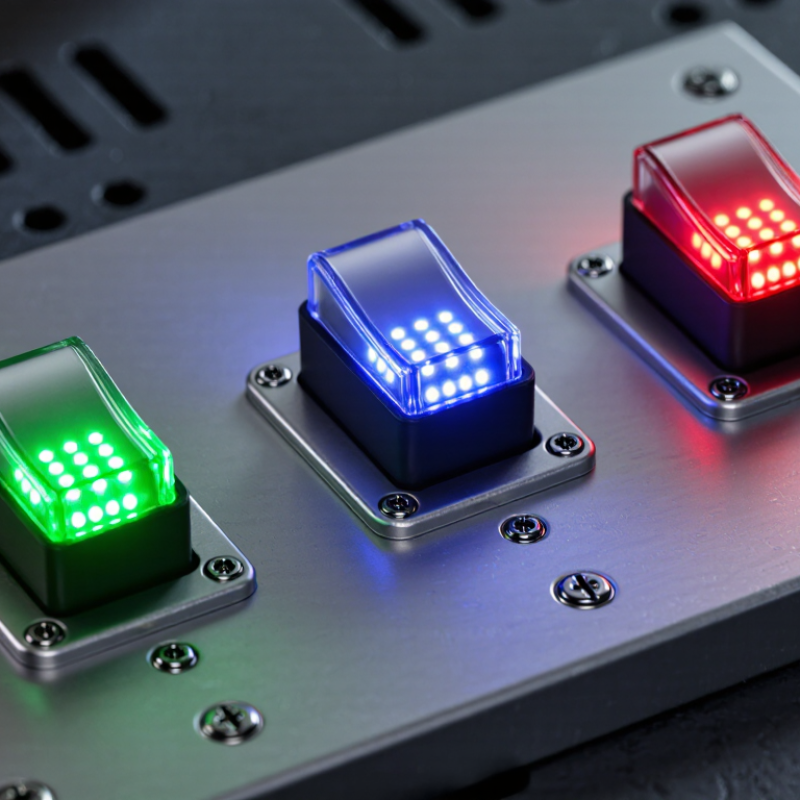
| Backlit buttons and status controls | Tact switch paired with a light-transmitting cap, lens, or overlay | Single-color LED; color depends on the selected LED and optical materials | Choose travel and force to suit the cap size and intended feel | Allow room for the switch, light source, and light guide or panel opening | Can make a control easier to locate and communicate a simple status | Evaluate light uniformity, viewing angle, ambient-light visibility, and alignment between the LED and cap |
| Multicolor status indication | Switch with a multicolor LED, or a tact switch combined with separate indicator LEDs | Two-color or RGB arrangements are available in some designs | Mechanical feel is selected separately from LED color control | Confirm the footprint and electrical connections for every LED channel | Can convey multiple states using one illuminated control area | Check LED polarity, drive method, current limits, color mixing, and whether the controller supports the required states |
| Frequent-use interfaces | Momentary tact switch selected for the required operating life and duty cycle | Integrated illumination or a separate indicator, as required | Compare operating force, release feel, and travel with user testing | Use a PCB layout that supports the switch mechanically and electrically | Provides a compact input with a defined actuation point | Verify mechanical life and electrical ratings under the actual load; rated life can depend on test conditions |
| Dust- or splash-exposed equipment | Sealed tact switch or a switch protected by a suitable enclosure and panel design | Sealed illuminated variants exist; illumination does not itself provide ingress protection | Force and travel depend on the specific sealed construction | Consider panel sealing, gasket compression, and how the actuator is exposed | Can support more demanding environments when the complete assembly is designed accordingly | Look for a documented IP rating for the relevant installed configuration; verify temperature, chemical, and cleaning compatibility |
| Cost-conscious consumer products | Standard tact switch with a separate LED or light pipe | Separate single-color LED is often straightforward to drive and replace | Broad range of forces and travel lengths is available across switch families | Requires space and alignment for both the switch and light source | Offers flexibility in component placement and independent switch or LED selection | Compare total assembly cost, PCB area, part count, optical performance, and assembly tolerances |
| Custom or space-constrained interfaces | Illuminated switch selected around the panel, cap, and PCB geometry | Integrated LED, light pipe, or externally positioned LED | Choose force and travel through prototype evaluation rather than appearance alone | Check dimensions, actuator alignment, soldering process, and available keep-out area | Can balance tactile feel, visibility, and packaging requirements | Request drawings and samples; validate tolerances, light leakage, thermal behavior, and user ergonomics |



 © Copyright 2020 Tianjin Tanghaidongyang Valve Co., Ltd. All Rights Reserved.