| 1 | Product Compliance | Whether lockout stations, padlocks, tags, hasps, and accessories are designed for hazardous-energy control. | Technical files, test reports, declarations, and product specifications. | 20% | Products should support applicable requirements such as OSHA 29 CFR 1910.147 and relevant ISO 14118 principles. |
| 2 | Material and Durability | Resistance to impact, corrosion, ultraviolet exposure, chemicals, and repeated workplace use. | Material grades, salt-spray or corrosion data, impact-test records, and sample inspection. | 15% | Metal components should have corrosion-resistant finishes; plastic parts should be suitable for the stated operating environment. |
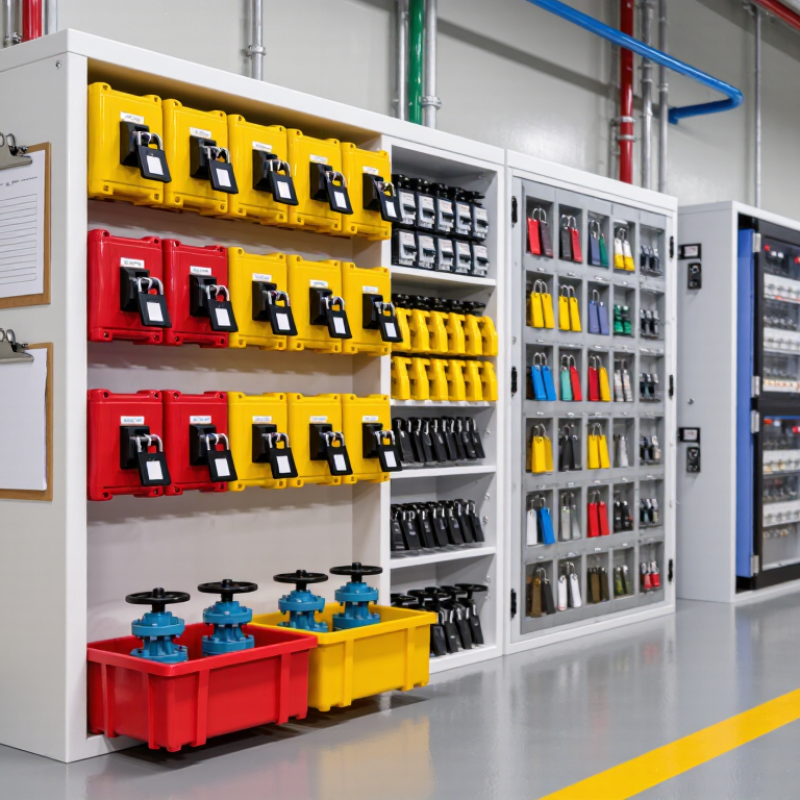
| 3 | Product Range | Availability of wall-mounted stations, portable kits, padlocks, tags, breaker lockouts, valve lockouts, and group lockout devices. | Current catalog, product drawings, compatibility lists, and sample kit contents. | 15% | A capable supplier should cover the main electrical, mechanical, hydraulic, pneumatic, and valve isolation applications. |
| 4 | Manufacturing Quality Control | Consistency of dimensions, color, printing, locking function, and assembly quality between production batches. | Quality manual, inspection procedures, batch records, calibration records, and pre-shipment inspection reports. | 15% | The supplier should use documented incoming, in-process, and final inspection procedures with traceable records. |
| 5 | Customization Capability | Ability to provide custom colors, warning labels, languages, logos, station layouts, and kit configurations. | Approved artwork, engineering drawings, prototypes, and documented revision control. | 10% | Custom printing and packaging should be supported without changing safety-critical dimensions or functions. |
| 6 | Lead Time and Capacity | Ability to meet sample, trial-order, and repeat-order schedules with stable production capacity. | Written production schedule, capacity statement, historical delivery records, and purchase-order terms. | 10% | For standard items, a clear quotation should state sample timing, production lead time, and shipment method. |
| 7 | Minimum Order Quantity | Whether minimum quantities are reasonable for standard products, customized products, and trial orders. | Formal quotation showing minimum order quantities, tooling charges, and sample policy. | 5% | A transparent supplier separates standard-item pricing from customization, tooling, printing, and packaging costs. |
| 8 | Export and Documentation Support | Ability to provide accurate commercial, technical, packaging, and shipping documentation. | Packing list, commercial invoice, HS-code information, product datasheets, and export references. | 5% | Documents should match the ordered products, quantities, packaging, and destination-country requirements. |
| 9 | Communication and After-Sales Service | Responsiveness, technical support, complaint handling, replacement policy, and corrective-action capability. | Service terms, response-time commitments, warranty policy, and corrective-action reports. | 5% | The supplier should provide a defined contact channel and a documented process for quality claims and replacements. |


 © Copyright 2020 Tianjin Tanghaidongyang Valve Co., Ltd. All Rights Reserved.