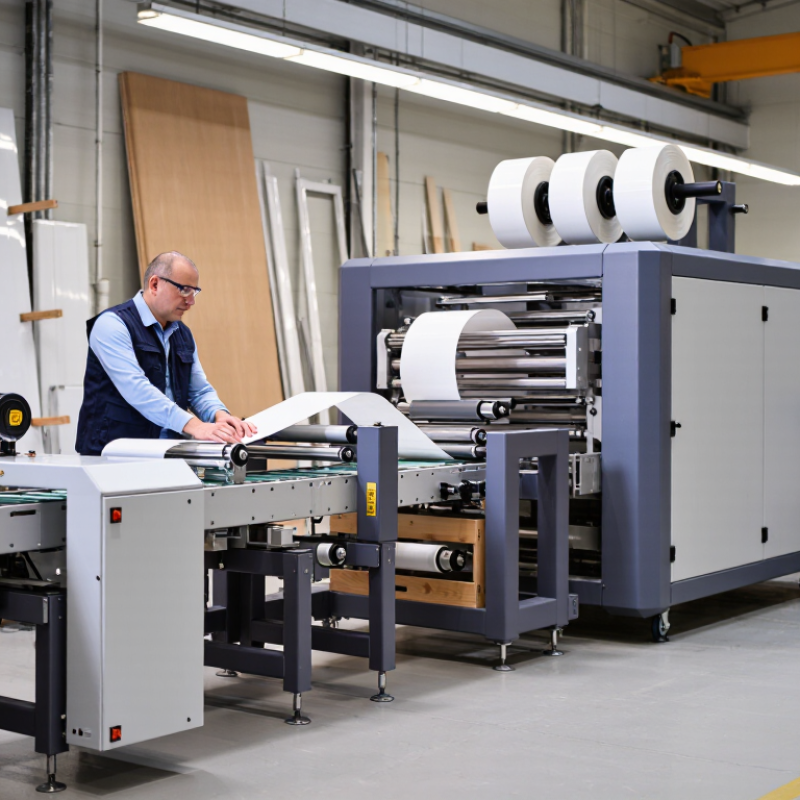
| Machine Function | A profile wrapping machine continuously applies decorative foil, veneer, paper, laminate, or other flexible materials to the surface of a rigid profile. | It creates a consistent finished surface on long, narrow components while reducing manual covering work. | Choose a continuous-feed machine with automatic material alignment and adhesive control. | Furniture components, interior trim, window and door profiles, wall panels, flooring accessories, and construction profiles. |
| Compatible Profile Materials | Common substrates include MDF, particleboard, wood, PVC, aluminum, steel, and composite profiles, depending on machine configuration. | The substrate affects adhesive selection, heating requirements, pressure settings, and surface preparation. | Select a machine with adjustable pressure rollers and interchangeable tooling for the intended substrate range. | Wood-based profiles, plastic extrusions, metal trims, and engineered composite sections. |
| Typical Profile Size | Many industrial systems handle profile widths of approximately 10–300 mm and profile heights of approximately 5–120 mm. Actual limits vary by tooling and machine design. | Correct dimensional capacity prevents edge lifting, incomplete coverage, and excessive material waste. | Choose a machine whose working range exceeds the largest planned profile by at least 10–20%. | Standard flat, rectangular, rounded, grooved, and moderately complex cross-sections. |
| Production Speed | Typical line speeds range from approximately 10–60 m/min. High-speed production lines can operate faster when profile geometry, adhesive, and covering material allow it. | Speed affects output, labor cost, adhesive curing, and the stability of the wrapped finish. | For mixed production, prioritize stable speed adjustment rather than maximum speed alone. | Low-volume customization, general industrial production, and high-volume profile manufacturing. |
| Adhesive System | Common options include hot-melt adhesive, PUR hot-melt adhesive, and water-based or solvent-free cold adhesive systems. | Adhesive choice influences bonding strength, heat resistance, open time, cleaning requirements, and environmental performance. | Use PUR hot melt when high moisture and heat resistance are required; use standard hot melt for many general-purpose applications. | Interior products, furniture components, moisture-resistant profiles, and demanding decorative surfaces. |
| Heating and Temperature Control | Hot-melt systems commonly use heated glue tanks, hoses, nozzles, or application rollers with electronically controlled temperature settings. | Stable temperature helps maintain adhesive viscosity and prevents weak bonding or material damage. | Choose independent temperature zones, digital monitoring, and over-temperature protection. | Thermoplastic films, decorative papers, laminates, veneers, and heat-sensitive coverings when properly configured. |
| Wrapping Coverage | Machines may wrap one face, two faces, three faces, or multiple sides of a profile in a single pass, depending on the roller and guide arrangement. | Coverage capability determines whether secondary operations are needed and affects total production time. | Select multi-side wrapping for profiles requiring a continuous decorative finish around corners and edges. | Visible furniture edges, door and window trims, skirting profiles, and decorative moldings. |
| Material Compatibility | Common covering materials include PVC film, PET film, PP film, decorative paper, CPL, HPL strips, and natural veneer. | Each material has different requirements for tension, temperature, adhesive quantity, and pressure. | Choose adjustable unwind tension, edge guides, and pressure rollers for mixed-material production. | Wood-grain finishes, solid colors, high-gloss surfaces, textured films, and natural wood surfaces. |
| Control and Adjustment | Modern systems commonly provide variable feed speed, adjustable roller pressure, adhesive temperature control, and recipe-based settings. | Digital adjustment improves repeatability when changing profile sizes, coverings, or adhesives. | Prioritize a touchscreen control system with stored production recipes and alarm diagnostics. | Factories producing multiple profile dimensions or frequent short production runs. |
| Changeover Capability | Changeover time depends on tooling, profile geometry, adhesive system, and the number of manual adjustments required. | Fast changeovers reduce downtime and make smaller production batches more economical. | Choose quick-adjust guides, marked settings, modular rollers, and tool-free or low-tool adjustments where available. | Contract manufacturing, customized profiles, and mixed-batch production. |
| Automation Level | Basic machines require more manual feeding and adjustment; advanced lines may include automatic feeding, edge control, cutting, defect detection, and production monitoring. | Automation can improve consistency and reduce operator dependence, but it increases initial investment and integration requirements. | Use semi-automatic equipment for flexible production and fully integrated automation for continuous high-volume output. | Small workshops, medium-sized factories, and automated industrial production lines. |
| Quality Control | Important quality indicators include complete adhesive transfer, clean edges, uniform tension, accurate alignment, wrinkle-free surfaces, and consistent bonding. | Visual defects and poor adhesion can lead to rework, material loss, and customer complaints. | Choose systems with stable pressure control, accurate guiding, and accessible inspection points. | Visible decorative components and products requiring consistent appearance across long runs. |
| Energy and Operating Efficiency | Energy consumption is mainly influenced by heater power, adhesive temperature, line speed, standby time, and compressed-air usage. | Efficient heating and reduced idle time can lower operating costs over the machine's service life. | Look for insulated heating zones, standby modes, automatic shutdown, and efficient pneumatic components. | Continuous production environments seeking lower energy use and improved operating-cost control. |
| Safety Features | Relevant features include emergency-stop circuits, guarded moving parts, temperature alarms, overload protection, and safe access around adhesive and heating areas. | Wrapping lines combine rotating rollers, heated components, adhesive systems, and moving profiles. | Select equipment with clearly accessible emergency stops, guarding, safety interlocks, and documented operating procedures. | All production environments, particularly facilities with multiple operators or shift-based operation. |
| Best Overall Selection Criteria | Working range, adhesive compatibility, stable guiding, controllable pressure, suitable speed, changeover time, safety, and serviceability. | The best machine is determined by the complete production process rather than by speed or purchase price alone. | For most 2026 applications, choose a digitally controlled, multi-side, adjustable machine compatible with the required substrate, covering material, and adhesive. | Manufacturers seeking repeatable quality, flexible production, and lower long-term operating risk. |



 © Copyright 2020 Tianjin Tanghaidongyang Valve Co., Ltd. All Rights Reserved.