| UV Protection and Transparency |
| UPF rating | The ultraviolet protection factor reported for the canopy material. | Request a laboratory report identifying the tested material, specimen condition, test method, and UPF result. | UPF 50 indicates that, under the test conditions, the material transmits about 1/50 of the erythemally weighted UV radiation. Check the report and applicable labeling rules before using a protection claim. |
| UV transmission | Separate UVA and UVB transmission data, where available. | Ask for spectrophotometric results across the relevant ultraviolet wavelength range, not only a marketing statement such as “UV resistant.” | Compare reports produced using the same method and test conditions. A UPF value alone may not describe every aspect of UVA transmission. |
| Test method and sample identity | Whether the report applies to the proposed transparent canopy, coating, and production specification. | Match the report’s material description, construction, color, coating, and sample date to the order specification. | A report for a different fabric or coating is not reliable evidence for the supplied umbrella. Confirm whether testing covers material swatches or the finished product. |
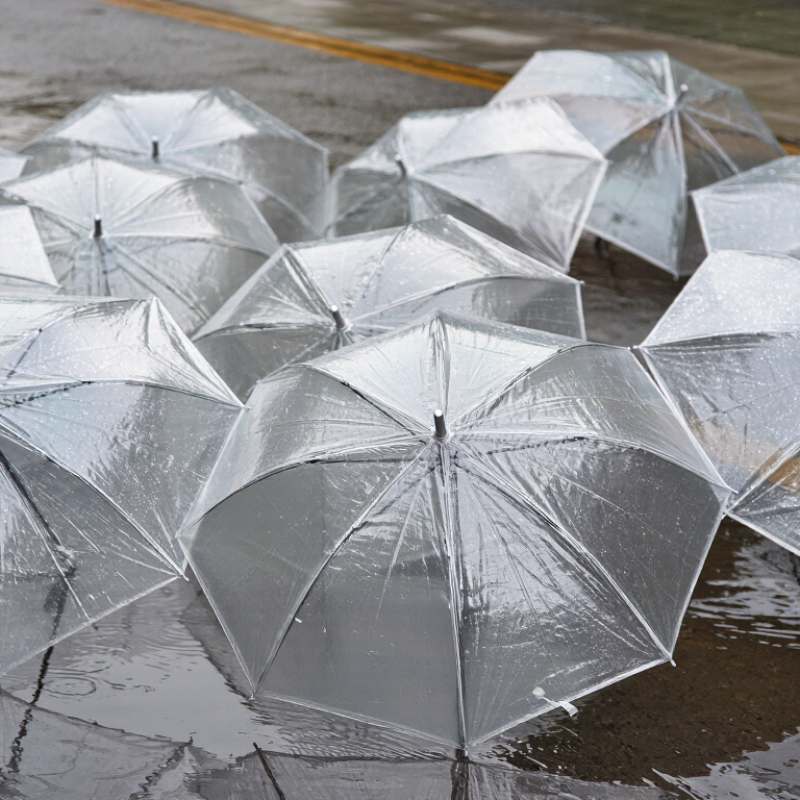
| Visible-light clarity | Transparency, haze, color cast, and visual distortion. | Inspect samples against printed text or a standard visual target under consistent lighting; request visible-light transmission or haze data if specified. | Set an agreed appearance sample and acceptance criteria. Transparency does not, by itself, demonstrate UV protection. |
| Coating consistency | Uneven coating, pinholes, cloudiness, peeling, or tacky areas. | Inspect the full canopy in transmitted and reflected light, including seams and panel edges. Compare production samples with the approved sample. | Define inspection conditions and defect limits in the purchase specification. Ask whether UV performance is tested after any relevant conditioning or ageing. |
| Care and use conditions | Whether cleaning, abrasion, folding, wetting, or ageing affects the claimed performance. | Review care instructions and ask for supporting test data if the protection claim is intended to apply after repeated use. | Do not assume a UV rating remains unchanged after wear or damage unless the supplier provides evidence for that condition. |
| Construction, Durability, and Wholesale Quality Control |
| Canopy material and seams | Material specification, panel alignment, stitching, seam finish, and attachment to ribs. | Inspect production samples for skipped stitches, loose threads, uneven panels, sharp edges, and weak attachment points. | Record the approved material and construction details in the order specification so substitutions can be identified. |
| Frame and ribs | Rib alignment, joints, shaft, runner, tips, and resistance to bending or corrosion. | Open and close samples repeatedly; check for sticking, loose joints, sharp parts, and visible damage after operation. | Set a cycle-test requirement and pass/fail criteria suited to the intended use. Do not treat a cycle count as a universal industry guarantee. |
| Wind performance | Frame stability and canopy behavior in the conditions relevant to the product’s intended use. | Request the supplier’s test procedure and results, or conduct an agreed test on representative samples. | Specify any wind-test conditions and acceptance criteria in advance. Avoid unsupported “storm-proof” claims. |
| Opening and closing | Manual or automatic mechanism, button response, smooth movement, and pinch-point safety. | Operate samples from each production lot and check that the mechanism locks, releases, and closes consistently. | Confirm the mechanism type, operating instructions, and any safety requirements for the destination market. |
| Dimensions and tolerances | Open diameter, closed length, canopy coverage, and handle dimensions. | Measure samples using the same reference points and method agreed with the supplier. | List target dimensions and permitted tolerances on the approved specification; tolerance limits should be agreed for the specific order. |
| Water shedding and drying | Canopy drainage, water pooling, leakage at seams, and drying behavior. | Wet a sample under an agreed test setup and inspect the canopy, seams, and handle area for leakage or pooling. | Specify the test conditions and acceptance criteria. Waterproofing and UV protection are separate performance properties. |
| Production inspection | Consistency between the approved sample and goods ready for shipment. | Use pre-production approval, in-line checks, and a documented pre-shipment inspection plan. | Agree inspection scope, sampling approach, defect categories, packaging checks, and corrective-action steps before production. |
| Documentation and traceability | Test reports, material specification, care instructions, carton details, and lot identification. | Check that documents refer to the correct product version and that production lots can be linked to inspection records. | Keep the approved sample, final specification, test documentation, and inspection records with the purchase order. |



 © Copyright 2020 Tianjin Tanghaidongyang Valve Co., Ltd. All Rights Reserved.