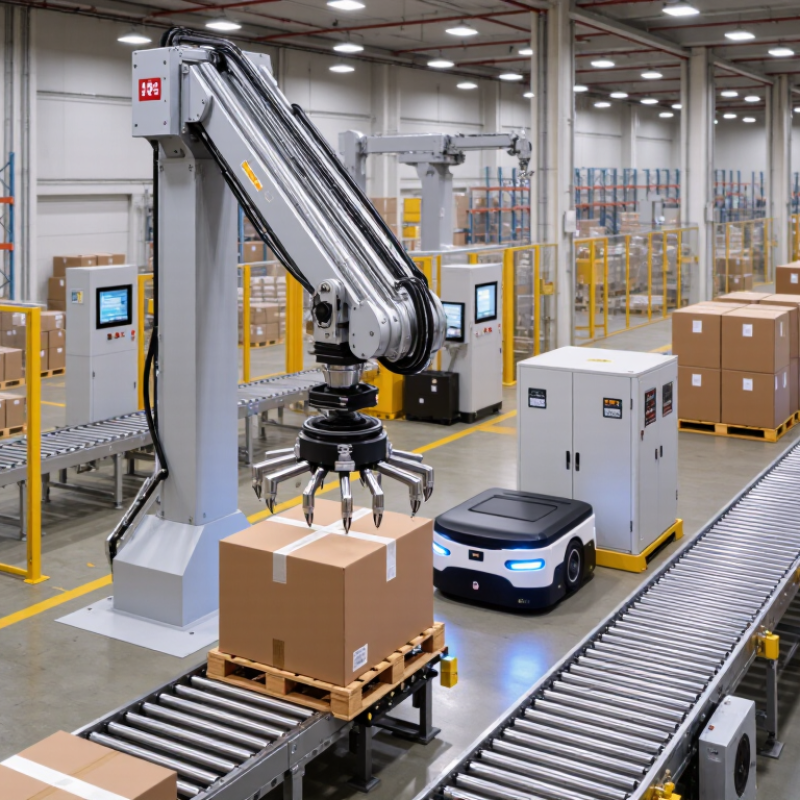
| Palletizing Technology | Robotic, conventional layer, gantry, or collaborative palletizing systems are commonly used for different production requirements. | Select the technology according to product shape, required speed, available floor space, changeover frequency, and budget. | Technical proposal, system layout, application references, and product-handling description. | 10% |
| Product Throughput | Approximately 10–40 cases per minute for many robotic applications; higher rates may require layer palletizing. | The proposed machine should achieve the required output continuously, with at least 10%–15% capacity reserve. | Factory acceptance test plan, cycle-time calculation, and performance guarantee. | 15% |
| Payload Capacity | Robotic palletizers commonly handle payloads from approximately 20 kg to 250 kg, depending on the robot model and tooling. | Choose a payload rating that exceeds the product weight plus gripper weight and safety margin. | Robot load chart, end-of-arm-tooling specification, and maximum product-weight confirmation. | 10% |
| Product Compatibility | Typical applications include cartons, bags, trays, cases, pails, drums, and shrink-wrapped packages. | The supplier should test the actual product, including unstable, dusty, flexible, or irregular packages. | Sample test report, product drawings, package dimensions, and handling videos. | 10% |
| Pallet Size Compatibility | Common pallet footprints include approximately 1,000 × 1,200 mm and 1,100 × 1,200 mm, with regional variations. | The system should support all pallet sizes required at the facility and allow controlled pallet positioning. | Approved pallet drawings, pallet magazine specifications, and pallet-positioning details. | 7% |
| Stacking Pattern Flexibility | Modern systems can usually store multiple pallet patterns and layer configurations through the control interface. | Verify support for interlocking patterns, column stacking, mixed-case layers, and recipe-based changeover. | Pattern examples, software screenshots, and the number of stored recipes. | 8% |
| Changeover Time | Automatic recipe changeover can reduce product or pallet-format changes to several minutes, depending on system complexity. | Prioritize tool-free adjustments, automatic parameter selection, and clear changeover instructions. | Changeover procedure, recorded demonstration, and changeover-time commitment. | 6% |
| Machine Footprint | A complete palletizing cell may require approximately 15–60 m², depending on conveyors, safety fencing, pallet dispensers, and wrapping equipment. | Request a layout that includes operator access, maintenance clearance, material flow, and emergency exits. | Dimensioned general arrangement drawing and installation-clearance requirements. | 6% |
| Electrical Requirements | Many industrial systems use three-phase power, commonly 380–415 V at 50 Hz in China and many export markets. | Confirm voltage, frequency, control-panel standards, total connected load, and local electrical compliance. | Electrical schematic, load list, wiring standard, and power-consumption estimate. | 5% |
| Compressed-Air Consumption | Systems using pneumatic grippers or conveyors may require approximately 0.4–0.7 MPa compressed air. | Confirm pressure, air quality, flow rate, filtration, and whether an air dryer or local compressor is required. | Pneumatic diagram, air-consumption calculation, and utility-condition checklist. | 4% |
| Control and Communication | Industrial palletizing cells commonly use PLC-based controls, touchscreen HMIs, safety circuits, and network communication. | Require clear alarm history, password levels, recipe management, remote diagnostics, and integration with line controls. | Control architecture, communication protocol list, HMI demonstration, and software backup policy. | 7% |
| Safety Protection | Typical safeguards include perimeter fencing, interlocked gates, emergency stops, light curtains, scanners, and safety relays. | The safety design should be risk-assessed for the destination country and include safe access for cleaning and maintenance. | Risk assessment, safety-circuit diagram, guarding layout, and conformity documentation. | 8% |
| Build Quality and Reliability | Industrial palletizing equipment should be designed for continuous multi-shift operation with accessible wear components. | Review frame construction, conveyor components, gripper durability, lubrication points, spare-part availability, and maintenance intervals. | Component list, preventive-maintenance schedule, expected service life, and inspection checklist. | 8% |
| Factory Testing | A documented factory acceptance test should verify speed, accuracy, safety functions, product handling, and pallet patterns. | Make payment milestones conditional on successful testing with the buyer’s actual products or representative samples. | FAT protocol, test records, acceptance criteria, and corrective-action procedure. | 6% |
| Installation and Commissioning | Commissioning may include mechanical installation, electrical connection, programming, operator training, and production trials. | Define responsibilities for travel, unloading, utilities, foundation work, installation, training, and production ramp-up. | Installation scope, commissioning schedule, training plan, and site-readiness checklist. | 5% |
| After-Sales Support | Effective support generally includes remote troubleshooting, spare-parts service, technical manuals, and response-time commitments. | Prefer suppliers with written service-level terms and a clear process for software, electrical, and mechanical support. | Service agreement, response-time table, spare-parts list, manuals, and support-contact information. | 8% |
| Export and Compliance Capability | Export projects may require documentation for electrical safety, machinery safety, packaging, customs, and destination-market requirements. | Confirm that the proposed configuration can be adapted to the buyer’s national standards and import requirements. | Declaration documents, compliance checklist, packing list, commercial invoice, and export references without confidential customer data. | 5% |
| Total Cost of Ownership | Purchase price is only one part of the cost; energy, tooling, maintenance, downtime, spare parts, and training also affect lifecycle cost. | Compare the complete delivered cost over at least five years rather than comparing equipment prices alone. | Itemized quotation, energy estimate, consumables list, spare-parts pricing, warranty terms, and maintenance forecast. | 10% |
| Recommended Supplier Selection Method | A weighted scorecard with technical verification and a practical product test provides a more reliable comparison than price alone. | Shortlist three to five qualified suppliers, complete technical clarification, conduct sample testing, and negotiate contractual performance guarantees. | Completed scorecard, comparison matrix, test results, approved drawings, and signed technical agreement. | Overall decision |


 © Copyright 2020 Tianjin Tanghaidongyang Valve Co., Ltd. All Rights Reserved.