| U-Factor | Measures heat transfer through the complete window. In U.S. ratings it is commonly reported in Btu/(h·ft²·°F); lower values mean less heat loss or gain through the window. | Compare certified whole-window ratings in the same units, not glass-only figures. For conversion, 1 Btu/(h·ft²·°F) equals approximately 5.678 W/(m²·K). | Prioritize a lower U-factor in cold climates and wherever reducing indoor heat loss is important. Compare the exact size and configuration you plan to buy. |
| Solar Heat Gain Coefficient (SHGC) | A dimensionless value from 0 to 1 describing the fraction of solar heat admitted through a window. A lower value admits less solar heat. | Compare the SHGC shown on the product’s certified rating label. The appropriate value depends on climate, orientation, shading, and cooling needs. | Lower SHGC can help limit unwanted summer heat, especially on sunny exposures. In cold, sunny locations, a higher SHGC may provide useful passive solar heat when the building design can use it. |
| Visible Transmittance (VT) | A dimensionless value from 0 to 1 indicating how much visible daylight passes through the window. | Compare VT alongside SHGC and U-factor; glazing choices that change solar control can also affect daylight and appearance. | Choose a higher VT when daylight is a priority, while checking glare, privacy, and the window’s solar-heat performance. |
| Air Leakage | Measures air passing through the closed window assembly under a specified test pressure. U.S. ratings commonly express it in cubic feet per minute per square foot (cfm/ft²). | When an air-leakage rating is available, compare products tested using the same method and units. Lower leakage indicates a tighter tested assembly. | Look for well-designed weatherstripping, secure locking points, and careful installation. A high-performing window can still leak if the frame-to-wall joint is poorly sealed. |
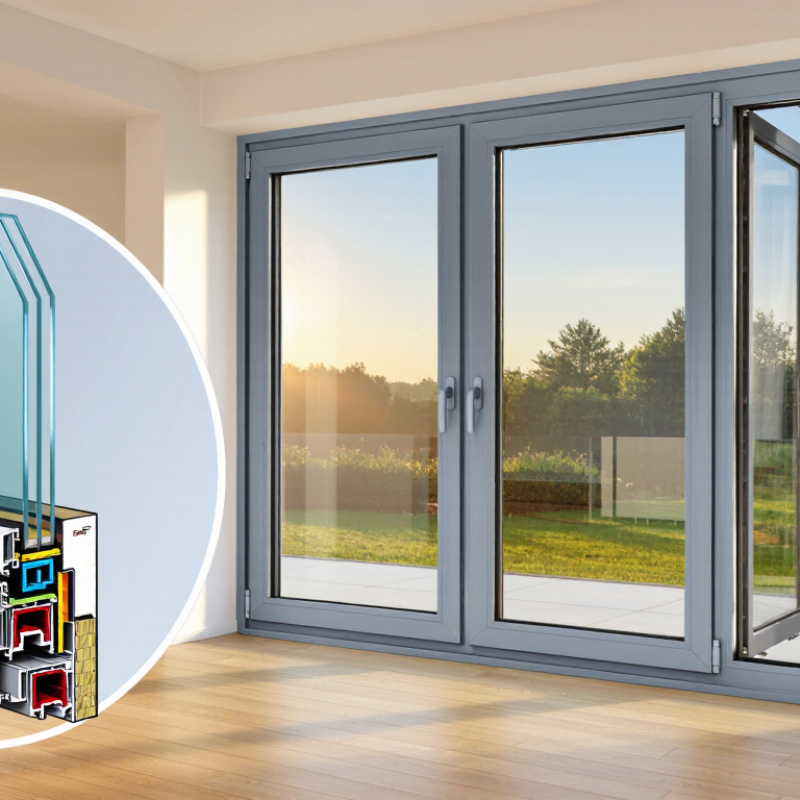
| Thermal Break in the Aluminum Frame | A less-conductive section separates the interior and exterior aluminum parts, reducing heat flow through the frame. It does not eliminate heat transfer. | Confirm that the specified product has a thermally broken frame. Compare whole-window ratings because frame design contributes to overall performance. | For energy efficiency, avoid assuming that all-aluminum frames perform alike. Frame geometry, thermal-break design, glazing, spacers, and seals all affect the result. |
| Glazing and Low-E Coatings | Multiple panes create insulating air or gas spaces. Low-emissivity (low-E) coatings reduce heat transfer by reflecting selected wavelengths; coating type affects solar gain and visible light. | Use the whole-window U-factor, SHGC, and VT to compare glazing packages rather than relying on pane count or coating descriptions alone. | Double- or triple-pane glazing, low-E coatings, and sealed gas-filled spaces can improve performance, but the best combination depends on climate and the target ratings. |
| Gas Fill and Spacer | Argon or krypton gas between panes can reduce heat transfer compared with ordinary air when the insulated glass unit is properly sealed. Spacers join the panes at the edge. | Check the stated whole-window ratings and product documentation. Gas type by itself does not establish the performance of the complete window. | Consider the glazing package as a system, including the spacer and seal durability. Ask for certified ratings for the exact product configuration. |
| Condensation Resistance | Where a recognized rating is provided, a higher condensation-resistance rating indicates better resistance to condensation under the specified test conditions. | Compare ratings using the same scale and testing program. Indoor humidity, ventilation, and outdoor temperature also affect real-world condensation. | Useful in cold or humid conditions. A thermally broken frame and suitable glazing may help, but no window rating can guarantee that condensation will never occur. |
| Installation and Whole-Window Fit | Performance depends on the complete window and how it is installed, including perimeter air sealing, flashing, drainage, and the connection to the wall. | Match the product’s certified size and configuration to the project, and review the installation instructions before purchase. | Specify professional installation details that control air and water leakage. Verify that the opening is measured correctly and that the finished assembly is sealed and drained as designed. |



 © Copyright 2020 Tianjin Tanghaidongyang Valve Co., Ltd. All Rights Reserved.