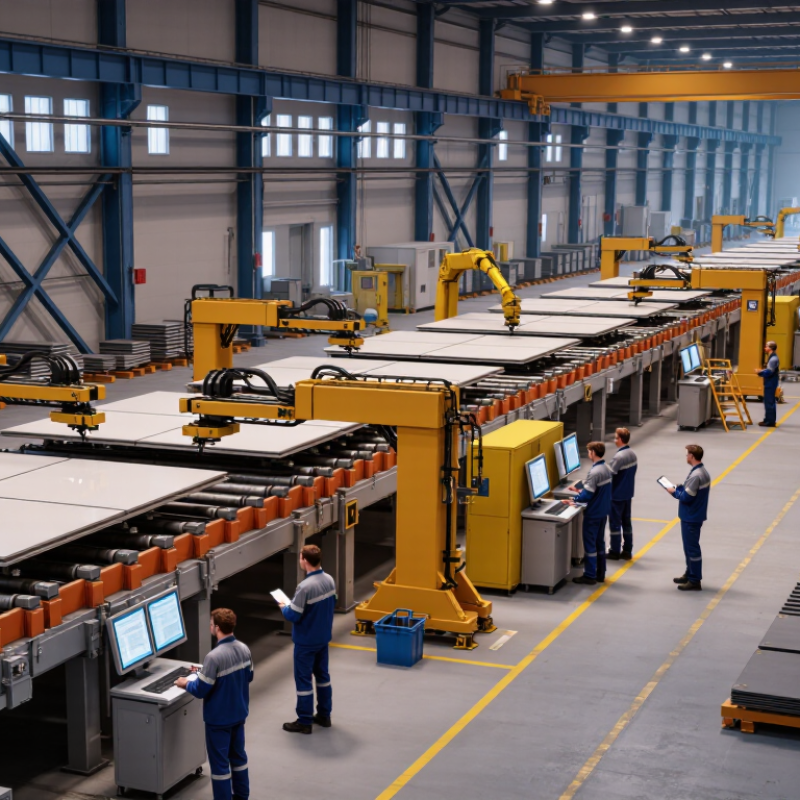
| Typical configuration | Separate plate preparation, fit-up, tack welding, and welding workstations. Panels are moved between stations using available shop-floor handling equipment. | Connected stations commonly include plate positioning, stiffener fit-up, tack welding, mechanized welding, and powered transfer between work areas. | Integrated material flow links plate handling, positioning, stiffener assembly, welding, and downstream transfer, with centralized production monitoring where specified. |
| Automation level | Operators perform most positioning, fit-up, transfer, and welding tasks. Mechanized equipment may be used for selected operations. | Machines automate repeatable tasks such as conveying, positioning, and long, consistent weld runs; operators oversee setup, fit-up, and process checks. | More operations use programmed equipment, automated transfer, and coordinated controls. Operators still manage exceptions, quality checks, setup, and maintenance. |
| Welding approach | Manual welding is common for varied work and local corrections. The process is selected to suit joint design, material, access, and approved procedures. | Mechanized welding can be used for suitable long, repeatable seams; manual welding remains useful for variable joints and detail work. | Mechanized or robotic welding may be integrated for repeatable joints. Automated welding requires suitable joint consistency, fixturing, access, and qualified procedures. |
| Panel and product flexibility | High flexibility for mixed panel sizes, frequent design changes, and one-off or repair work; output depends strongly on operator skill and scheduling. | Suitable for a recurring mix of flat panels and stiffened panels, with changeovers and manual intervention for less-standard work. | Best suited to stable, repeatable product families and planned production flow. Unusual geometries or frequent changes can require additional programming and setup. |
| Material flow | Often relies on crane or forklift moves between work areas. Extra handling can increase waiting time and work-in-process. | Powered conveyors or transfer systems can reduce repeated handling between connected stations; crane access may still be needed for loading and exceptions. | Coordinated conveyors and transfer equipment can support a more continuous flow. Layout, safe access, crane coverage, and buffer space remain important design factors. |
| Staffing and skills | Requires hands-on labor for fit-up, movement, and welding. Production depends on retaining experienced tradespeople and consistent work instructions. | Reduces some repetitive manual tasks but needs operators able to set up equipment, manage fit-up, monitor welding, and handle changeovers. | Shifts labor toward programming, setup, process supervision, maintenance, and quality control. Automation does not eliminate the need for qualified welding and production staff. |
| Quality and process control | Quality relies on approved welding procedures, skilled workmanship, inspection, and accurate fit-up at each work area. | Repeatable machine settings and fixtures can improve consistency on suitable operations; fit-up and weld quality still need monitoring. | Data capture and repeatable programs can support process control and traceability when included in the system. Inspection and acceptance remain governed by project and classification requirements. |
| Space and layout | Can be arranged around existing equipment, but separate work areas may require substantial space for staging and intermediate storage. | Needs coordinated station placement and transfer paths, with space for buffers, loading, maintenance, and safe operator access. | Requires careful end-to-end layout planning, foundations or support structures as specified, utility routing, maintenance access, and provision for line stoppages. |
| Investment and implementation | Typically lower initial equipment integration requirements and easier incremental upgrades; capacity improvements may be limited by manual handling and bottlenecks. | Moderate integration effort. A phased build can connect priority operations while retaining some existing equipment and manual work areas. | Higher integration and commissioning complexity. The business case depends on sustained workload, product standardization, utilization, and the cost of supporting the system. |
| Best suited to | Shipyards with varied work, constrained investment, low or irregular panel-line volume, or a need to retain flexibility for non-routine jobs. | Shipyards seeking to improve repeatability and reduce handling on a regular mix of panel work without automating every operation. | Shipyards with high, predictable workloads, repeatable panel families, sufficient space, and the engineering and maintenance capability to sustain integrated equipment. |
| Key questions before selection | Which tasks are the current bottlenecks? Can layout, fixtures, or work instructions improve flow before equipment is replaced? | Which operations repeat often enough to mechanize? Can the line accommodate the actual range of panel dimensions and stiffener layouts? | Is workload sufficient to keep the system utilized? Are product data, utilities, maintenance support, safety systems, and downstream capacity ready? |



 © Copyright 2020 Tianjin Tanghaidongyang Valve Co., Ltd. All Rights Reserved.