| Applicable design standard | Use NCRP Report No. 147 as the shielding-calculation framework, together with the applicable local radiation-control, building, fire, and electrical codes. | NCRP 147 addresses diagnostic X-ray facilities, including radiography, fluoroscopy, CT, dental, mammography, and related rooms. | NCRP 147 does not provide one universal barite-drywall thickness or one universal lead-equivalence value. The required barrier is calculated for the specific room and equipment. |
| Radiation source and beam quality | Identify equipment type, maximum tube potential, filtration, target angle, and whether the barrier receives primary or secondary radiation. | Diagnostic X-ray systems commonly operate within approximately 40–150 kVp, depending on the application. CT shielding is normally based on workload and scatter/leakage conditions rather than a single fixed kVp. | Lead equivalence is beam-quality dependent. A value verified at one kVp or filtration condition must not automatically be applied to another beam quality. |
| Barrier classification | Classify each wall, floor, ceiling, door, window, and equipment enclosure as a primary or secondary barrier. | Primary barrier: may intercept the useful beam.
Secondary barrier: intercepts leakage and scattered radiation. | Primary barriers generally require more shielding than secondary barriers. The barrier category should be confirmed on the approved shielding plan. |
| Required design goal | Specify the permissible weekly dose or design goal at the occupied area beyond the barrier. | Common planning values used in shielding practice are approximately 0.1 mSv/week for controlled areas and 0.02 mSv/week for uncontrolled areas, subject to local regulatory requirements. | These values are planning examples, not a substitute for the limits or design goals adopted by the local authority having jurisdiction. |
| Workload | Provide the expected workload using the units appropriate to the equipment, such as mA·min/week, patient examinations/week, or CT workload data. | Use actual operating records where available. If the installation is new, use a documented conservative estimate approved by the qualified medical physicist. | Underestimating workload can result in inadequate shielding. Future workload growth should be considered before the wall system is finalized. |
| Use and occupancy factor | Document the use factor for primary barriers and the occupancy factor for the adjacent area. | Occupancy examples include full-time offices or control rooms, partial-time corridors, and low-occupancy storage areas. The correct factor depends on actual use. | Do not select a lower shielding level solely because an adjacent space is currently unoccupied if its future use could change. |
| Distance to occupied area | Record the distance from the focal spot or relevant radiation source to the point of occupancy beyond the barrier. | Measure the shortest realistic distance for the applicable barrier and room configuration. | Distance is a major factor in NCRP-style calculations. A wall serving multiple adjacent spaces should be checked for the most demanding condition. |
| Required lead equivalence | State the calculated minimum lead equivalence for each barrier, including the beam quality and test basis. | Typical project specifications may use values such as 0.5 mm Pb, 1.0 mm Pb, 1.5 mm Pb, or higher, but the correct value must come from the shielding calculation. | Lead-equivalence values are not interchangeable across kVp, filtration, primary-beam, and secondary-radiation conditions. Specify the required value separately for every barrier type. |
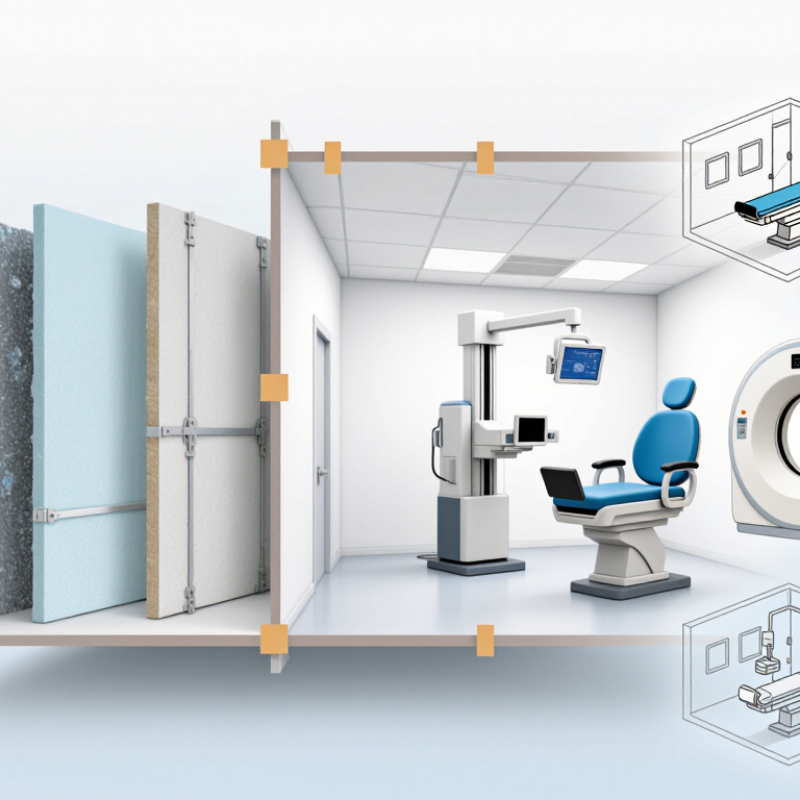
| Barite drywall material | Specify the board thickness, dry density, composition, dimensional tolerance, and tested radiation-attenuation performance. | Barite-containing gypsum products are commonly supplied in nominal thicknesses such as 12.7 mm and 15.9 mm; actual product dimensions and densities vary by formulation. | Thickness or density alone does not establish lead equivalence. Require a current independent test report or code-recognized product evaluation for the specified beam quality. |
| Layering strategy | Define the number of board layers, orientation, total assembly thickness, and whether additional shielding is required. | Multiple layers may be used where one layer does not meet the calculated requirement. The total attenuation must be based on tested assembly performance, not simple thickness multiplication unless justified. | Stagger joints between layers and follow the tested installation configuration. Avoid unprotected paths around sockets, ducts, framing, and service penetrations. |
| Joints, corners, and penetrations | Specify continuity of shielding at board joints, internal and external corners, ceiling-to-wall interfaces, floors, doors, windows, outlets, ducts, and cable routes. | All discontinuities should provide shielding equal to the adjacent barrier requirement unless the approved design states otherwise. | A high-performance wall can fail its design goal if joints or penetrations create direct radiation streaming paths. |
| Fire, structural, and moisture requirements | Confirm wall assembly fire rating, framing capacity, fastener requirements, impact resistance, moisture exposure, and installation tolerances. | Barite-containing boards are substantially heavier than ordinary gypsum board; verify wall dead load and handling requirements before construction. | Radiation shielding performance does not automatically demonstrate compliance with fire, structural, acoustic, or accessibility requirements. |
| Installation quality control | Require inspection before concealment, photographic records, as-built drawings, and verification of all shielding transitions. | Check board count, thickness, joint staggering, fasteners, corner details, penetrations, door and window shielding, and ceiling/floor continuity. | Any field change affecting the barrier should be reviewed by the qualified medical physicist or shielding designer before installation is completed. |
| Acceptance survey | Arrange a radiation-protection survey after equipment installation and commissioning. | Survey conditions should represent the maximum intended operating parameters and should cover occupied areas outside every shielded boundary. | The final survey should be performed and documented by a qualified medical physicist or other person authorized under local regulations. |
| Recommended specification wording | Write the requirement as a performance specification rather than relying only on board thickness. | Example: “Provide a continuous barite-containing gypsum wall assembly achieving not less than ___ mm Pb equivalent at ___ kVp under the specified test method and installation configuration.” | Insert the blank values only after the NCRP 147 calculation, local-code review, and product-performance verification are complete. |



 © Copyright 2020 Tianjin Tanghaidongyang Valve Co., Ltd. All Rights Reserved.