| Cabinet Knob | Provides a compact gripping point for opening a door or small drawer. | Cabinet doors and narrow drawers. | Fixed single-point attachment; the user pulls the knob outward. | Solid metal, corrosion-resistant stainless steel, or durable zinc-based alloy with a well-sealed finish. | Secure base, clean threads, smooth edges, stable mounting, and no visible plating bubbles or cracks. | Usually requires one drilled hole; screw length must match the door or drawer front thickness. | Traditional, minimalist, or space-conscious cabinet designs. | Medium to High |
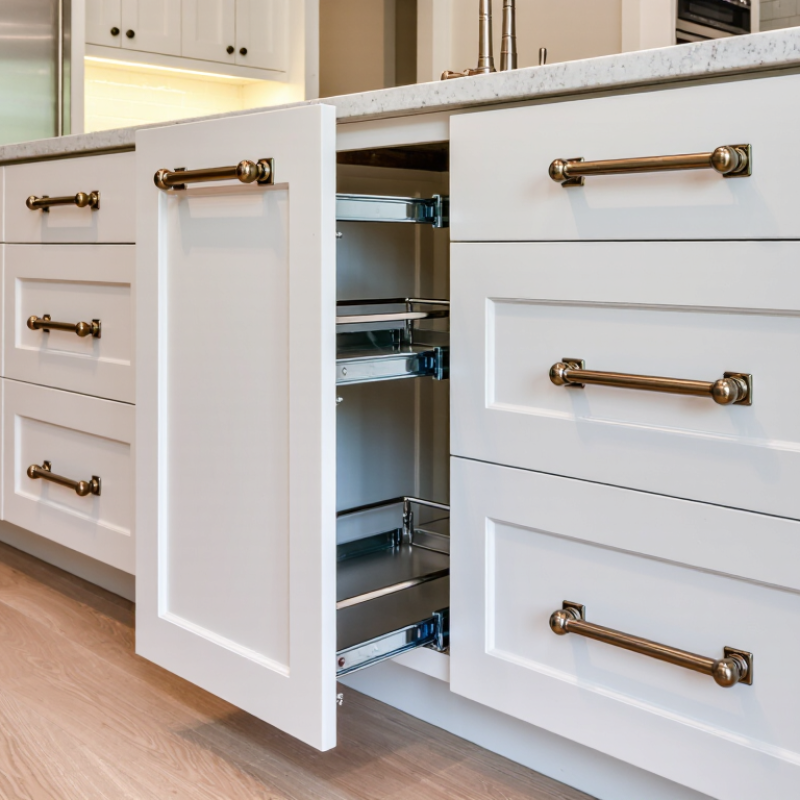
| Cabinet Pull | Offers a larger gripping surface and distributes pulling force across two mounting points. | Drawers, doors, tall pantry units, and frequently used cabinets. | Two-point fixed handle; the user grips and pulls the bar or handle. | Stainless steel or solid metal with a consistent wall thickness and a durable surface treatment. | Rigid construction, accurately aligned mounting holes, comfortable grip, strong screw connection, and uniform finish. | Requires accurate center-to-center measurement and a drilling template for consistent placement. | High-use kitchens, bathrooms, utility rooms, and larger drawer fronts. | High |
| Cup Pull | Creates a recessed grip that allows the drawer to be pulled from underneath. | Drawer fronts, especially in traditional or farmhouse-style cabinetry. | Recessed cup-shaped grip supported by multiple mounting points. | Thick-gauge metal with a stable finish; the recessed cavity should be smooth and free from sharp edges. | Firm attachment, comfortable finger clearance, strong mounting points, and resistance to finish wear at the grip area. | Requires careful positioning and may need pilot holes because the hardware is often mounted near the upper portion of the drawer. | Drawers where a concealed lower grip is preferred. | High |
| Appliance Pull | Provides leverage for opening wide or heavy appliance panels and extra-large doors. | Integrated refrigerator, freezer, dishwasher, and tall appliance panels. | Long two-point or multi-point handle designed for higher pulling force. | Rigid solid metal or reinforced construction with strong mounting posts and corrosion-resistant finishing. | Low flex, robust mounting system, accurate alignment, comfortable grip diameter, and adequate clearance from adjacent surfaces. | Mounting must account for panel thickness, appliance alignment, handle projection, and clearance for adjacent doors. | Large panels and applications exposed to frequent or forceful use. | Very High |
| Concealed Cabinet Hinge | Connects a cabinet door to the cabinet box while allowing controlled opening and closing. | Most modern framed and frameless cabinet doors. | Multi-link pivot mechanism, often with adjustable mounting plates; some versions include soft-close damping. | Hardened steel or durable metal components with accurate pivots, dependable springs, and corrosion protection. | Smooth movement, minimal side-to-side play, reliable adjustment, consistent closing, and a secure mounting cup. | Door overlay, cup diameter, opening angle, mounting plate position, and door thickness must be compatible. | Full-overlay, half-overlay, and inset cabinet doors requiring concealed hardware. | Very High |
| Side-Mount Drawer Slide | Supports a drawer and guides it in and out of the cabinet. | Drawer sides inside base, vanity, and storage cabinets. | Telescoping or rolling members travel along a side-mounted track. | Precision-formed steel with smooth bearings or rollers, corrosion protection, and accurately formed tracks. | Even travel, low noise, minimal lateral movement, consistent extension, and a secure locking or release feature where applicable. | Requires correct side clearance on both sides, level installation, and suitable length for the drawer depth. | Standard drawer construction where visible side hardware is acceptable. | High |
| Undermount Drawer Slide | Supports and guides a drawer while keeping the slide mostly hidden beneath the drawer. | Premium drawers and cabinets with clean, unobstructed side surfaces. | Underside-mounted rail and locking devices guide the drawer through its travel. | Precision steel components with stable rollers or bearings, corrosion-resistant surfaces, and accurately made locking clips. | Smooth synchronized travel, minimal sag, quiet closing, reliable adjustment, and secure drawer release mechanisms. | Requires compatible drawer dimensions, accurate cabinet leveling, correct bottom clearance, and precise installation. | Modern kitchens, high-end furniture, and drawers where appearance and usable width are priorities. | Very High |
| Magnetic Catch | Keeps a cabinet door closed when no self-latching hinge is used. | Light cabinet doors, small storage doors, and furniture doors. | Magnet attracts a metal strike plate to hold the door closed. | Enclosed magnet assembly with a corrosion-resistant metal plate and a durable mounting body. | Consistent holding force, secure screws, protected magnet surface, quiet engagement, and accurate alignment. | The catch and strike plate must be mounted level and aligned so the door closes without excessive force. | Lightweight doors and supplemental door retention. | Medium |
| Shelf Support Pin | Supports adjustable shelves inside a cabinet or bookcase. | Vertical cabinet sides and adjustable shelf systems. | Pin or clip fits into a pre-drilled hole and carries the shelf load. | Hardened steel or strong molded material with a precisely formed support shoulder. | Accurate diameter, firm fit, adequate load capacity, resistance to bending, and a properly supported shelf edge. | Hole diameter, spacing, insertion depth, and shelf thickness must be compatible with the cabinet system. | Adjustable storage shelving and removable cabinet interiors. | High |



 © Copyright 2020 Tianjin Tanghaidongyang Valve Co., Ltd. All Rights Reserved.