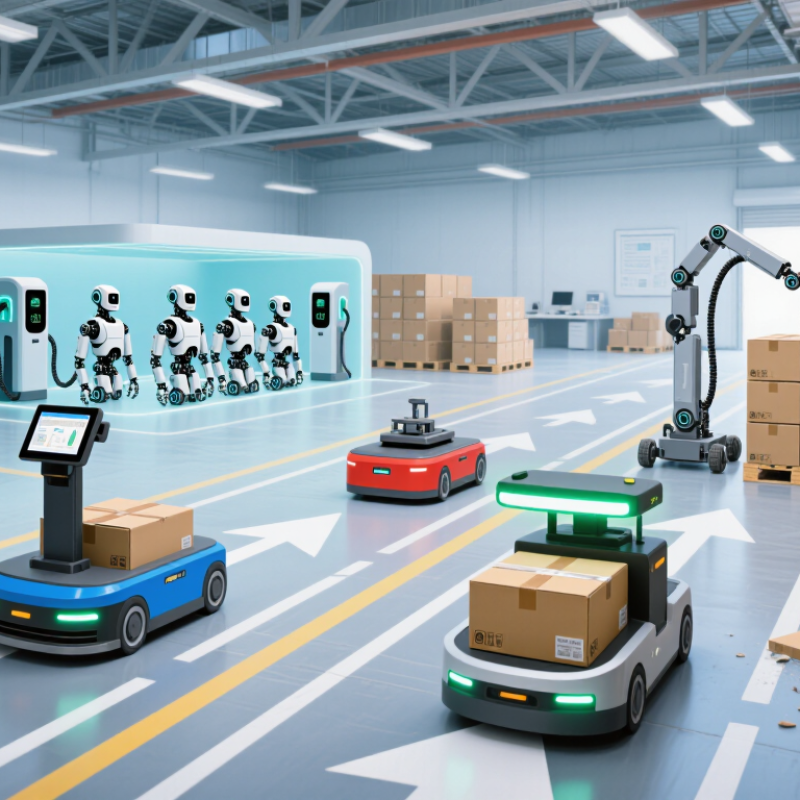
| Autonomous mobile robot (AMR) | Moving totes, carts, bins, or other loads between work areas. | Uses onboard sensing and a mapped environment to navigate; many systems can adjust routes around obstacles. | Repetitive, point-to-point transport in facilities where routes or work locations may change. | Load and carrier compatibility, aisle width, floor condition, pedestrian traffic, door and lift access, and integration with work systems. | Completed transport missions, delivery time, manual interventions, blocked-route recovery, and availability during operating hours. | Confirm that routes, fleet management, charging, and site connectivity can support additional robots and new destinations. |
| Automated guided vehicle (AGV) | Repeated movement of pallets, carts, or loads along established routes. | Typically follows defined guidance, such as installed markers, wires, reflectors, or a configured route, depending on the system. | Stable workflows with predictable traffic patterns and limited route changes. | Guidance infrastructure, route crossings, traffic control, installation disruption, load transfer points, and changes to the facility layout. | Successful trips, route delays, interaction with other traffic, loading and unloading accuracy, and time spent waiting. | Assess the cost and effort of extending routes and whether future layout changes would require modifications to the guidance system. |
| Autonomous or automated forklift | Transporting and positioning palletized loads, including movement between floor-level and elevated locations when the model is designed for it. | Uses vehicle navigation and control systems; operating capabilities vary by truck type and application. | Facilities with recurring pallet flows, suitable load presentation, and tasks that can be separated safely from people and other vehicles. | Pallet condition and type, load dimensions, rack and aisle clearances, floor capacity, docking accuracy, pedestrian controls, and site safety requirements. | Pick-and-place success, pallet damage, positioning accuracy, completed moves, waiting time, and safety-related stops. | Check compatibility with rack layouts, pallet standards, traffic-management rules, and planned changes in throughput or storage configuration. |
| Robotic palletizer or depalletizer | Building pallet loads from cases or removing cases from pallets for downstream processing. | A robot arm uses an end-of-arm tool and a programmed pattern; vision or other sensing may be used where the application requires it. | Repetitive case handling with known product dimensions, stable presentation, and defined pallet patterns. | Case range, package strength, pallet quality, layer pattern, infeed consistency, guarding, and required changeover time. | Cases handled per operating period, pattern accuracy, dropped or damaged cases, changeover time, and unplanned stops. | Plan for additional product formats, pallet patterns, infeed lanes, end-of-arm tooling, and integration with upstream and downstream equipment. |
| Industrial robotic arm for machine tending or transfer | Loading and unloading machines, transferring parts, or handling components within a defined work cell. | Moves through programmed paths within its work envelope; the cell may use fixtures, sensors, and safety equipment. | Repeatable handling tasks with consistent part presentation and a work area that can be arranged around the robot. | Payload including tooling, reach, cycle sequence, part variation, fixture accuracy, machine interface, and cell safety design. | Successful transfers, cycle completion, part-placement accuracy, machine waiting time, and recovery time after a fault. | Consider whether new parts, tooling, fixtures, or process steps can be accommodated without redesigning the full cell. |
| Collaborative robot (cobot) for handling tasks | Assisting with tasks such as picking, tending, or transferring lighter items in a shared work area, subject to application-specific risk assessment. | Designed for applications that may involve close human interaction, but collaboration does not remove the need for safety assessment and safeguards. | Tasks where a flexible arm can support an operator and the work can be divided between people and automation. | Payload and reach at the required speed, tool design, pinch and impact hazards, task variability, and applicable safety requirements. | Task completion, operator handoffs, stoppages, ergonomic changes, quality results, and time needed to change tasks. | Evaluate how easily the arm, end-of-arm tooling, and workstations can be redeployed as product mix or staffing needs change. |
| All robot types: pilot and scale-up checklist | Validate a defined material flow before committing to a broader deployment. | Run the selected robot on representative shifts, loads, routes, and operating conditions; record exceptions as well as successful cycles. | Choose a bounded workflow with a clear starting point, destination, process owner, and baseline for comparison. | Include peak periods, mixed traffic, human work, maintenance access, network coverage, charging or power needs, and failure recovery. | Compare baseline and pilot results for throughput, task time, intervention rate, damage, availability, safety events, and labor time per completed task. | Set measurable expansion criteria; confirm support, training, spare-parts, software, infrastructure, and integration requirements before adding sites or fleets. |


 © Copyright 2020 Tianjin Tanghaidongyang Valve Co., Ltd. All Rights Reserved.