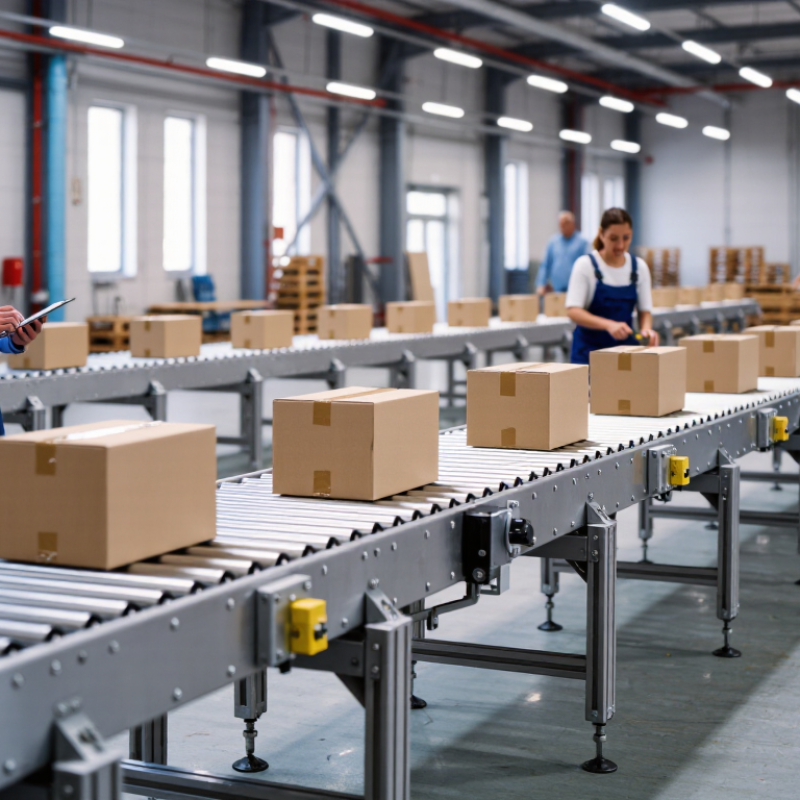
| Gravity roller conveyor | Loads roll down a slight incline on parallel cylindrical rollers, or move manually on a level section. | Cartons, totes, bins, and other items with a reasonably flat, stable bottom. Roller spacing should support the load throughout its travel. | Simple operation, no drive motor required, and suitable for straight conveying, accumulation, and packing areas. | Very small, soft-bottomed, or uneven loads may not bridge the roller gaps reliably. Slope, roller spacing, load weight, and stopping method affect operation. | Ask how roller diameter, spacing, frame strength, and recommended incline are matched to your actual load dimensions and weight. Confirm end stops and safe accumulation arrangements where needed. |
| Gravity skatewheel conveyor | Small wheels mounted on axles support the load and rotate as it travels down an incline or is pushed along a level section. | Light to medium cartons and packages with a firm, flat underside. Often used for shipping, packing, and short transfer lines. | Lightweight and relatively easy to reposition. Multiple contact points can help packages move with less resistance on suitable loads. | Loads need adequate bottom support across the wheels. It is generally less suitable for heavy, narrow, soft, or irregular-bottomed items than an appropriately designed roller conveyor. | Check wheel spacing and layout against the smallest package footprint. Ask for the rated load per section and guidance on curves, supports, and transitions. |
| Flexible or expandable gravity conveyor | Rollers or skatewheels are mounted on a collapsible frame. The conveyor can be extended, curved, or repositioned, and loads move by gravity on an incline or by manual pushing. | Temporary or variable-length connections between docks, vehicles, packing areas, and workstations. Select the roller or wheel configuration to suit the packages being handled. | Adjustable length and layout can serve changing work areas and reduce the need for fixed conveyor sections. | Capacity and stability depend on the frame, leg supports, extension length, and operating configuration. Curves and uneven floors can affect package tracking and flow. | Request capacity information for the intended extended length and layout, including curves. Confirm locking devices, support spacing, height adjustment, and safe handling procedures. |
| Gravity chute | Packages slide down an inclined, usually continuous surface rather than rolling on discrete rollers or wheels. | Controlled transfers between different levels for packages whose surfaces and contents can tolerate sliding. The chute surface and shape should suit the product. | A simple way to move suitable items between elevations, with few moving parts. | Sliding friction, impact at the discharge, package orientation, and product fragility need consideration. A chute is not appropriate for every package or handling process. | Ask how the surface material, slope, side guides, and discharge protection are selected. Test representative packages when possible, especially if they are fragile or prone to tipping. |
| Selection factor: load and capacity | Gravity systems rely on load weight, conveyor slope, and low-resistance movement; they do not use a powered belt or motor to move items. | Suitable when the load can roll or slide as intended and the operating conditions are consistent with the system design. | Can provide a straightforward, non-powered material-handling option. | Do not assume one capacity rating applies to every layout. Load distribution, conveyor length, supports, joints, and accumulation affect the required design. | Provide the manufacturer with minimum and maximum package dimensions, weights, bottom characteristics, throughput, and layout. Request capacity and application details for the proposed configuration. |
| Selection factor: quality and safety | Frame, rollers or wheels, bearings, supports, and connection hardware determine how the conveyor performs in its intended environment. | Relevant to all gravity conveyor types, particularly installations with frequent loading, changing layouts, or significant elevation changes. | Well-matched components can support dependable operation and easier maintenance. | Material choice, corrosion exposure, floor conditions, pinch points, and uncontrolled package movement should be considered as part of the installation. | Compare written specifications, load-rating assumptions, materials and finish, replacement-part availability, installation guidance, warranty terms, and safety recommendations. Request a layout review based on the actual application. |



 © Copyright 2020 Tianjin Tanghaidongyang Valve Co., Ltd. All Rights Reserved.