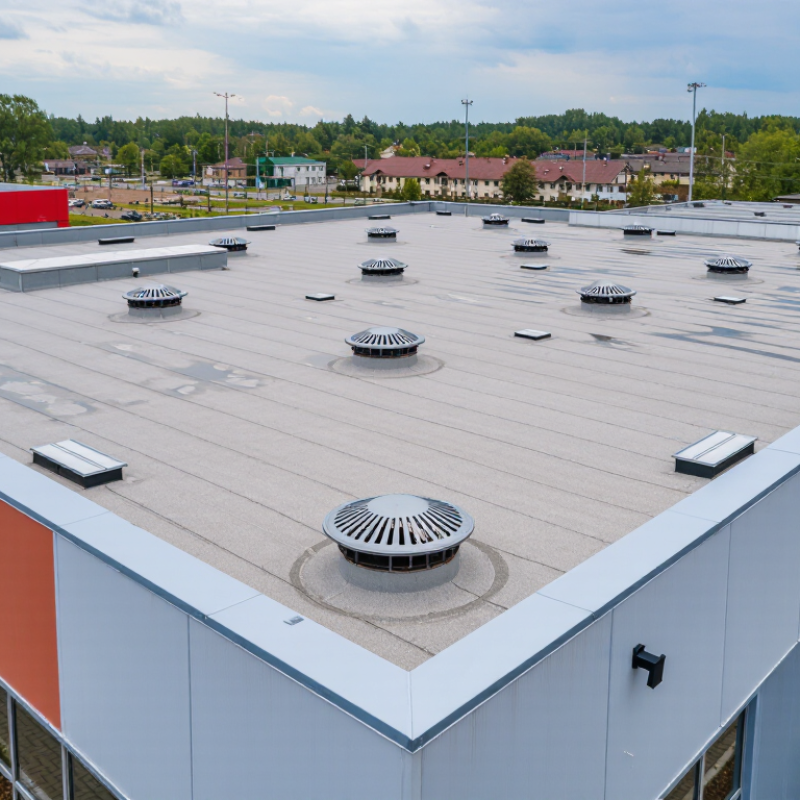
| Conventional Gravity Roof Drain | 75–150 mm | 2–12 L/s | Most low-slope commercial, residential, and institutional roofs with adequate slope to drain points. | Requires positive roof slope, properly sized horizontal leaders, a waterproof flashing connection, and a protective dome or grate. | Inspect at least twice per year and after major storms; remove leaves, sediment, and debris as needed. | Easy
Usually accessible from the roof surface. | Simple design, widely available components, low installation complexity, and straightforward inspection. | Requires more pipe capacity and roof penetrations as drainage demand increases; standing water may occur if slopes are inadequate. |
| Siphonic Roof Drain | 75–200 mm | 8–35 L/s | Large commercial, industrial, airport, warehouse, and multi-bay roofs where high flow rates and long drainage runs are required. | Needs hydraulic engineering, anti-vortex baffles, precisely designed pipework, full-bore operation, and coordinated installation. | Inspect at least twice per year; check baffles, outlets, pipe supports, and air-entry protection. | Moderate
Access may be needed at outlets and inspection points. | High flow capacity, fewer roof penetrations, smaller horizontal pipe diameters, and efficient long-distance drainage. | Higher design and installation complexity; performance depends on correct system sizing and airtight pipe connections. |
| Overflow Roof Drain | 75–150 mm | 2–12 L/s | Secondary drainage for buildings where blocked primary outlets could create unsafe water depth or structural loading. | Must be set above the primary drain level and coordinated with parapet height, waterproofing, and visible discharge points. | Inspect at least twice per year and confirm that the opening and discharge path remain unobstructed. | Easy
Exterior outlets are generally simple to observe. | Provides an independent warning and relief path during primary drain blockage or extreme rainfall. | It is a backup system, not a substitute for correctly sized primary drainage; discharge may affect façades or walkways. |
| Roof Scupper | 100–300 mm opening width | 3–25 L/s | Roofs with parapets, perimeter gutters, or visible exterior drainage routes. | Requires accurately formed wall openings, durable flashing, adequate overflow protection, and a clear external discharge route. | Inspect twice per year and after severe weather; remove debris from the opening and downstream gutter or leader. | Easy
Typically visible from the roof edge or building exterior. | Simple visual inspection, no vertical roof penetration, and convenient emergency overflow visibility. | Can stain exterior walls, discharge water near pedestrians, and perform poorly if the opening is too small or obstructed. |
| Channel or Linear Roof Drain | 100–300 mm channel width | 2–20 L/s per outlet | Terraces, balconies, podium roofs, planted roofs, roof edges, and areas receiving concentrated surface runoff. | Requires continuous falls toward outlets, accurate channel setting, removable grates, waterproofing integration, and accessible cleanouts. | Inspect quarterly in areas with trees or heavy debris; otherwise inspect at least twice per year. | Moderate
Grates should be removable without damaging adjacent finishes. | Collects sheet flow across wide areas and can provide a neat, low-profile drainage detail. | Long channels can clog or pond if improperly sloped; grates require regular cleaning in high-debris locations. |
| Green Roof Drain with Inspection Box | 75–150 mm | 2–12 L/s | Extensive and intensive green roofs where drainage layers, root barriers, and growing media surround the outlet. | Requires a drainage layer, filter fabric, root-resistant detailing, visible inspection boxes, and a clear gravel or maintenance zone around the drain. | Inspect quarterly during the growing season and after severe storms; control roots, plants, and sediment near the drain. | Moderate
Inspection boxes must remain visible and accessible. | Protects the waterproofing system while supporting controlled drainage beneath planted roof assemblies. | Vegetation and sediment can obstruct flow; maintenance access must be planned before planting and paving are installed. |



 © Copyright 2020 Tianjin Tanghaidongyang Valve Co., Ltd. All Rights Reserved.