How to Choose Translucent Glass for Your Project
Choosing Translucent Glass is about balancing daylight, privacy, appearance, and practical needs. A panel that softens a bright window may suit a bathroom, while a textured partition can add visual separation in an office. The details matter. Glass can look different in a showroom than it does beside a north-facing window or under warm evening lights. A small sample helps reveal those changes.
Start by considering where the glass will go and what people need from it. Compare clear, frosted, patterned, and laminated options for light diffusion, privacy, cleaning, and durability. Check product specifications, including thickness and safety-glazing details, with the supplier or a qualified installer. A textured surface may hide fingerprints, but some patterns collect dust in their grooves. There is no perfect choice. Even a well-matched option can feel too opaque once installed, so mock-ups and measured samples are worth the extra effort.
This guide explains the questions to ask before choosing glass for a door, screen, partition, or window. It also considers how lighting, framing, maintenance, and installation affect the finished result. Your project’s setting should lead the decision, not a product photo alone. A little uncertainty is reasonable; test the material in its intended space before committing.
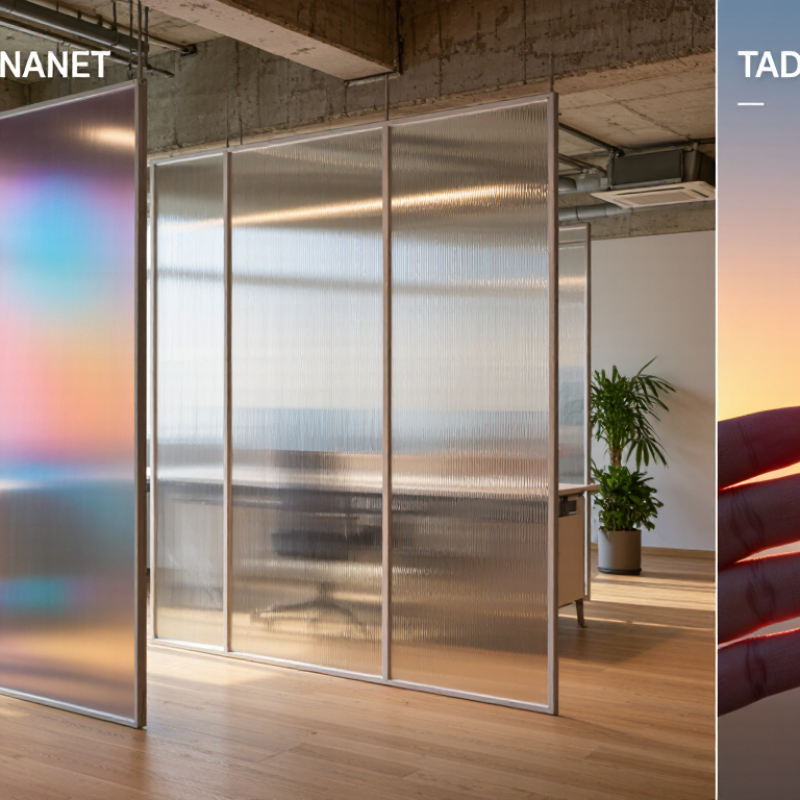
Understanding Translucent Glass and Its Key Properties
Translucent glass softens views while still allowing daylight to pass through. Its appearance depends on more than surface texture. Thickness, color, and the type of diffusion all affect how much light reaches a room. A frosted panel may blur a figure nearby, while patterned glass can create sharper shadows across a floor. Light changes everything. Check the glass under both daylight and evening lighting before choosing a finish.
Key properties include light transmission, privacy, haze, and surface texture. Higher light transmission can keep a hallway bright, but it may also reveal more silhouettes than expected. Haze describes how widely the glass scatters light; more haze usually means less visual detail. Thickness can influence strength and appearance, but the right specification depends on panel size, support, and intended use. Confirm technical requirements with a qualified glass supplier or installer. A small sample is useful, though it cannot fully represent a large installed panel.
Tips: Hold a sample against a window, then view it from both sides at typical distances. Note reflections, glare, and how faces or furniture appear. It is easy to focus on privacy and overlook the light; revisit that trade-off before ordering.
Defining Your Project’s Light, Privacy, and Design Requirements
Before choosing translucent glass, define what needs to be seen and what should remain indistinct. A shower enclosure may need soft daylight without a clear view of the person inside. A street-facing office may need privacy while still feeling open. Note viewing distance, light direction, and the hours when privacy matters most. Light matters. Textured or etched surfaces diffuse light, but they may not hide silhouettes at close range. At night, a bright room can make a window less private than it seems during the day.
Compare samples in the actual space, not only under showroom lighting. Hold each one near the intended window, then check it from both sides and at different distances. Look closely. A small sample can reveal how a pattern softens light, though it cannot show every effect across a full panel. Consider whether you want a clear view of shapes, a vague outline, or almost no detail. Also check how the glass will be cleaned and whether its thickness and edge finish suit the installation. The best balance is not always obvious; a surface that feels private in daylight may feel too exposed after dark.
Comparing Glass Types, Textures, and Light-Transmission Levels
Translucent glass balances privacy with useful daylight, but surface appearance alone is a poor guide. Acid-etched glass scatters light evenly; patterned glass softens views while creating directional shadows. Laminated translucent interlayers can add privacy, though their haze may vary. That matters. Compare samples at the intended thickness and angle, not just in a showroom. A white wall behind the panel can make it seem brighter than a dark corridor.
Check visible transmittance (VT), haze, and the full glass build-up. The National Fenestration Rating Council’s rating system reports VT on a 0–1 scale; a 0.60 rating represents about 60% visible-light transmission under standardized test conditions. This is a useful comparison, not a promise of identical room brightness. Frames, coatings, tint, and installation all affect the result. A high VT can preserve daylight but reveal more silhouettes; heavier diffusion may improve privacy while flattening detail. There is no perfect middle. I would not treat a small swatch as a guarantee: room scale and changing daylight can make its effect feel different. Ask for full-size samples and project-specific technical data before specifying.
How Glass Type and Texture Affect Light Transmission
Approximate visible light transmission (VLT) values for representative glass types. Clear and low-iron glass generally transmit more light, while tint and surface texture can reduce transmission or diffuse the light. Actual VLT varies with glass thickness, coatings, color, and product specification; check the manufacturer’s data for your project.
Assessing Safety, Durability, Cleaning, and Environmental Needs
Translucent glass should be chosen for its location, not appearance alone. For doors, sidelights, and low panels, check whether safety glazing is required and select glass tested to applicable standards, such as ANSI Z97.1 or CPSC 16 CFR Part 1201. A textured surface may soften views, but it does not automatically make glass safer. Ask for test documentation and confirm the thickness and installation suit the opening. Small detail. Big consequence.
Durability and cleaning depend on the glass finish and any applied coating. Fine textures can trap dust or soap residue, so inspect a sample under the room’s actual lighting and try cleaning it with a soft cloth. Avoid assuming every cleaner is suitable; follow the product care instructions. For environmental performance, compare U-factor and solar heat gain coefficient, not just visible light. The U.S. Department of Energy estimates that windows account for 25–30% of residential heating and cooling energy use. Its Energy Saver guidance makes clear that window performance matters, though results vary by building and climate. The U.S. EPA’s 2018 materials report recorded a 31.3% recycling rate for glass containers; that figure does not represent architectural glass. Check whether local recyclers accept the specific glass type before treating recyclability as a given.
Choosing Specifications and Planning for Installation
Translucent glass should be specified for its actual location, not just its appearance in a sample. Record the required panel size, thickness, edge finish, and glass type before requesting a quote. A bathroom partition may need different safety glazing from a cabinet door. Check local building requirements with a qualified glass professional. Texture and opacity also affect privacy and light: a softly patterned panel can brighten a hallway while still blurring faces. View samples in the room, at daytime and evening. The same glass can look surprisingly different under warm lamps.
Plan the installation before the glass is made. Measure the opening at several points; older frames are rarely perfectly square. Note how the panel will be supported, how much clearance the frame needs, and whether doors or nearby fittings will obstruct it. Confirm the frame can carry the glass’s weight, and ask the installer about suitable setting blocks and sealants. Moisture, temperature changes, and movement can affect the assembly. Small details matter. Keep a written record of final measurements and approved specifications, then have the installer verify them on site. A paper plan can miss a bowed sill or an awkward corner, and correcting that late can mean a remake.



 © Copyright 2020 Tianjin Tanghaidongyang Valve Co., Ltd. All Rights Reserved.