| Indoor, clean and dry electrical room | Controlled room, no direct water exposure, limited dust, stable ventilation | Dust accumulation, condensation caused by temperature differences | IP31 to IP41, subject to the project specification | Sealed cable entries, adequate ventilation, anti-condensation heater where required, and separation from water pipes or wet-process equipment | Confirm the required IP code under IEC 60529 and review room HVAC, drainage, and condensation-control arrangements |
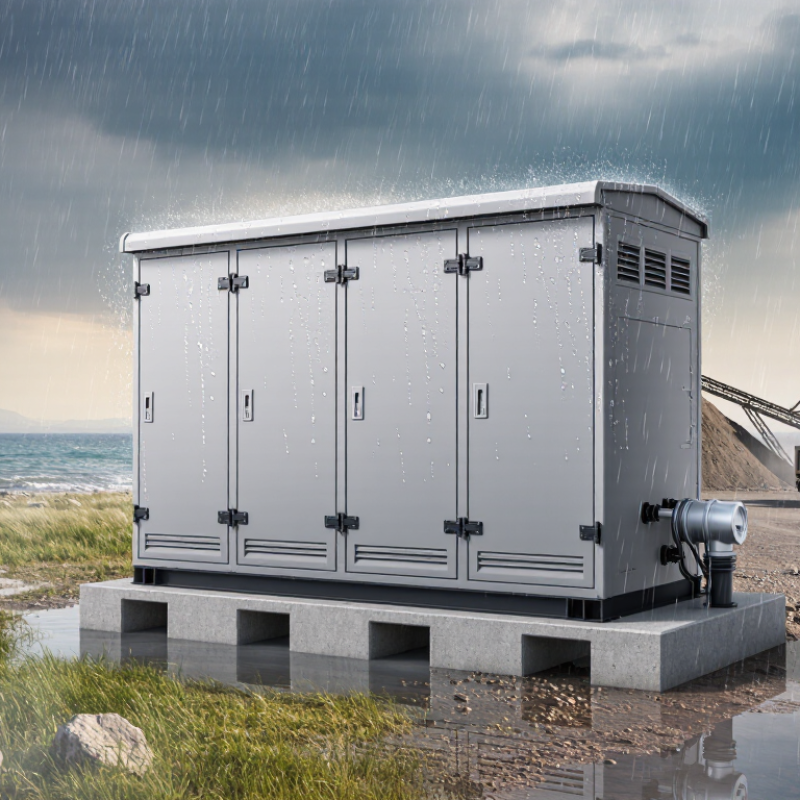
| Outdoor installation with rain and wind-driven water | Uncovered yard, frequent rainfall, exposed doors and cable compartments | Water ingress, insulation deterioration, corrosion of fasteners and busbar connections | IP55 as a common minimum design target; IP65 where stronger water-jet protection is required | Sloped roof, rain hood, sealed door gasket, protected hinges, corrosion-resistant hardware, bottom-entry cable sealing, and effective drainage | Verify the enclosure IP test report, gasket material, door compression, cable-gland system, and drainage details |
| Heavy rain, monsoon, or frequent water jets | High annual rainfall, storm exposure, washdown areas, or nearby spray systems | Water jets entering through doors, joints, ventilation openings, and cable glands | IP65 or IP66; IP66 provides protection against powerful water jets but does not automatically indicate immersion protection | Continuous sealing system, protected ventilation path, raised plinth, drip edges, water-resistant cable glands, and controlled door-opening procedures during storms | Check the exact IEC 60529 test level and ensure all installed accessories maintain the enclosure’s stated protection |
| Temporary or accidental flooding | Low-lying site, flood-prone area, coastal storm surge zone, or drainage uncertainty | Short-duration immersion, loss of insulation resistance, water trapped in cable compartments | IP67 only where temporary immersion is a defined design requirement; IP67 is not a substitute for flood-resistant installation | Install above the design flood level, provide raised foundations, sealed cable routes, backflow prevention, and accessible post-flood inspection points | Confirm the specified immersion duration and depth; assess the complete installation because IP testing applies to the enclosure configuration tested |
| Permanent or prolonged immersion risk | Submersible equipment area, deep flood exposure, or continuously wet underground location | Long-term water penetration, pressure-related leakage, corrosion, and failure of cable interfaces | IP68 only when the manufacturer defines the applicable depth and duration | Use purpose-designed submerged equipment, pressure-rated cable entries, compatible seals, corrosion-resistant materials, and monitoring for moisture ingress | Require documented IP68 test conditions; do not treat IP68 as a universal rating because test depth and duration are application-specific |
| Dusty industrial or construction environment | Cement, mining, quarrying, grain, roadwork, or unsealed outdoor location | Dust deposits, blocked ventilation, tracking across insulation, and abrasive contamination | IP6X for dust-tight protection when dust ingress could impair operation | Dust-tight doors and cable entries, filtered or sealed ventilation, positive-pressure systems where appropriate, and a maintenance plan for external surfaces | Verify the first IP characteristic; IP6X means dust-tight protection and should not be confused with water protection represented by the second characteristic |
| Coastal or offshore atmosphere | Salt spray, marine humidity, prevailing sea winds, or offshore platform exposure | Accelerated corrosion, surface leakage, contact resistance increase, and gasket degradation | Typically IP55 to IP66, combined with a project-defined corrosion-protection class | Marine-grade coating system, stainless or suitably protected hardware, sealed joints, anti-condensation control, and separation of dissimilar metals | Specify coating preparation, dry-film thickness, salt-spray or cyclic-corrosion evidence, and material compatibility; IP rating alone does not measure corrosion resistance |
| High humidity with condensation cycles | Daily temperature swings, tropical climate, intermittent energization, or poorly ventilated rooms | Condensation on insulation and metal surfaces, corrosion, and reduced dielectric withstand | Select the IP rating based on water exposure; commonly IP54 or higher for exposed equipment, with condensation control | Anti-condensation heaters, thermostats or hygrostats, drain plugs where permitted, breathable pressure-equalizing devices, and continuous or scheduled energization | Review humidity records, dew-point risk, heater sizing, control settings, and the manufacturer’s condensation limitations |
| High solar radiation and ultraviolet exposure | Desert, tropical, high-altitude, or year-round outdoor installation | Enclosure temperature rise, seal aging, coating degradation, and reduced service life of polymeric parts | Use the water and dust rating required by the site; IP55 or IP65 is often selected for outdoor designs | Solar shield or canopy, UV-resistant gaskets and cable glands, light-colored coating, thermal calculation, and ventilation that does not compromise IP protection | Check maximum internal temperature, solar-load calculations, UV resistance of non-metallic components, and ambient-temperature limits |
| Very low or high ambient temperature | Arctic, cold-storage, desert, or tropical installation; temperatures outside standard service conditions | Seal hardening, lubricant changes, brittle materials, overheating, and protection-device derating | Choose the required IP rating separately from the temperature capability | Low-temperature-rated gaskets, heaters, thermostats, sunshades, forced cooling where permitted, and temperature-rated breakers, relays, and control wiring | Compare site design temperatures with the equipment’s declared service range and document derating or special accessories |
| High-altitude installation | Mountain, plateau, or site elevation above 1,000 m above sea level | Reduced air density affecting insulation withstand, cooling, and interrupting performance | Select IP protection for the environmental exposure; altitude correction is an additional electrical and thermal requirement | Apply manufacturer altitude correction factors, review clearances and creepage distances, and check thermal performance and interrupting ratings | Provide site elevation and obtain written confirmation of altitude suitability; IEC high-voltage equipment normally treats altitude above 1,000 m as a special service condition |
| Chemical, corrosive, or process environment | Acid or alkali vapors, chlorine, fertilizer, wastewater, chemical processing, or battery rooms | Coating attack, metal corrosion, seal swelling, insulation contamination, and loss of mechanical strength | Specify IP protection according to water and dust exposure, then define a separate chemical-resistance requirement | Compatible enclosure material and coating, sealed cable entries, chemical-resistant gaskets, isolation from process emissions, and local exhaust ventilation | Provide a chemical exposure list, concentration range, temperature, and exposure frequency; verify material compatibility with documented test data |
| High-pressure cleaning or sanitary washdown | Food, beverage, pharmaceutical, or industrial area cleaned with pressurized water | Forced water ingress through seals, hinges, cable entries, and operator interfaces | IP66 or IP69 where the specified cleaning process requires protection against high-pressure or high-temperature water jets | Sloped hygienic surfaces, sealed pushbuttons, suitable stainless or coated enclosure, protected cable glands, and avoidance of water traps | Match the enclosure test method to the actual cleaning pressure, temperature, nozzle distance, and duration; verify the complete installed assembly |



 © Copyright 2020 Tianjin Tanghaidongyang Valve Co., Ltd. All Rights Reserved.