| CNC control unit | Reads the part program and coordinates machine movements and operating functions. | Interprets programmed commands, such as tool paths, spindle speed, feed rate, and auxiliary functions, then sends instructions to the machine’s drive and control systems. | Provides the automated, repeatable control that distinguishes a CNC lathe from a manually operated lathe. |
| Machine bed and guideways | Support the main machine assemblies and provide defined paths for moving components. | The bed forms the machine’s rigid base. Guideways or linear guides constrain the carriage and other moving assemblies to travel along their intended axes. | Help maintain alignment and resist cutting forces during machining. |
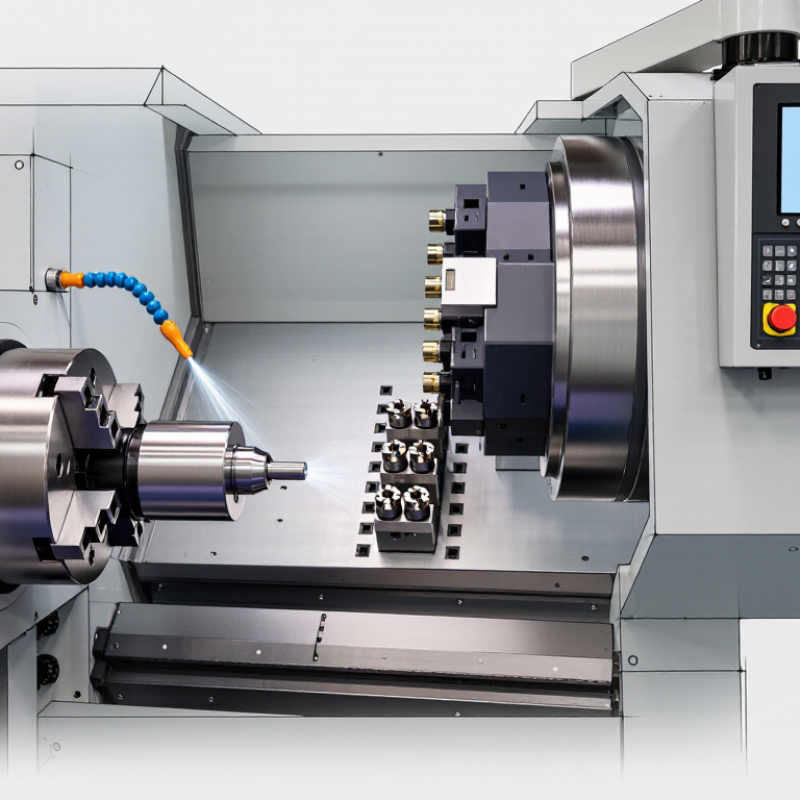
| Spindle | Rotates the workpiece at a commanded speed. | A motor and drive system turn the spindle. The control unit can regulate spindle speed and, on suitable machines, spindle orientation. | Supplies the rotary motion needed for operations such as facing, turning, and threading. |
| Chuck or workholding device | Holds the workpiece securely on the spindle. | Chuck jaws or another workholding arrangement grip the stock. The setup must suit the part’s shape, size, and machining forces. | Keeps the workpiece centered and stable while it rotates and is cut. |
| Turret and tool stations | Carry cutting tools and present the selected tool to the work area. | On a turret-style lathe, the turret indexes to bring a programmed tool station into position. Toolholders secure inserts, drills, or other compatible tools. | Allow different machining operations to be performed in sequence, often without manually changing tools. |
| Tooling and cutting insert | Remove material from the workpiece to create the required geometry. | The cutting edge engages the rotating workpiece as the tool advances. Tool shape, material, and cutting conditions are selected for the operation and workpiece material. | Creates features such as diameters, shoulders, grooves, and threaded surfaces. |
| Axis drive system | Moves the turret, carriage, or other controlled assemblies along programmed axes. | Servo motors and mechanical transmission elements, such as ball screws or direct-drive systems, convert control commands into precise motion. Many CNC lathes use X and Z axes; some include additional axes. | Controls tool position and feed relative to the rotating workpiece. |
| Tailstock or sub-spindle | Provides support or additional workholding, depending on the machine configuration. | A tailstock can support the free end of a long workpiece with a center or hold axial tools. A sub-spindle can grip and transfer a part for machining from another side. | Helps machine long or slender parts, or supports additional operations on suitable machines. |
| Coolant and chip-management system | Delivers cutting fluid where required and manages chips produced during machining. | A pump may circulate coolant through nozzles or tooling passages. Chip conveyors or other collection systems move chips away from the cutting area. | Can help control heat, lubricate the cutting zone, and keep chips from interfering with machining. |
| Enclosure and safety interlocks | Separate the operator from the machining area and help contain chips and coolant. | Guard doors enclose the work zone. Interlocks can prevent or stop certain machine functions when a guard is open, according to the machine’s safety design. | Support safer operation; guards should remain in place during automatic machining. |
| What defines a CNC lathe? | A lathe in which a computer numerical control system directs programmed machining movements. | The workpiece is commonly rotated by the spindle while one or more tools move along controlled axes to remove material. Configurations and capabilities vary by machine. | Typical work includes producing cylindrical features, but the exact operations depend on the machine, tooling, and setup. |


 © Copyright 2020 Tianjin Tanghaidongyang Valve Co., Ltd. All Rights Reserved.