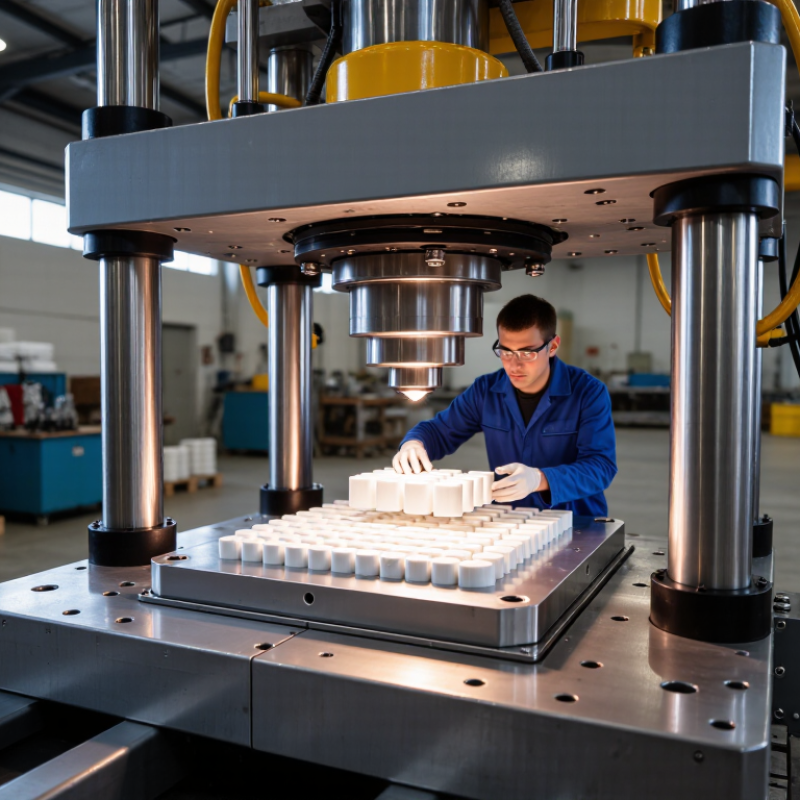
| Press and frame | Supports the mold and supplies the force needed to close it and shape the material. | Press capacities range from tens to thousands of tonnes, depending on machine size and application. | Required force depends on projected part area, material, mold design, and the pressure needed for the application. |
| Heated platens and mold | Heat the material in the mold so it can flow and, for thermosets, cure into a set shape. | Many thermoset molding processes use mold temperatures of roughly 130–180 °C. | The appropriate temperature depends on the compound and its supplier’s processing guidance; thermoplastics use different conditions. |
| Hydraulic or mechanical drive | Moves the press platen and controls mold-closing force and motion. | Hydraulic systems are common where high force and controlled motion are needed; machine speed and force vary by design. | Controls can set parameters such as approach speed, closing force, dwell time, and opening sequence. |
| Material charge | A measured amount of molding compound is placed in the open mold before it closes. | Charge mass and placement are set for the part and mold; there is no single standard charge size. | Consistent weighing and placement help reduce short fills, excess flash, and part-to-part variation. |
| Closing and material flow | The closing mold compresses the charge, spreading it into the cavity under heat and pressure. | Molding pressure is application-specific and is determined by the material, part geometry, and tooling. | The press tonnage is not the same as the pressure inside the mold cavity. |
| Cure or forming time | Holds the material in the closed mold so it can cure or take shape before removal. | Cycle times can range from seconds to several minutes, depending on material, part thickness, and process conditions. | Thermoset parts require sufficient cure; the required time should be established for the specific compound and part. |
| Opening and part removal | The press opens after the forming or cure stage, allowing the molded part to be removed. | Removal may be manual or assisted by ejectors or automation, depending on the machine and mold. | Safe guarding and the correct removal method help protect operators and prevent damage to the part or mold. |
| Common molded materials | Forms materials that can be shaped under heat and pressure in a matched mold. | Examples include sheet molding compound (SMC), bulk molding compound (BMC), phenolic compounds, and some rubber compounds. | Material selection determines processing conditions, finished properties, and whether the material cures or cools to retain its shape. |
| Data note: The ranges above are general process examples, not machine specifications or settings for a particular material. Always follow the compound supplier’s recommendations and validate conditions with the mold and part design. |



 © Copyright 2020 Tianjin Tanghaidongyang Valve Co., Ltd. All Rights Reserved.