| Meaning of “dual frequency” | A card designed to operate at two distinct radio frequencies, commonly low frequency (LF) and high frequency (HF). | The card can communicate with compatible readers for either supported frequency. It does not necessarily communicate with both at the same time. |
| Common LF band | Approximately 125 kHz or 134.2 kHz, depending on the card and system. | LF systems commonly use near-field inductive coupling. The reader’s magnetic field powers or signals the card over a short distance. |
| Common HF band | 13.56 MHz. | HF systems also commonly use inductive coupling. The exact communication method and supported features depend on the card’s protocol and reader. |
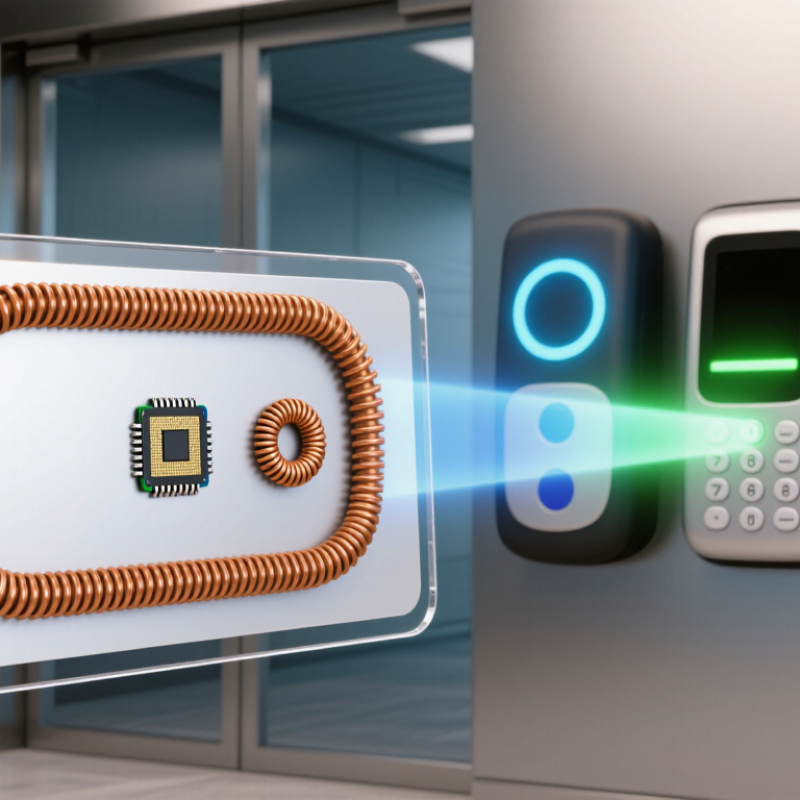
| Card components | A dual-frequency card may contain separate antenna structures and separate or integrated electronics for its two frequency interfaces. | When a reader generates a field at a supported frequency, the matching antenna and circuitry handle that link. |
| Reader field and card power | Many contactless cards have no battery and obtain operating power from the reader’s electromagnetic field. | The reader creates a field; the card couples to it and may use the harvested energy to respond. This is often called passive operation. |
| Data exchange | The reader sends commands or a polling signal, and the card returns data by modulating its response to the field. | The reader and card must use compatible frequency, protocol, and data settings. Frequency compatibility alone does not guarantee communication. |
| Examples of relevant standards | Some LF animal-identification systems use ISO 11784 and ISO 11785. At 13.56 MHz, examples include ISO/IEC 14443 and ISO/IEC 15693. | These standards describe different system requirements and communication behavior. A card and reader must support compatible standards to exchange data. |
| Reader selection | A reader must support the card’s operating frequency and the relevant protocol or application. | A single-frequency reader may detect only the matching interface, even when the card supports a second frequency. |
| Read range | Range varies with frequency, antenna design, reader power, card orientation, surrounding materials, and system configuration. | There is no universal read distance for dual-frequency cards; the supported system and installation determine practical performance. |
| Security and data access | Security features vary by card and protocol. Some systems use authentication or protected data, while others provide limited identification data. | A reader may need the correct credentials and procedures in addition to radio-frequency compatibility to access protected information. |



 © Copyright 2020 Tianjin Tanghaidongyang Valve Co., Ltd. All Rights Reserved.