| Primary Measurement | Relative humidity (RH), which expresses the amount of water vapor in air relative to the maximum amount the air can hold at the same temperature. | Usually reported as %RH, commonly over a range such as 0–100 %RH, subject to the sensor’s operating limits. | The measured value is converted into a digital number and placed in an Ethernet data packet. |
| Temperature Compensation | Humidity readings depend on temperature, so many devices measure temperature at the same time. | Temperature may be displayed in °C or °F. The usable range depends on the sensing element and enclosure. | Temperature and humidity values can be transmitted together in one response or in separate fields. |
| Sensing Element | A capacitive or resistive humidity element detects changes caused by water vapor in the surrounding air. | Capacitive sensing is widely used because it supports digital measurement and low-power operation. | The sensor’s electrical signal is processed by internal electronics before network transmission. |
| Signal Conversion | An analog sensing signal is converted into a digital measurement by an analog-to-digital converter or an integrated digital sensor circuit. | Digital resolution varies by sensor design; the reported value may include decimal places for monitoring and control. | Digital data can be formatted consistently for a server, automation controller, or monitoring application. |
| Ethernet Interface | The network interface connects the sensor to a wired local-area network using twisted-pair Ethernet cabling. | Common Ethernet physical rates include 10 Mbps and 100 Mbps; the actual rate depends on the device and network equipment. | Ethernet carries the sensor’s network frames between the device, switch, gateway, and receiving software. |
| Network Addressing | An IP address identifies the sensor on an IP-based network. | The device may use a manually assigned static address or obtain an address automatically through DHCP. | The destination system uses the address to locate the sensor and request or receive humidity data. |
| Application Protocol | The application protocol defines how measurement values are requested, formatted, and delivered. | Common choices include HTTP/HTTPS, MQTT, Modbus TCP, and SNMP, depending on the software environment. | The protocol determines whether data is sent by polling, publishing, web requests, or device alerts. |
| Data Packet Contents | A message normally contains measurement values and information needed to interpret them. | Typical fields include device address, timestamp, relative humidity, temperature, status, and measurement unit. | The receiving application parses the packet and stores or displays each field. |
| Transmission Method | Ethernet humidity sensors may send readings on a schedule or when a system requests them. | The interval can be configured in seconds or minutes, depending on the application and sensor firmware. | Periodic reporting supports trend analysis, while polling allows a controller to obtain current values when needed. |
| Power Delivery | The sensor requires electrical power for its sensing circuit, processor, and Ethernet interface. | Some Ethernet installations use Power over Ethernet (PoE), while others use a separate DC power supply. | PoE can carry power and data through the same network cable when supported by the device and network equipment. |
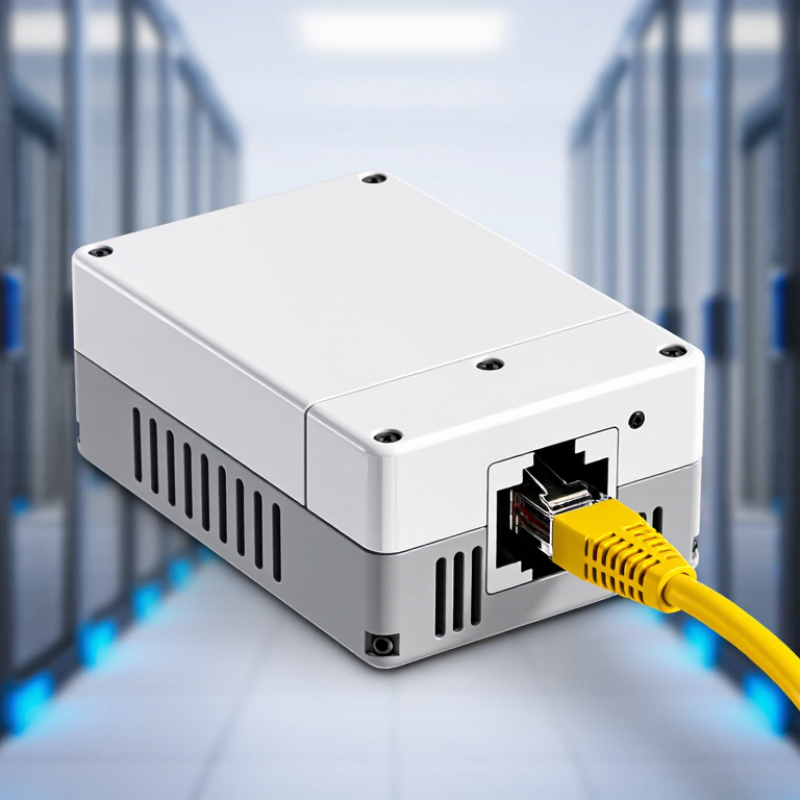
| Cable and Connection | The wired link uses balanced twisted-pair cabling and compatible network connectors. | Cable category, installation quality, electromagnetic interference, and network hardware affect link reliability. | The cable provides the physical path from the sensor to a switch or other Ethernet networking device. |
| Accuracy and Calibration | Accuracy describes how closely the reading represents the actual environmental humidity under specified conditions. | Accuracy varies with humidity, temperature, condensation, contamination, aging, and the sensor’s technical specification. | Calibration status or correction factors may be included in device settings or measurement records. |
| Alarm and Threshold Data | Thresholds define conditions that require attention, such as humidity above or below a selected limit. | A system may use separate high and low limits, delay periods, and hysteresis to reduce false alarms. | The sensor or monitoring platform can transmit an alert through the network when a threshold is crossed. |
| Data Security | Security controls help prevent unauthorized access to the sensor and its measurements. | Possible controls include network segmentation, access credentials, firewall rules, encrypted HTTPS, and secure management practices. | Security is applied through the network configuration and the communication protocol used by the sensor. |
| End-to-End Data Flow | The complete process moves from environmental sensing to digital processing, Ethernet transmission, and data visualization. | Air humidity → sensing element → digital processing → Ethernet frame → IP network → application or database. | A monitoring system can record trends, generate alarms, support remote access, and integrate humidity data with automation systems. |



 © Copyright 2020 Tianjin Tanghaidongyang Valve Co., Ltd. All Rights Reserved.