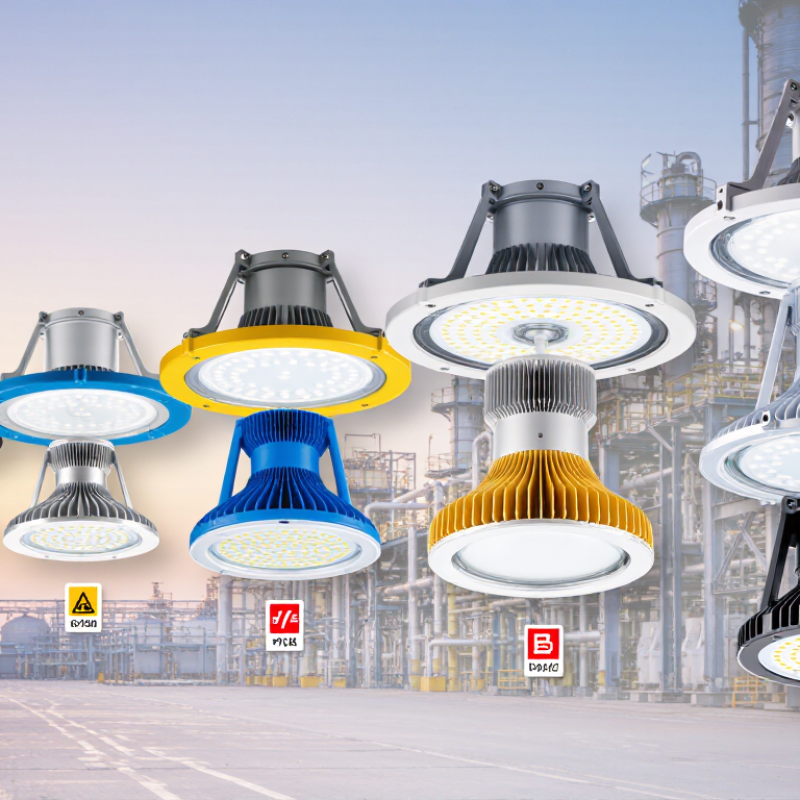
| 1 | Explosion-Proof High Bay | High-ceiling process buildings, chemical production halls, and hazardous-area workshops | Pendant, ceiling, or bracket mount | Approximately 10,000–30,000 lm | Match beam distribution and mounting height to the lighting layout; verify the exact hazardous-location approval and temperature rating. |
| 2 | Explosion-Proof Low Bay | Lower-ceiling production areas, pump rooms, and compact process spaces | Ceiling or pendant mount | Approximately 4,000–12,000 lm | Choose optics that control glare and overlap; check ambient-temperature limits and clearance from equipment. |
| 3 | Linear Hazardous-Area Luminaire | Walkways, production lines, utility corridors, and long equipment rows | Surface, pendant, or continuous-row mount where approved | Approximately 3,000–12,000 lm | Check lens material, ingress protection, chemical compatibility, and whether the complete assembly is approved for the area. |
| 4 | Explosion-Proof Floodlight | Tank farms, loading areas, outdoor process equipment, and broad work zones | Adjustable yoke or wall bracket | Approximately 5,000–25,000 lm | Use suitable beam angles and aiming to limit glare and spill light; confirm wind, corrosion, and weather requirements. |
| 5 | Hazardous-Area Wall Pack | Exterior doors, building perimeters, service bays, and access routes | Wall mount | Approximately 2,000–8,000 lm | Consider mounting height, cutoff, weather exposure, and whether a photocell or other control is permitted for the installation. |
| 6 | Explosion-Proof Bulkhead Light | Stairwells, narrow passages, machinery access points, and low-clearance locations | Wall or ceiling mount | Approximately 1,000–5,000 lm | A compact body can suit confined spaces, but confirm impact resistance, mounting orientation, and required illumination levels. |
| 7 | Hazardous-Area Canopy Light | Covered loading bays, fuel or chemical transfer canopies, and sheltered outdoor work areas | Recessed, surface, or pendant mount, depending on the approved design | Approximately 4,000–15,000 lm | Check canopy depth, heat buildup, moisture exposure, and the fixture’s suitability for the classified location. |
| 8 | Explosion-Proof Emergency Luminaire | Hazardous-area exits, egress routes, and critical access points requiring backup lighting | Wall or ceiling mount | Output and duration depend on the listed emergency design | Verify emergency-lighting code requirements, rated backup duration, battery operating temperature, and hazardous-area approval. |
| 9 | Portable Hazardous-Area Work Light | Maintenance, inspection, shutdown work, and temporary tasks in classified locations | Handheld, tripod, or temporary mounting as specifically approved | Approximately 500–5,000 lm | Use only equipment approved for the area and power source; inspect cables, connectors, battery limits, and portable-use restrictions. |
| 10 | Tank or Vessel Inspection Light | Tank interiors, vessel access points, and inspection tasks where portable lighting is allowed | Portable or temporary mount, subject to site procedures | Approximately 500–3,000 lm | Assess confined-space and gas-testing requirements separately; confirm the complete light and supply arrangement is suitable for the location. |



 © Copyright 2020 Tianjin Tanghaidongyang Valve Co., Ltd. All Rights Reserved.