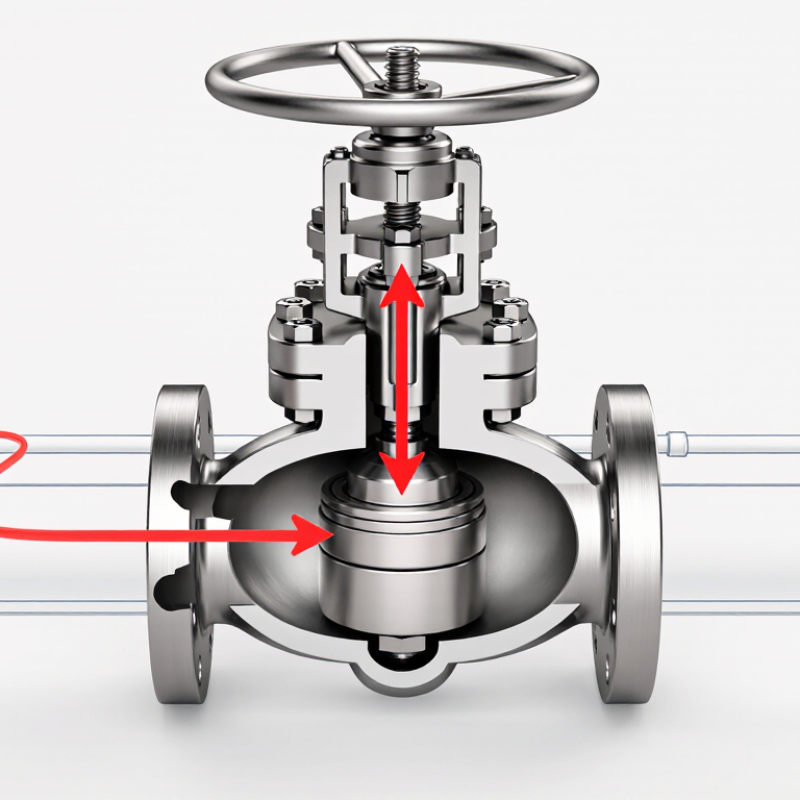
| Globe valve operating principle | A handwheel or actuator moves a stem and disc toward or away from a stationary seat. The disc moves approximately perpendicular to the seat, varying the opening through which fluid passes. | Provides reliable shutoff and allows flow to be regulated across a range of positions. | The changing flow direction and restricted passage generally create more pressure loss than a similarly sized, fully open gate valve. | Isolation and flow regulation in water, steam, oil, gas, and process systems when the valve is suitable for the service conditions. |
| T-pattern (standard pattern) | The inlet and outlet are usually aligned, while the internal passage turns through the valve body and directs flow beneath or around the disc, depending on the design. | Common, versatile body arrangement; well suited to throttling and shutoff duties. | Its relatively indirect flow path can produce a comparatively high pressure drop. | General-purpose piping, including many utility and process services. |
| Angle pattern | The inlet and outlet ports are arranged at roughly a right angle. The body itself changes the direction of the flow, so a separate elbow may not be needed at that point. | Can simplify piping at a change of direction and may reduce the number of fittings required. | Suitable piping layout and support are needed; flow characteristics and pressure loss depend on the specific valve design and operating conditions. | Piping locations where the flow must turn, including some drain, vent, and process lines. |
| Y-pattern | The stem and seat are set at an angle to the main flow path, creating a less abrupt passage than in a standard T-pattern body. | Often offers lower flow resistance than a comparable standard-pattern globe valve. | Its angled layout may require more installation space or a different arrangement of adjacent piping. | Services where lower pressure loss is desirable while retaining globe-valve-style control or shutoff. |
| Plug or parabolic disc | A shaped disc moves toward or away from the seat. Its profile influences how flow changes as the valve opens. | Can provide a useful relationship between stem travel and flow, particularly for throttling when matched to the application. | Control performance depends on disc profile, trim, valve sizing, and operating conditions. | Modulating flow in process and utility systems. |
| Needle disc | A slender, tapered disc approaches a small seat opening, allowing fine adjustments to a relatively small flow passage. | Supports precise adjustment at low flow rates. | Typically intended for smaller passages and flows; it is not a universal substitute for a larger control valve. | Instrument lines, sampling systems, and other low-flow services where fine adjustment is needed. |



 © Copyright 2020 Tianjin Tanghaidongyang Valve Co., Ltd. All Rights Reserved.