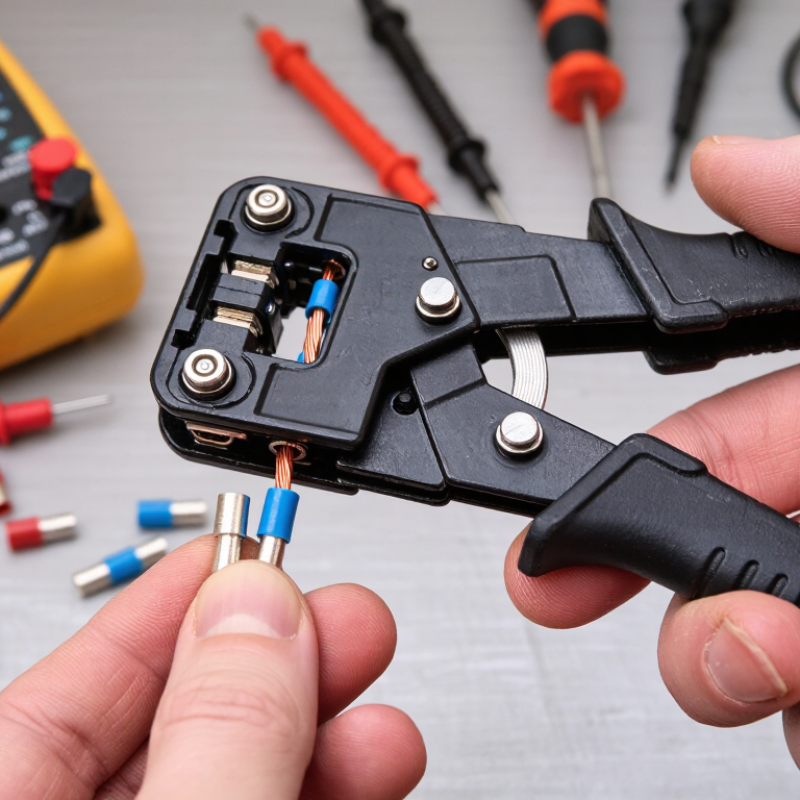
| Hand Crimper | A manually operated tool used to compress a terminal, connector, or sleeve onto a wire or cable. | The user closes the handles, transferring hand force through a lever system to press the terminal around the conductor. | Common overall length: approximately 150–300 mm; intended for controlled, low-volume or field crimping. |
| Frame | The rigid body that supports the handles, pivot points, dies, and ratchet assembly. | It keeps the dies aligned and resists bending while crimping force is applied. | Usually made from stamped, forged, or machined steel; a rigid frame helps maintain consistent crimp geometry. |
| Dies | The shaped jaws or inserts that contact and form the terminal. | When the handles close, the die cavities compress the terminal to create a mechanical and electrical connection. | May be fixed or interchangeable; cavity profiles can include hexagonal, indention, oval, or trapezoidal forms. |
| Die Cavities | Individual size-specific recesses within the dies. | Each cavity matches a defined terminal or conductor-size range and limits how the metal is formed. | Typical markings may identify wire size, terminal size, or conductor cross-sectional area; compatibility must be checked before use. |
| Handles | The two lever arms held and squeezed by the operator. | They multiply hand force through their length and pivot location, moving the dies together. | Longer handles generally provide greater mechanical advantage but may require more clearance; insulated grips improve comfort and handling. |
| Pivot Pins | Pins or rivets that connect and guide the moving parts. | They provide the rotational axis for the handles and help maintain die alignment during the crimp cycle. | Require secure fit and adequate lubrication; excessive looseness can produce uneven or unreliable crimps. |
| Ratchet Mechanism | A toothed or cam-operated locking system that controls handle movement. | It prevents the handles from reopening until the dies reach the designed crimp position, helping complete the compression cycle. | Common on precision hand crimpers; many designs include a release lever for emergency opening. |
| Ratchet Release | A manual override that disengages the ratchet before the normal end of the cycle. | The operator activates the release to open the dies if a terminal is positioned incorrectly or the wrong cavity is selected. | Useful for preventing damage to the tool, terminal, or wire; location and operation vary by tool design. |
| Return Spring | A spring that assists the handles and dies in returning to the open position. | After the ratchet is released or the crimp is completed, spring force separates the handles and opens the dies. | Should provide smooth opening without excessive resistance or binding. |
| Crimping Cycle | The sequence used to form the connection. | Strip the wire, insert it into the correct terminal, position the terminal in the matching die cavity, squeeze the handles, and complete the ratchet cycle. | A completed crimp should hold the conductor securely without cutting strands or deforming the terminal beyond its intended profile. |
| Mechanical Advantage | The increase in force produced by the tool’s lever arrangement. | Handle movement is converted into higher compressive force at the dies, allowing the operator to form metal with less hand effort. | Depends on handle length, pivot geometry, die position, and the terminal material and size. |
| Quality Check | A visual and mechanical inspection of the finished connection. | The operator checks that the conductor is fully inserted, the insulation is supported where intended, and the terminal is not cracked or excessively flattened. | The correct die, terminal, wire size, and specified crimp height or pull-test requirement should always be used for the application. |



 © Copyright 2020 Tianjin Tanghaidongyang Valve Co., Ltd. All Rights Reserved.