China Top Steel Rod Suppliers How to Choose the Best?
China’s steel industry offers enormous sourcing depth, but volume alone does not identify the right Steel Rod supplier. The World Steel Association reported that China produced approximately 1.019 billion tonnes of crude steel in 2023. This output supports a broad manufacturing base, from construction rebar to cold-drawn rods and industrial wire rod. Yet, a large national production figure does not guarantee consistent quality from every factory.
A reliable evaluation should connect supplier claims with verifiable evidence. Review mill test certificates, chemical composition, tensile strength, yield strength, elongation, and dimensional tolerance. Compare these records with applicable standards, such as GB/T 1499.2 for hot-rolled ribbed bars, ASTM A615, or EN 10080. The OECD’s steel market studies also highlight persistent global overcapacity concerns, making transparent production capability and export experience increasingly important. Ask whether the supplier owns its mill, operates a rolling line, or merely trades finished material.
The best supplier is not always the cheapest. That matters. Check heat numbers on bundles, barcode traceability, coating condition, packing photographs, and pre-shipment inspection procedures. A serious exporter should explain inspection frequency, testing equipment, and corrective actions without avoiding difficult questions. I would also compare shipment records, payment terms, and response quality before selecting a factory. Some suppliers present excellent certificates but weak batch control. That gap is easy to miss. A practical decision should combine documented compliance, stable dimensions, realistic lead times, and evidence from independent inspections. Mistakes still happen, so build verification into the purchase rather than trusting a polished quotation.
Understanding Steel Rod Types and Their Industrial Applications
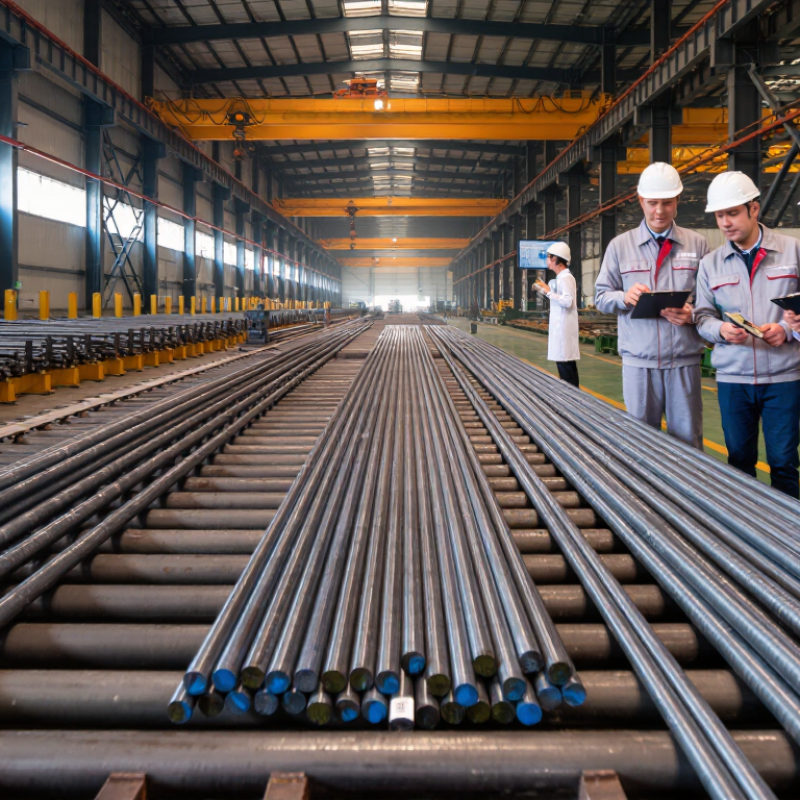
Steel rods differ by chemistry, forming method, surface condition, and final use. Carbon steel rods suit general fabrication, shafts, fasteners, and construction components. Alloy steel rods contain elements such as chromium, nickel, or molybdenum. They support higher strength, wear resistance, or heat performance.
Stainless steel rods perform well where moisture, chemicals, or clean surfaces matter. Cold-drawn rods usually provide tighter dimensions and smoother surfaces than hot-rolled rods. That difference matters for pins, precision parts, and automated assemblies. Reinforcing rods, however, are designed for concrete structures and require suitable rib patterns, strength grades, and bending performance. Choosing the wrong type can create costly rework.
A capable supplier should provide material certificates, heat numbers, dimensional reports, and independent test results. Check tensile strength, yield strength, elongation, hardness, and chemical composition against the required standard. Surface defects deserve attention. Small seams or rust marks may become serious during machining or welding. Ask about cutting tolerances, packing, moisture protection, and traceability before placing an order.
Price alone is a weak filter. A lower quotation may exclude testing, straightening, or protective packaging. Procurement teams should compare the complete delivered specification. No checklist is perfect. Application conditions can change after production begins, so engineers should review temperature, loading, corrosion exposure, and machining needs with the supplier. Clear technical drawings and sample approval reduce misunderstandings, though they cannot replace incoming inspection.
Evaluating Quality Standards and Manufacturing Capabilities
China Top Steel Rod Suppliers: How to Choose the Best?
Quality evaluation should begin with verifiable standards, not attractive catalog photographs. The World Steel Association reported 1.892 billion tonnes of crude steel production worldwide in 2023. China contributed about 1.019 billion tonnes. This scale creates choice, but also makes supplier comparison more demanding. Ask for mill test certificates, heat numbers, chemical analysis, tensile strength, yield strength, and elongation results. Check whether testing follows recognized standards such as ISO, ASTM, or EN requirements. A certificate without traceable heat identification is weak evidence.
Manufacturing capability matters when steel rods face bending, welding, or repeated loads. Examine furnace control, continuous casting, rolling accuracy, cooling systems, and heat-treatment records. Request actual dimensional data, not only stated tolerances. A 12-millimeter rod should be checked with calibrated equipment at several points. Surface cracks, rust pits, and uneven ribs can reveal poor handling or unstable rolling. The International Organization for Standardization’s ISO Survey shows that certified quality-management systems remain widely used across global manufacturing. Certification helps. It does not replace factory inspection.
Review production capacity against your delivery schedule. Ask for monthly output, backup equipment, inspection staffing, and corrective-action records. Independent laboratories can verify samples before shipment. That step costs money. It may prevent larger losses. Some buyers focus too heavily on certificates and overlook storage conditions or packaging damage. That is an imperfect habit. Quality can decline after production, especially when rods sit outdoors near moisture and salt. Supplier evaluation should therefore connect laboratory results with real manufacturing evidence.
The chart compares minimum specified yield and tensile strengths for commonly referenced reinforcing steel standards. When evaluating steel rod suppliers, verify the applicable standard, mill test certificates, chemical composition, dimensional tolerances, traceability, and production quality-control procedures. Requirements may vary by grade and bar diameter.
Reference basis: ASTM A615 Grade 60, EN 10080 B500B, and GB/T 1499.2 HRB400E minimum strength requirements. Values are shown in MPa.
Checking Certifications, Pricing, Lead Times, and Export Services
Choosing among China’s top steel rod suppliers requires more than comparing quotations. The World Steel Association reported about 1.88 billion tonnes of crude steel production worldwide in 2024, with China producing roughly 1.01 billion tonnes. This scale creates options, but not automatic quality. Ask for current ISO 9001 certification, mill test certificates, heat numbers, and compliance with the required standard, such as ASTM A615, EN 10080, or GB/T 1499.2. Verify that the certificate matches the actual batch.
Pricing Considerations Pricing needs careful interpretation. The World Bank’s Commodity Markets Outlook shows that steel-related prices can change with energy costs, construction demand, and raw-material markets. Compare offers using the same diameter, grade, quantity, tolerance, packaging, and Incoterm. A low price may exclude testing, export packing, or port charges. Request a validity period in writing. Short quotes can mislead.
Lead time should include production, inspection, document preparation, and ocean transit. In practical purchasing, standard orders may require several weeks, but custom lengths and peak-season bookings can extend the schedule. Confirm a realistic shipping window, not a hopeful promise. Export service matters too. Check commercial invoices, packing lists, certificates of origin, customs data, and corrosion protection. I would not trust perfect spreadsheets alone. One unchecked document can delay a full container. Ask for sample reports and a video inspection when the order is significant.



 © Copyright 2020 Tianjin Tanghaidongyang Valve Co., Ltd. All Rights Reserved.