| Feed Throughput | Average flow, peak flow, solids concentration, and daily operating hours | Common duty range: approximately 0.5–2.0 m³/m²·h hydraulic loading, subject to particle settling characteristics | Conduct settling tests and calculate surface overflow rate using peak and average conditions | Prevents hydraulic overloading, solids carryover, and unstable overflow quality | High |
| Solids Loading | Dry-solids feed rate, sludge type, flocculant response, and underflow target | Typical design checks may cover about 50–250 kg dry solids/m²·day; actual values vary significantly by feed material | Use laboratory or pilot thickening tests and verify mass balance at peak solids loading | Determines tank area, rake torque, bed depth, and risk of blanket buildup | High |
| Tank Diameter and Depth | Required settling area, side-water depth, floor slope, and available foundation space | Large circular units commonly range from approximately 10–100 m in diameter; side-water depth is often about 3–6 m | Review process calculations, geotechnical conditions, wind loads, seismic requirements, and civil drawings | Influences residence time, clarification efficiency, steel or concrete quantity, and installation complexity | High |
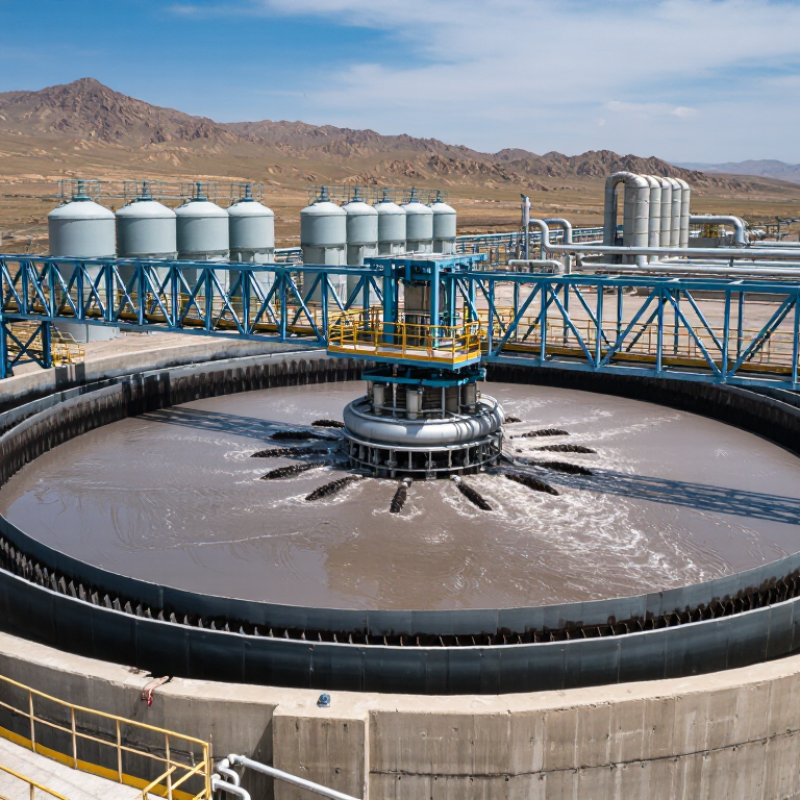
| Peripheral Drive Arrangement | Drive location, wheel loading, rail alignment, drive redundancy, and access for replacement | A peripheral drive travels around the tank rim; drive speed is commonly in the low single-digit metres per minute | Inspect drive layout, wheel-to-rail load calculations, alignment tolerances, and emergency stopping provisions | Reduces central shaft requirements but makes rail condition and wheel alignment critical | Medium |
| Rake Rotation Speed | Adjustability, torque response, scraper configuration, and allowable shear rate | Typical rake speeds are approximately 0.05–0.30 rpm, depending on diameter, sludge properties, and design | Confirm variable-speed control, low-speed starting capability, and torque-based automatic control | Slow, controlled movement promotes compaction while limiting floc breakage and excess power demand | Medium |
| Rake Torque Capacity | Normal torque, peak torque, overload trip setting, and structural safety factor | Torque capacity must be calculated from rake geometry, bed depth, solids properties, and upset conditions; a documented overload margin is essential | Review torque calculations, finite-element checks, factory testing, and trip-history records during commissioning | Protects rake arms, drive components, and tank structure during blanket accumulation or sudden solids surges | High |
| Underflow Solids Concentration | Target concentration, pumpability, withdrawal rate, and interface control | Many mineral or industrial sludges may target roughly 15–40% dry solids; biological sludges are often lower | Compare thickener test results with pump curves, yield-stress data, and downstream process requirements | Higher underflow concentration can reduce downstream pumping and treatment volume but may increase torque and pumping difficulty | High |
| Overflow Clarity | Suspended-solids limit, flocculant dosage, feedwell design, and short-circuiting risk | A site-specific target is required; many applications establish limits in the tens to low hundreds of mg/L | Perform jar tests, settling-column tests, tracer checks, and continuous turbidity or suspended-solids monitoring | Controls water-reuse quality and reduces solids recycle to upstream or downstream equipment | Medium |
| Feedwell and Flocculation | Feed energy dissipation, dilution water, polymer mixing, and inlet distribution | Design should avoid excessive shear and provide even radial distribution across the thickener area | Verify mixing intensity, polymer preparation quality, feedwell residence time, and distribution during commissioning | Good feed distribution improves settling and reduces localized torque, short-circuiting, and overflow solids | Medium |
| Drive Motor and Energy Use | Motor rating, gearbox efficiency, variable-frequency drive, and standby philosophy | Installed motor power varies widely with diameter and torque duty; low-speed operation is normally more important than high power | Check rated torque, starting torque, overload class, measured kW, and power-factor data under normal operation | Correct sizing prevents nuisance trips without paying for unnecessary motor capacity | Low to Medium |
| Rail and Wheel System | Rail flatness, wheel material, wheel loads, lubrication, drainage, and corrosion protection | Rail alignment and wheel loading must remain within the equipment designer’s specified tolerances; drainage should prevent standing water | Use laser or surveying checks, wheel-contact inspection, vibration monitoring, and scheduled rail cleaning | Misalignment can cause wheel slip, uneven loading, vibration, and premature drive failure | High |
| Corrosion and Materials | Feed chemistry, chloride level, pH, abrasion, coating system, and submerged materials | Material selection should be based on measured chemistry and abrasion data rather than generic stainless-steel assumptions | Review corrosion assessment, coating specification, weld procedures, thickness allowance, and inspection plan | Appropriate materials extend service life and reduce unplanned tank or rake repairs | High |
| Instrumentation and Controls | Bed-level sensor, torque monitoring, rake lift, underflow density, turbidity, and alarms | At minimum, monitor torque, drive status, rake position or lift, underflow pressure, and overflow condition | Test alarm setpoints, fail-safe actions, calibration intervals, and control-system integration | Early detection limits damage from high torque, rising blanket levels, loss of underflow withdrawal, or poor flocculation | Medium |
| Routine Maintenance | Inspection frequency, lubrication points, scraper wear, gearbox oil, rail cleaning, and electrical checks | Typical inspections are weekly to monthly; detailed mechanical inspections are commonly scheduled annually or during planned shutdowns | Require a preventive-maintenance schedule, spare-parts list, inspection forms, and maintenance access review | Predictable maintenance reduces emergency shutdowns and extends gearbox, wheel, bearing, and scraper life | Medium |
| Spare Parts and Serviceability | Availability of wheels, bearings, seals, scrapers, gear components, sensors, and control hardware | Critical rotating and wear parts should be identified with recommended quantities and replacement intervals | Review bill of materials, lead times, interchangeability, lifting requirements, and local service capability | Shorter repair time improves plant availability and reduces dependence on emergency procurement | High |
| Capital Cost | Equipment, tank, bridge or walkway, civil works, installation, electrical systems, and commissioning | Compare complete installed cost rather than equipment purchase price alone | Use a normalized quotation basis with identical duty, materials, instrumentation, testing, and exclusions | Prevents underestimating civil, structural, access, electrical, and commissioning requirements | High |
| Total Operating Cost | Electricity, polymer, water, labor, maintenance, wear parts, sludge pumping, and disposal | Evaluate at least a 10-year or 15-year ownership period using site-specific utility, chemical, labor, and disposal rates | Build a lifecycle-cost model with sensitivity cases for flow, solids loading, polymer price, downtime, and sludge concentration | Provides a more reliable comparison than initial purchase price or motor power alone | High |
| Commissioning and Acceptance | Hydraulic performance, solids capture, underflow density, torque behavior, alarms, and operator training | Acceptance criteria should include stable operation at normal and agreed peak conditions | Perform documented performance testing with mass balance, samples, torque trends, and alarm verification | Confirms that the installed unit meets the process duty and that operators can respond to upset conditions | Medium |



 © Copyright 2020 Tianjin Tanghaidongyang Valve Co., Ltd. All Rights Reserved.