| 1. Establish the heaviest load | The combined weight of the pallet and its contents—not just the product weight. | Choose a truck with a rated capacity that meets or exceeds the heaviest expected load. Never exceed the truck’s rating; follow the load plate and operating instructions. | For a maximum loaded pallet of 1,800 kg, consider a truck rated for at least 1,800 kg, subject to the manufacturer’s stated conditions. |
| 2. Check how the load is distributed | Whether the load is centered and evenly supported across the forks. | A long, uneven, or off-center load can affect stability and safe handling. Confirm capacity limits for the actual load arrangement with the truck supplier. | Position a centered, evenly distributed load across both forks rather than allowing most of its weight to sit at one end. |
| 3. Measure pallet length and width | The pallet’s outside dimensions and the direction from which the forks enter. | Measure several pallets if sizes vary. Confirm that the fork length and spacing suit the pallet’s entry openings and provide appropriate support. | A common European pallet measures 1,200 × 800 mm; verify its entry direction and underside clearance before selecting a truck. |
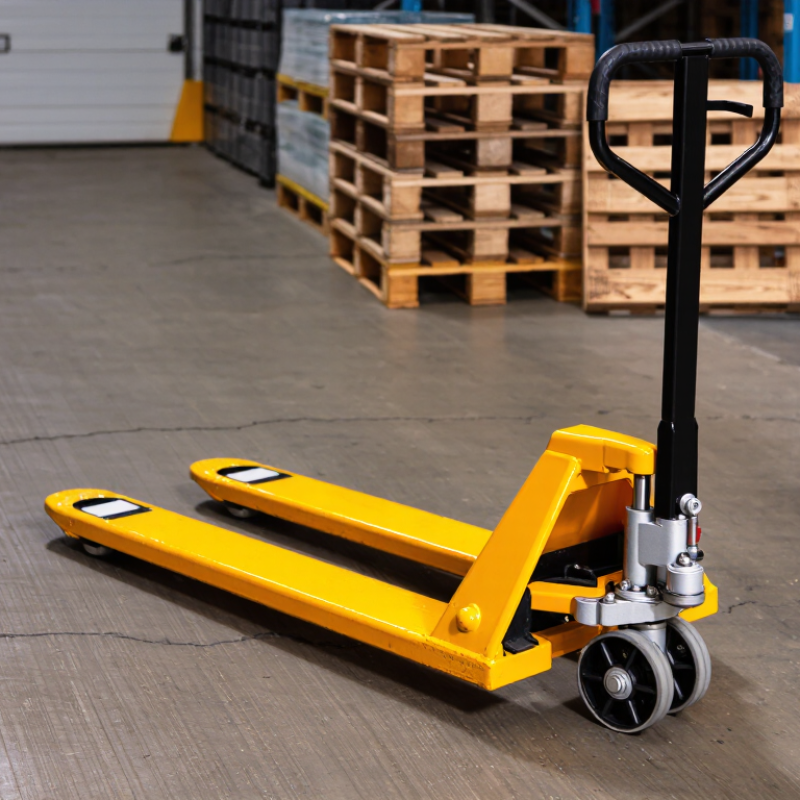
| 4. Match fork length to the pallet | Fork length, pallet depth in the entry direction, and the support needed for the load. | A 1,150 mm fork length is a common option for handling many standard 1,200 mm-long pallets from the appropriate entry side, but the fit must be checked for the specific pallet and load. | For a pallet with approximately 1,200 mm of depth in the fork-entry direction, check whether 1,150 mm forks provide the required support. |
| 5. Confirm fork outside width and spacing | The truck’s overall fork width and the clear spacing between its forks. | Compare these measurements with the pallet’s openings, runners, and blocks. Forks must enter freely and support the pallet without fouling its structure. | A narrow pallet may need a different fork arrangement from a wider pallet; check the manufacturer’s drawing against the measured pallet underside. |
| 6. Check pallet entry and clearance | Fork-entry openings, bottom-board height, and the truck’s lowered fork height. | Confirm that the forks can enter and exit without striking the pallet. Low-profile pallets may require a truck designed for reduced fork height. | Measure the clearance beneath the pallet’s entry openings and compare it with the truck’s lowered fork height. |
| 7. Verify the complete operating route | Aisle width, turning space, floor condition, slopes, and any tight doorways. | Compare the truck’s overall dimensions and turning requirements with the narrowest parts of the route. Use the truck only on surfaces and gradients permitted by its instructions. | Measure the narrowest aisle and doorway, then confirm the selected truck can maneuver through them with the intended pallet. |



 © Copyright 2020 Tianjin Tanghaidongyang Valve Co., Ltd. All Rights Reserved.