| Fabric-Wrapped Fiberglass | Porous fiberglass core covered with acoustically transparent fabric; commonly available in 1–2 in. thicknesses. | Porous fibers dissipate sound energy as sound waves pass into the panel, reducing reflections and reverberation. | About 0.70–1.00 | Offices, meeting rooms, classrooms, studios, and living rooms. | Performance depends on thickness, mounting method, and whether an air gap is used. |
| Mineral Wool Panels | Dense, fibrous mineral-wool core, often finished with fabric or a protective facing. | Absorbs a broad range of reflected sound; thicker panels and spaced mounting can improve lower-frequency absorption. | About 0.70–1.00 | Home theaters, music rooms, offices, and other spaces with noticeable echo. | Check the product’s facing, edge finish, and installation requirements. |
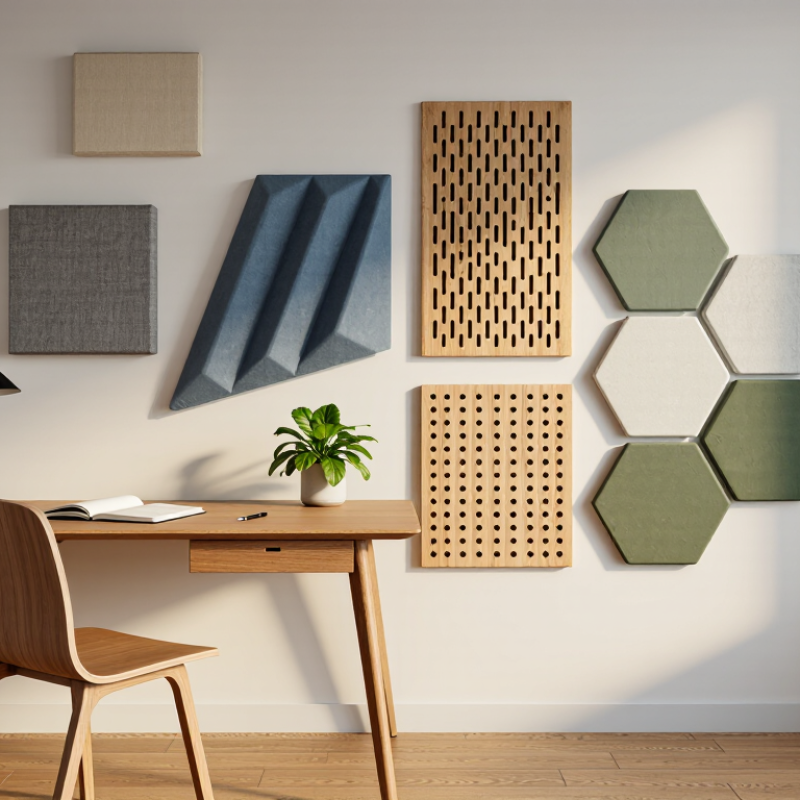
| PET Felt Panels | Rigid or semi-rigid panels made from compressed polyester fibers, sometimes including recycled content. | Fiber structure absorbs some sound reflections, especially in the mid and high frequencies. | About 0.30–0.85 | Shared workspaces, classrooms, corridors, and decorative wall layouts. | Thin panels may provide limited low-frequency absorption; verify fire and cleaning specifications. |
| Perforated Wood Panels | Wood or wood-based facing with holes or slots over an absorptive backing and cavity. | Sound passes through the openings to the backing material, where it is absorbed; the panel can also provide a hard-wearing finish. | About 0.40–0.90 | Conference rooms, libraries, auditoriums, and interiors needing a wood finish. | Absorption depends on perforation pattern, backing, cavity depth, and panel installation. |
| Wood Slat Panels with Acoustic Backing | Spaced wood slats mounted over a porous acoustic layer, commonly felt or mineral fiber. | Gaps between slats allow sound to reach the absorptive backing, reducing reflected sound while retaining a slatted appearance. | About 0.30–0.85 | Living areas, offices, reception spaces, and feature walls. | Slats alone are mostly reflective; the backing and open-area ratio drive absorption. |
| Open-Cell Acoustic Foam | Lightweight open-cell foam, typically installed as shaped or flat wall tiles. | Air movement through the cells creates friction that absorbs some sound energy, primarily at mid and high frequencies. | About 0.30–0.80 | Small recording spaces, practice rooms, and targeted reflection-control areas. | It does not soundproof a room; confirm fire safety and suitability for the intended interior. |
| Fabric-Covered Recycled Textile Panels | Panels made from compressed textile fibers or recycled fiber batts, often finished with fabric. | Porous fibers absorb reflected sound and can help reduce room reverberation when coverage is adequate. | About 0.40–0.95 | Offices, schools, home studios, and multipurpose rooms. | Results vary with fiber density, thickness, mounting, and the tested panel configuration. |



 © Copyright 2020 Tianjin Tanghaidongyang Valve Co., Ltd. All Rights Reserved.