| Common Large-Bead Diameter | Approximately 10–30 mm; custom sizes are possible depending on tooling and design. | Larger diameters create stronger visual impact but require tighter control of drying, shrinkage, and firing distortion. |
| Main Ceramic Materials | Porcelain, stoneware, earthenware, or other formulated ceramic bodies based on clay, feldspar, silica, and mineral additives. | The body composition affects color, strength, porosity, firing temperature, weight, and surface finish. |
| Forming Methods | Press molding, slip casting, extrusion with cutting, or hand shaping for smaller production runs. | Press molding supports repeatability, while slip casting is useful for complex shapes and hollow designs. |
| Bead-Hole Formation | A hole is created during forming with a pin, mandrel, or core; the hole may be refined after drying. | Hole diameter, alignment, edge smoothness, and blockage should be checked because large beads are often used on cords, wires, or rods. |
| Drying Stage | Controlled air drying or chamber drying removes moisture before firing; the exact time depends on bead size, wall thickness, and body composition. | Slow and even drying helps reduce cracking, warping, and uneven shrinkage in large or thick beads. |
| Firing Temperature | Often about 1,000–1,300°C, depending on the ceramic body and glaze system. | The firing schedule determines vitrification, mechanical strength, porosity, color development, and dimensional stability. |
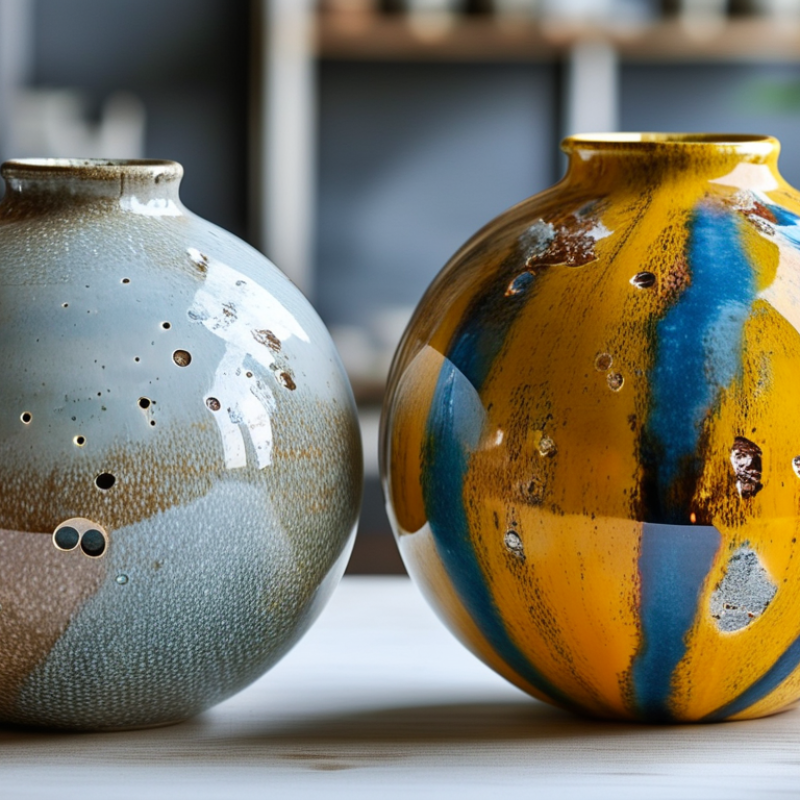
| Glazing and Surface Options | Gloss, satin, matte, textured, speckled, metallic-look, reactive, or unglazed surfaces. | Surface selection influences appearance, cleanability, abrasion resistance, and compatibility with jewelry or decorative applications. |
| Typical Dimensional Shrinkage | Often approximately 5–15% from wet or molded size, depending on the clay body and production process. | A supplier should confirm fired dimensions rather than relying only on mold dimensions, especially for custom sizes. |
| Water Absorption | Varies by ceramic type: porcelain is generally very low, while earthenware is typically more porous; glazed and unglazed values can differ. | Water absorption is a useful indicator of vitrification and should be verified when beads may contact moisture or require easy cleaning. |
| Strength and Durability | Ceramic beads are rigid and scratch-resistant compared with many soft decorative materials, but they can chip or fracture under impact. | Packaging, edge design, firing quality, and drop-resistance checks are important for international shipment and repeated handling. |
| Weight Consideration | Generally heavier than acrylic, wood, or foam beads of the same size; actual weight depends on density, wall thickness, and whether the bead is hollow. | Weight affects freight cost, jewelry comfort, mounting requirements, and the choice of packaging materials. |
| Quality-Control Checks | Diameter, length, hole size, hole alignment, glaze coverage, color consistency, cracks, chips, warpage, and quantity. | A written tolerance range and approved reference sample help maintain consistency across production batches. |
| Customization Possibilities | Custom shapes, dimensions, hole configurations, textures, glaze colors, patterns, logos, and packaging can be developed. | Custom tooling and sampling may increase development time and cost, so specifications should be finalized before mass production. |
| Global-Sourcing Advantages | Stable ceramic raw materials, scalable kiln production, broad design flexibility, and suitability for decorative, craft, jewelry, and interior applications. | Multiple production regions can be evaluated using the same technical specification, sample approval process, packaging standard, and inspection criteria. |
| Recommended Buyer Documents | Technical drawing, fired dimensions, tolerance table, material description, glaze requirements, color reference, packaging specification, and inspection checklist. | Clear documentation reduces interpretation differences and supports consistent purchasing across international suppliers. |


 © Copyright 2020 Tianjin Tanghaidongyang Valve Co., Ltd. All Rights Reserved.