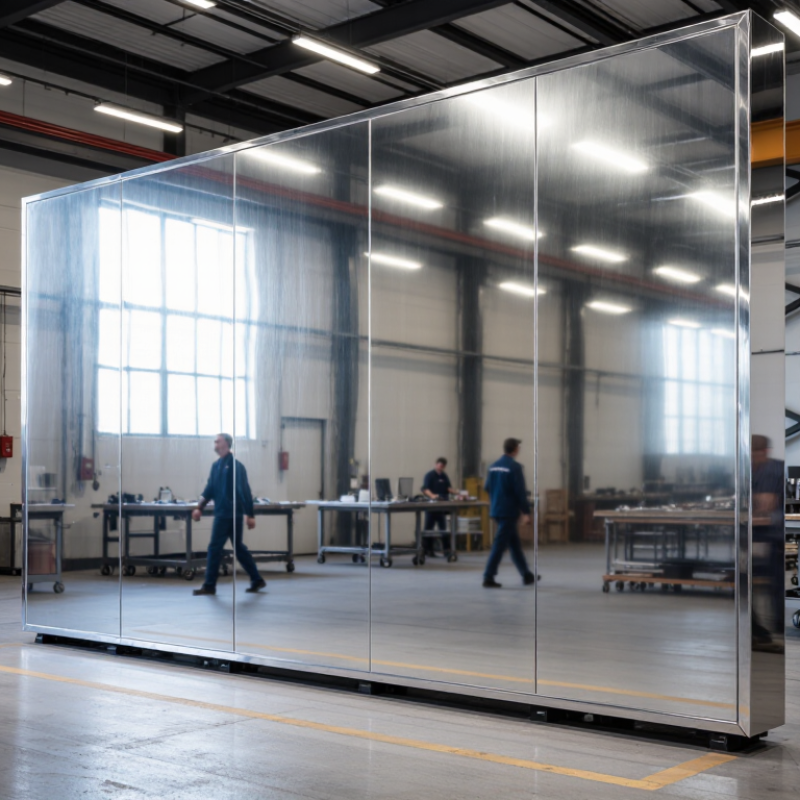
| Material Definition | Stainless steel with a highly smooth, reflective surface produced by progressive mechanical polishing | The surface reflects light clearly instead of scattering it across visible scratches, pits, or grinding marks | “Mirror finish” describes surface appearance and condition rather than a separate type of stainless steel |
| Common Stainless Steel Grades | 304 and 316 are widely used; ferritic grades such as 430 can also be polished | Polishability depends on the alloy, starting surface, hardness, inclusions, and fabrication history | Grade selection should be based on corrosion resistance, forming requirements, service temperature, and intended environment |
| Typical Finish Designations | Commercial specifications commonly identify bright polished surfaces as No. 8 or equivalent highly reflective finishes | Higher finish designations generally indicate greater reflectivity and fewer visible surface imperfections | Finish names and acceptance criteria can vary by standard, supplier, and project specification |
| Starting Surface | Cold-rolled, hot-rolled, or previously ground sheet; the starting roughness must be suitable for the target finish | A rough or damaged substrate requires more material removal and more polishing stages | Deep dents, weld discoloration, scale, and embedded iron should be removed before fine polishing begins |
| Stage 1: Cleaning and Inspection | Degreasing, removal of dirt and shop contaminants, followed by visual inspection | Clean metal allows abrasives to cut consistently and prevents contamination from being dragged across the surface | Protective films and residues are normally removed or managed according to the fabrication procedure |
| Stage 2: Defect Removal | Coarse abrasive work is selected according to the depth of scratches, weld marks, or oxidation | All deep defects must be blended below the final surface level before fine polishing can produce uniform reflection | Excessive grinding can create flat spots, gouges, heat tint, or dimensional loss |
| Stage 3: Progressive Abrasive Polishing | Typical abrasive progression: approximately P80–P120, P180–P240, P320–P400, then finer grades such as P600 and above | Each finer abrasive removes the directional scratches left by the preceding coarser abrasive | The exact sequence depends on the initial condition, geometry, abrasive type, and required appearance |
| Abrasive Direction | Each polishing stage is often performed at a different direction or angle to the previous scratch pattern | Changing direction makes remaining coarse scratches easier to identify and remove | Consistent movement and pressure help prevent random swirl marks and uneven brightness |
| Stage 4: Fine Polishing | Fine abrasive belts, discs, or compounds are used after the visible coarse scratch pattern has been eliminated | Fine polishing reduces surface roughness and creates the low-scattering surface needed for clear reflection | Pressure, speed, lubrication, and tool condition must be controlled to avoid overheating and smearing |
| Stage 5: Buffing | Soft cloth or fiber wheels with a suitable polishing compound may be used for final brightening | Buffing can increase brightness and improve visual uniformity after abrasive refinement | Buffing is not a substitute for removing deep scratches; it may hide defects temporarily rather than eliminate them |
| Surface Roughness | Mirror-polished surfaces are commonly specified by a low Ra value; exact limits depend on the project requirement | Lower average roughness generally supports sharper reflection, although waviness and visible defects also affect appearance | Typical values may be specified around Ra 0.1–0.2 µm for highly polished surfaces |
| Heat Control | Moderate tool pressure, suitable speed, and intermittent cooling or lubrication where appropriate | Excessive heat can discolor the surface, alter the finish, and make polishing marks more difficult to remove | Abrasive loading and friction should be monitored throughout the operation |
| Edge and Weld Treatment | Edges are blended and weld areas are ground progressively before fine polishing | Differences in height, hardness, or texture can remain visible even when the surrounding sheet is reflective | Weld heat tint should be removed using an appropriate cleaning or finishing method before final polishing |
| Cleaning After Polishing | Removal of abrasive residue, compound, oil, and metal particles using a compatible cleaning process | Cleanliness preserves optical clarity and prevents stains or particles from appearing as surface defects | Chloride-containing cleaners and embedded carbon-steel particles should be avoided because they may promote corrosion |
| Passivation Consideration | Passivation may be specified after fabrication and cleaning when restoration of the passive chromium-oxide layer is required | Passivation supports corrosion resistance but does not replace mechanical polishing or correct scratches | The treatment must be compatible with the stainless steel grade and the required surface appearance |
| Quality Checks | Visual inspection, reflected-image inspection, scratch-pattern review, and roughness measurement when specified | Checks confirm that the surface is uniform, free from visible defects, and within the agreed appearance criteria | Inspection should use consistent lighting, viewing distance, sample orientation, and acceptance standards |
| Typical Applications | Decorative panels, architectural trim, interior fixtures, elevator surfaces, food-service equipment, and hygienic installations | The reflective appearance provides an attractive finish and a smooth surface that is relatively easy to wipe clean | Highly reflective surfaces can show fingerprints, dust, waviness, and scratches more readily than satin finishes |
| Surface Protection | Temporary protective film, clean handling gloves, separators, and careful packaging are commonly used | Protection prevents scratches and contamination after the final polishing operation | The surface should be protected from abrasive dust, carbon-steel contact, moisture, and rough handling during transport and installation |



 © Copyright 2020 Tianjin Tanghaidongyang Valve Co., Ltd. All Rights Reserved.