| Material | Natural white oak finish | White oak is a hardwood with a visible grain pattern and a warm, light-to-medium brown appearance. “Natural” usually indicates that the wood character remains visible rather than being covered by an opaque color. | Expect variation in grain, tone, knots, and shade between panels. Samples should be reviewed before installation. |
| Construction | Slat-and-absorber design | Most acoustic slat panels combine narrow wood slats with a dark acoustic backing, commonly made from a porous fiber or felt-like material. The spacing between slats allows sound energy to reach the absorber. | Confirm the core material, slat spacing, panel thickness, and mounting method in the product specifications. |
| Common Use | Home offices and study rooms | The panels can reduce reflected sound from hard walls and help create a calmer environment for calls, reading, and focused work. | Treat the wall behind a desk or the primary reflection area first. They do not replace soundproofing between rooms. |
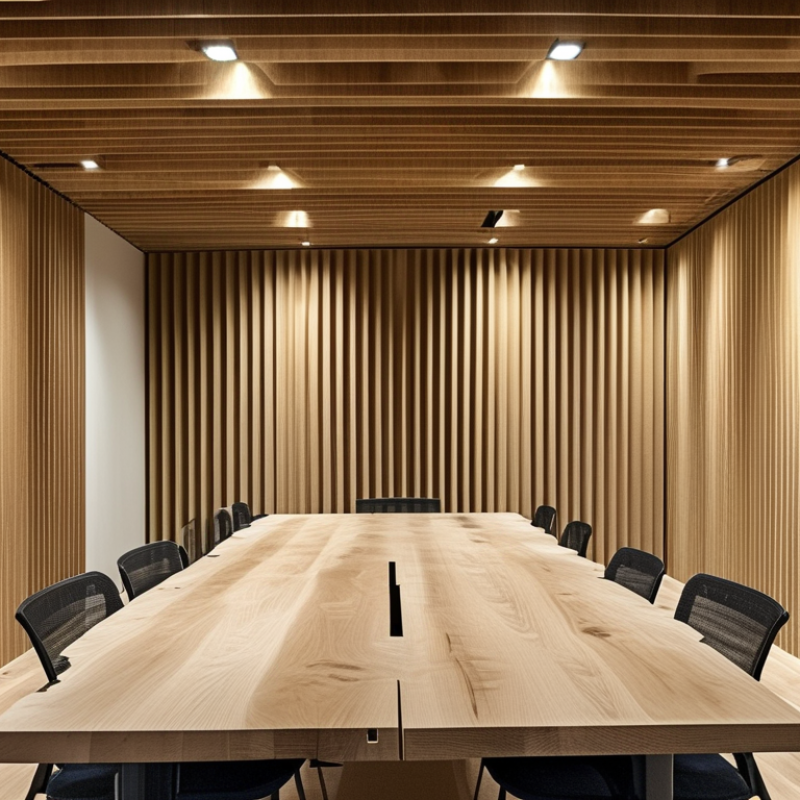
| Common Use | Meeting rooms and conference areas | Wall-mounted panels can help improve speech clarity by reducing excessive reverberation from large, reflective surfaces. | Combine wall treatment with a suitable ceiling, floor, or furnishing strategy when the room has strong echo. |
| Common Use | Restaurants, cafés, and hospitality spaces | White oak slat panels provide a decorative wood appearance while helping manage noise created by conversations, dishes, and hard flooring. | Select a surface finish and installation system that can withstand the expected cleaning frequency and traffic level. |
| Common Use | Living rooms and media rooms | Panels may reduce wall reflections around televisions and speakers, supporting a more controlled listening environment. | Use alongside soft furnishings such as rugs, curtains, and upholstered furniture for more balanced room acoustics. |
| Acoustic Performance | Sound absorption | Performance depends on the absorber behind the slats, the open area between slats, panel thickness, installation method, and the air gap behind the panel. | Look for laboratory-tested absorption data, such as sound absorption coefficients or a weighted absorption rating, rather than relying only on appearance. |
| Acoustic Performance | Frequency range | Thin panels are generally more effective at controlling mid- and high-frequency reflections. Low-frequency control usually requires greater thickness, a deeper air cavity, or additional bass treatment. | For music rooms or spaces with strong bass buildup, plan a broader acoustic treatment strategy. |
| Acoustic Performance | Reverberation and speech clarity | Reducing repeated reflections can lower perceived echo and improve speech intelligibility. The overall result depends on the amount and placement of treatment in the room. | Prioritize large untreated walls and the first-reflection zones near speaking or listening positions. |
| Installation | Wall preparation | The mounting surface should be structurally sound, reasonably flat, clean, and dry. Uneven walls may require battens, shims, or another leveling method. | Locate electrical wiring and plumbing before drilling or fastening panels. |
| Installation | Air gap behind the panel | A small cavity between the panel and wall can increase the effective depth of the absorber and may improve lower-frequency absorption compared with direct mounting. | Use the tested installation configuration whenever acoustic ratings are important. |
| Maintenance | Routine cleaning | Remove dust with a soft, dry microfiber cloth, soft brush, or vacuum cleaner fitted with a brush attachment. Clean in the direction of the wood grain when possible. | Clean gently and avoid pressing debris into the acoustic backing. |
| Maintenance | Spill and stain treatment | Wipe liquid spills promptly with a clean, lightly damp cloth, then dry the surface. Standing moisture can stain wood and affect the backing material. | Test any approved cleaner on an inconspicuous area first. Do not saturate the panel. |
| Maintenance | Humidity and temperature | Wood naturally expands and contracts as indoor humidity changes. Excessive moisture or rapid environmental changes can contribute to movement, gaps, or warping. | Use the panels in stable indoor conditions and avoid direct exposure to leaks, steam, or persistent condensation. |
| Limitations | Soundproofing | Acoustic slat panels primarily absorb reflected sound inside a room. They generally do not provide substantial blocking of sound traveling through walls, ceilings, doors, or windows. | For sound isolation, consider mass, airtight construction, decoupling, and specialist acoustic design. |
| Safety | Fire performance | Fire behavior depends on the wood finish, backing, adhesives, substrate, and complete installation assembly. A decorative wood appearance does not indicate a specific fire rating. | Request tested fire-classification documentation when panels are intended for commercial, public, or code-regulated interiors. |
| Selection | Key specifications to compare | Important specifications include panel dimensions, total thickness, slat width and spacing, backing type, acoustic test results, fire classification, finish, installation method, and environmental limitations. | Compare complete technical data rather than judging performance from color, slat density, or visual texture alone. |



 © Copyright 2020 Tianjin Tanghaidongyang Valve Co., Ltd. All Rights Reserved.