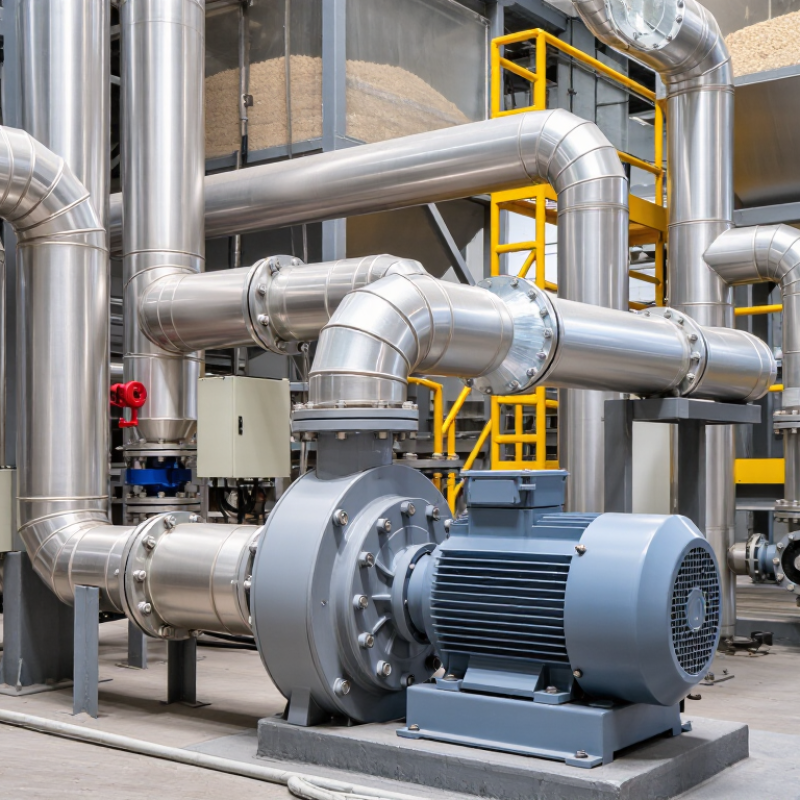
| What it is | A machine that supplies a flow of air or another conveying gas to move bulk materials through a pipeline. | Depending on the system, the blower may provide positive pressure to push material or vacuum to draw it. |
| Primary purpose | To provide the airflow and pressure difference needed to transport dry, bulk solids between process points. | It can move material from a pickup point to a storage bin, mixer, packaging line, or processing machine. |
| Common materials conveyed | Dry powders, granules, pellets, and other suitable free-flowing bulk solids. | Examples include flour, cement, plastic pellets, grain, and powdered minerals. Material properties affect system design. |
| Dilute-phase conveying | Air carries particles at relatively high velocity, with the solids dispersed through the conveying line. | Often used for powders and granules that can be conveyed in suspension. Air velocity must be sufficient to keep material moving. |
| Dense-phase conveying | Moves material at a higher solids concentration and generally lower velocity than dilute-phase conveying. | System arrangements vary; dense-phase systems may require pressure vessels and higher conveying pressures than a blower alone typically supplies. |
| Positive-pressure systems | The blower supplies air upstream, pushing material through the pipeline toward its destination. | Useful for conveying from one feed point to one or more receiving points, subject to the system layout and material requirements. |
| Vacuum systems | A vacuum source creates suction that draws material and air toward a receiver. | Often selected for pickup from multiple points or where containing dust within the conveying equipment is important. |
| Airflow and pressure | The blower must deliver airflow and pressure appropriate to the material, pipeline, distance, and conveying method. | There is no single suitable operating point for every system; pressure losses increase with factors such as line length, bends, and material loading. |
| Blower selection | Selection depends on required airflow, pressure or vacuum, operating conditions, and the properties of the conveyed material. | Engineers also consider temperature, altitude, filtration, noise limits, duty cycle, and whether the gas must be oil-free. |
| Supporting equipment | A blower operates as part of a conveying system rather than as a material-handling device by itself. | Typical components include feed devices, pipelines, bends, filters, airlocks, receivers, and controls. |
| Key operating considerations | Correct airflow helps prevent line blockage, excessive particle wear, and unnecessary energy use. | Filters need suitable dust collection and maintenance; combustible dust may require a properly engineered safety system. |



 © Copyright 2020 Tianjin Tanghaidongyang Valve Co., Ltd. All Rights Reserved.