| External Walls | Rigid insulation boards or semi-rigid slabs | Reduce heat transfer and improve fire and acoustic performance | Typical thermal conductivity: approximately 0.034–0.045 W/m·K; non-combustible mineral fibers; water-repellent products are available | Cavity walls, rainscreen façades, external wall insulation systems, and framed wall assemblies |
| Interior Walls and Partitions | Flexible batts, slabs, or acoustic panels | Limit airborne sound transmission and provide thermal insulation | Fibrous structure absorbs sound; performance depends on thickness, density, framing, and the complete wall system | Stud partitions, ceilings, service walls, home theaters, offices, and recording spaces |
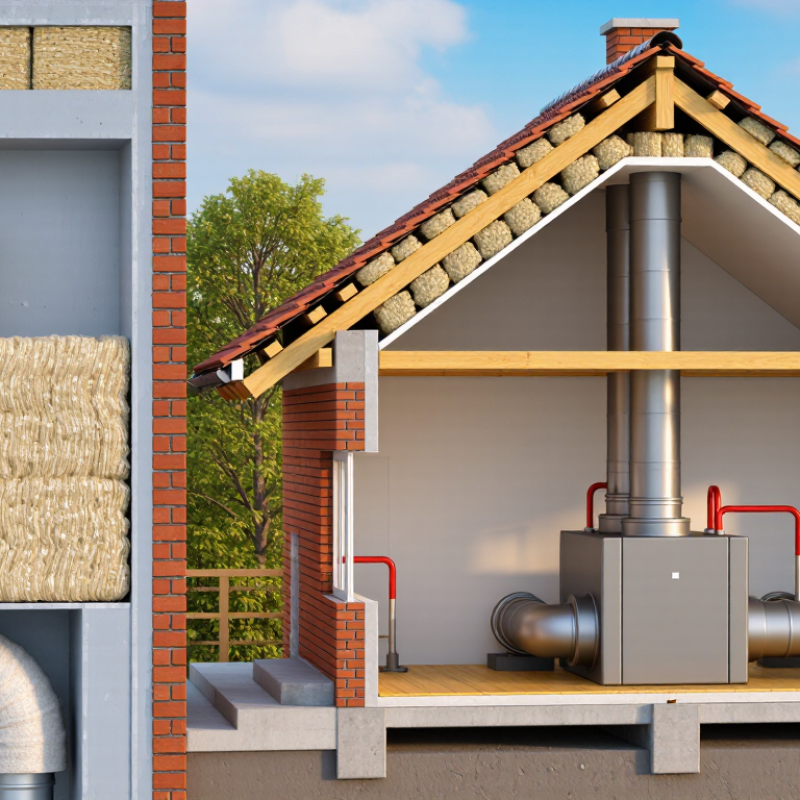
| Pitched Roofs and Attics | Batts, rolls, or rigid roof boards | Improve roof thermal resistance and reduce rain and external noise | Suitable thickness is selected according to climate, target U-value, ventilation, and available roof depth | Between rafters, over ceiling joists, and beneath or above roof decking where the system permits |
| Flat Roofs | High-density rigid roof boards | Provide continuous insulation beneath or within a waterproof roof assembly | Good dimensional stability and compressive strength; the board must be compatible with the membrane and roof loading | Warm roofs, protected membrane roofs, commercial buildings, and industrial roof decks |
| HVAC Ductwork | Rigid duct liner, external boards, or wrapped blankets | Control heat gain or loss and attenuate fan and airflow noise | Non-combustible insulation can support fire safety; the vapor-control layer and facing must suit the operating environment | Supply and return air ducts, plant rooms, air-handling units, and mechanical service corridors |
| Pipes and HVAC Equipment | Pipe sections, wired mats, blankets, or removable covers | Maintain fluid temperature and protect personnel from hot or cold surfaces | Product selection depends on service temperature, pipe diameter, moisture exposure, and required thickness | Chilled-water lines, heating pipes, boilers, tanks, valves, pumps, and air-handling equipment |
| Industrial Equipment | High-temperature boards, blankets, wired mats, or molded sections | Reduce heat loss, protect equipment surfaces, and support personnel safety | Useful temperature capability varies by product; high-temperature grades can withstand substantially higher temperatures than building-grade boards | Furnaces, ovens, process vessels, exhaust systems, storage tanks, and industrial ducting |
| Fire Protection Assemblies | Fire-resistant slabs, cavity barriers, firestop components, or pipe penetration systems | Delay the spread of fire, heat, and smoke through building elements | Rock wool is generally non-combustible, but the fire rating belongs to the tested and approved assembly, not the insulation alone | Service penetrations, façades, compartment walls, floors, ceilings, and structural steel protection systems |
| Key Material Properties | Fibers made primarily from natural rock or other mineral raw materials | Combine thermal insulation, sound absorption, and fire resistance in one material family | Density, thickness, facing, binder, moisture conditions, and installation quality strongly affect actual performance | Choose the product according to local building codes, tested system data, exposure conditions, and the manufacturer’s installation requirements |



 © Copyright 2020 Tianjin Tanghaidongyang Valve Co., Ltd. All Rights Reserved.