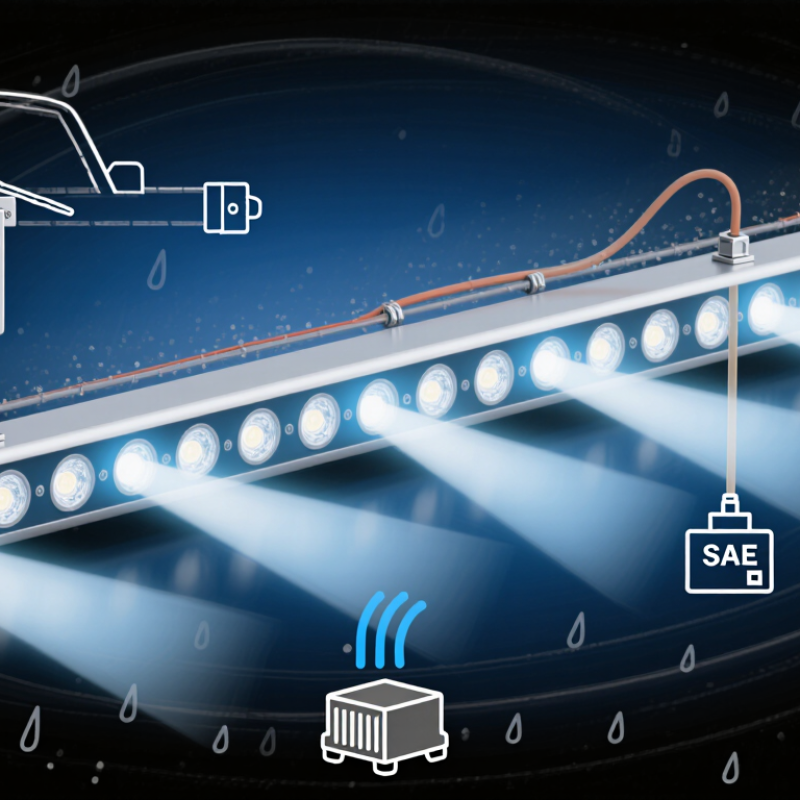
| Meaning of “SAE” | SAE refers to standards published by SAE International; it is not a particular LED technology or a guarantee that every lightbar meets the same performance level. | Applicable standards define test methods and performance requirements for specific types of vehicle warning lights. | Check the product documentation for the exact standard and classification claimed. |
| LED emitters | Semiconductor devices that emit light when electrical current passes through them. | LEDs generate light at their emitting surfaces. Their color depends on the LED and, in some designs, an optical filter or colored lens. | LEDs are arranged in modules so the lightbar can create multiple illuminated sections. |
| Optics: lenses and reflectors | Clear or colored lenses, reflectors, and other optical surfaces positioned around the LED modules. | These surfaces refract, reflect, or diffuse light to control its direction and spread, rather than simply allowing it to travel straight out of the LED. | Optical design affects the lightbar’s viewing angles and how its output appears from different positions. |
| Module placement and coverage | LED modules are distributed along the lightbar and may be aimed in different directions. | Forward-, side-, and rear-facing optics can direct light toward different parts of the surrounding area. | The actual coverage pattern depends on the module layout and optical design of the particular lightbar. |
| Flash patterns and control | An electronic controller switches LED modules on and off in selected sequences. | Timed activation creates warning patterns, including alternating or grouped flashes. The sequence changes when the controller selects a different pattern. | Patterns and available functions vary by model and installation. |
| Electrical supply and driver | The vehicle’s electrical system supplies power; driver circuitry regulates current to the LED modules. | The driver helps operate the LEDs within their electrical limits while the controller manages the selected flash sequence. | Power requirements and wiring should follow the lightbar’s installation instructions. |
| Heat management | LEDs and their driver electronics produce heat during operation. | The housing and heat-spreading components help conduct heat away from the electronics. | Adequate thermal design supports reliable operation; heat handling varies between designs. |
| SAE J595 and SAE J845 | SAE J595 addresses directional flashing optical warning devices; SAE J845 addresses optical warning devices. | These standards include performance and test provisions for the device types they cover; they do not describe one universal lightbar design. | A standard number alone does not establish the classification or compliance of every model; consult its test or certification documentation. |
| Overall light output | The visible warning signal results from the combined output of the LEDs, optics, module arrangement, and flash control. | The lightbar shapes the emitted light into intended directions and timed patterns; measured performance depends on the complete assembly. | LED count alone does not determine viewing coverage or standards compliance. |


 © Copyright 2020 Tianjin Tanghaidongyang Valve Co., Ltd. All Rights Reserved.