| 1. Confirm the grade | Verify that the material is specified and certified as Type 304L, rather than relying on a general “304” description. | ASTM A240/A240M covers chromium and chromium-nickel stainless-steel plate, sheet, and strip for pressure-vessel and general applications. | State the grade and applicable product standard in the purchase specification, and review the material test certificate. |
| 2. Check the low-carbon limit | Confirm the certified carbon content against the 304L specification. | Type 304L has a maximum carbon content of 0.030% by mass. Type 304 has a higher maximum of 0.080% under ASTM A240/A240M. | The lower carbon limit can reduce sensitization risk during welding or elevated-temperature exposure; it does not make the material immune to corrosion. |
| 3. Review the main alloy ranges | Compare the certified heat analysis with the grade’s specified chemistry. | For Type 304L under ASTM A240/A240M, chromium is 18.0–20.0% and nickel is 8.0–12.0% by mass. | Use the test certificate to verify the chemistry of the supplied heat; nominal grade ranges are not a substitute for product certification. |
| 4. Match thickness and tolerances to the design | Specify the required thickness, sheet size, and dimensional tolerances. | Thickness and dimensional tolerances depend on the applicable product requirements and order specification. | Allow for forming, machining, and fabrication needs, and confirm the ordered thickness and tolerances against the governing standard. |
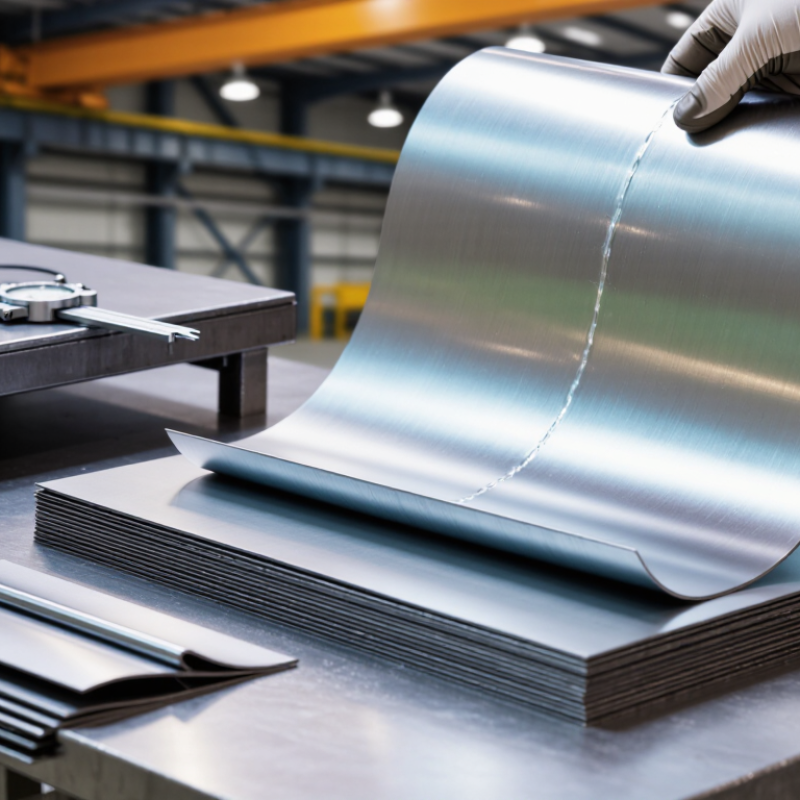
| 5. Choose the surface finish for its use | Identify the required finish and appearance, such as 2B or No. 4. | Common stainless-steel sheet finishes include 2B, a smooth, reflective cold-rolled finish, and No. 4, a mechanically polished finish with directional lines. | Specify the finish by its recognized designation and agree on any appearance or protective-film requirements before ordering. |
| 6. Consider the service environment | Assess exposure to chlorides, chemicals, moisture, temperature, and cleaning conditions. | 304L is a general-purpose austenitic stainless steel. Its low carbon content does not provide the added molybdenum found in 316L. | For chloride-rich or otherwise aggressive environments, evaluate whether a more corrosion-resistant grade is needed; confirm suitability for the actual service conditions. |
| 7. Verify mechanical requirements and documentation | Check the required mechanical properties, delivery condition, traceability, and inspection documents. | ASTM A240/A240M lists minimum tensile strength of 485 MPa (70 ksi), minimum yield strength of 170 MPa (25 ksi), and minimum elongation of 40% for annealed Type 304L sheet. | Confirm the applicable standard edition, product thickness requirements, and certified test results; do not assume every finished sheet has identical properties. |



 © Copyright 2020 Tianjin Tanghaidongyang Valve Co., Ltd. All Rights Reserved.