| 1. Match the feeder capacity to your session | Maximum ball capacity and whether balls feed consistently | Balls loaded per batch; successful feeds; interruptions during a timed test | Test with the number of balls your drills require. A larger hopper reduces reloading, but only if the feeder handles your ball sizes reliably. |
| 2. Check compatibility with your footballs | Supported ball sizes, surface condition, and inflation range | Ball size; manufacturer’s stated pressure range; feed consistency across the balls you use | For reference, a size 5 ball under the IFAB Laws of the Game has a circumference of 68–70 cm and a mass of 410–450 g at the start of a match. Confirm that the machine supports your ball type. |
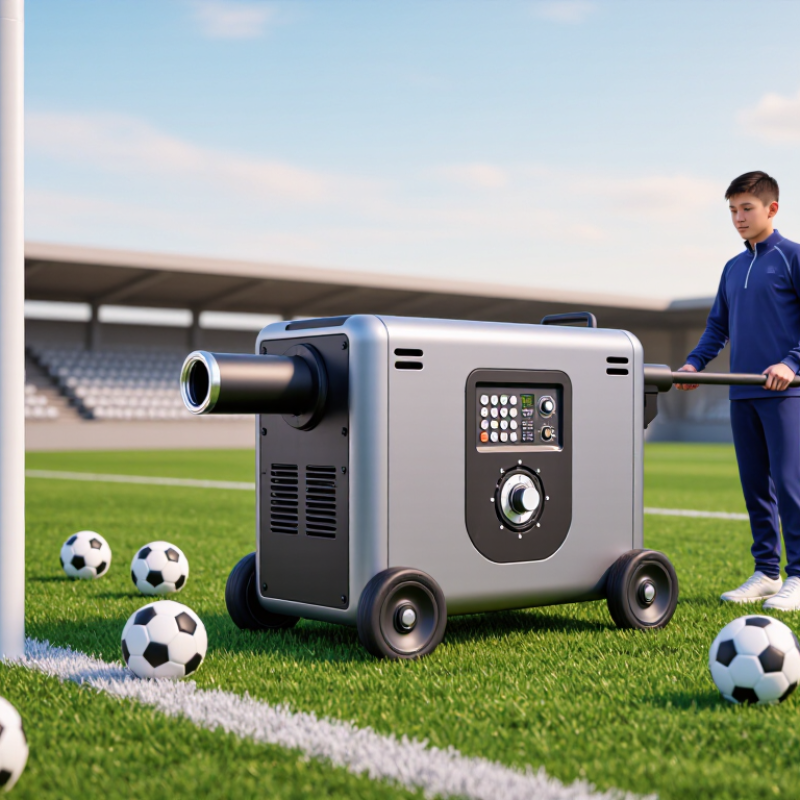
| 3. Compare portability, not just weight | Machine weight, folded dimensions, handle, wheels, and setup time | Weight in kg; packed length × width × height; number of people needed to move it | Check that it fits your vehicle and can be moved over the surfaces at your training site. A wheeled unit may be easier to transport across a field than a lighter unit without wheels. |
| 4. Verify power requirements and runtime | Mains or battery operation, rated input, battery capacity, and charging time | Input voltage and power in W; battery capacity in Wh; measured runtime at your intended settings | For battery-powered equipment, watt-hours describe stored energy, not guaranteed operating time. Ask for runtime under load and confirm whether a spare battery or extension cable is practical. |
| 5. Test launch speed, range, and repeatability | Adjustable output, target distance, trajectory, and shot-to-shot consistency | Speed in km/h or m/s if provided; landing distance; spread of landing points over repeated launches | Compare machines using the same balls, settings, and measured field conditions. Check whether the available speed and trajectory settings suit your drills rather than relying on a maximum-speed claim alone. |
| 6. Assess controls and safety features | Remote control, emergency stop, guarding, warning indicators, and setup instructions | Control range stated by the manufacturer; safety features present; time needed to stop and reset | Review the operating manual and demonstrate the stop procedure before use. Keep people clear of the launch path and follow the manufacturer’s safety distances. |
| 7. Include durability, maintenance, and support | Weather limitations, cleaning access, replaceable parts, warranty, and service availability | Warranty duration and coverage; maintenance intervals; parts availability; stated operating conditions | Ask which components need routine inspection and whether the machine must be stored indoors. Compare the total cost of ownership, not only the purchase price. |



 © Copyright 2020 Tianjin Tanghaidongyang Valve Co., Ltd. All Rights Reserved.