| 1. Match the battery voltage | Confirm the trolling motor’s required system voltage and the battery configuration specified in its manual. | Common systems are 12 V, 24 V, and 36 V. A higher-voltage system may require multiple batteries connected in series. | The battery setup must match the motor’s voltage requirements for safe, correct operation. |
| 2. Size capacity for expected runtime | Check capacity in amp-hours (Ah) and estimate how long the motor will run at your usual speed. | A simple estimate is: required Ah = average current draw (A) × operating time (hours). Actual draw varies with speed, load, conditions, and motor model. | A suitable capacity helps prevent an unexpectedly depleted battery. Use the motor manual and battery specifications when estimating runtime. |
| 3. Compare battery weight | Check the battery’s listed weight and the boat’s available payload and balance. | As a broad guide, many 12 V deep-cycle AGM batteries weigh roughly 50–75 lb, while comparable-capacity LiFePO₄ batteries are often lighter. Exact weights vary by capacity and design. | Battery weight affects handling and can influence how weight is distributed in the boat. |
| 4. Measure the battery space | Measure the compartment’s length, width, and height, including clearance for cables and terminals. | Common 12 V case sizes include Group 24 (about 10.25 × 6.81 in), Group 27 (about 12.06 × 6.81 in), and Group 31 (about 13.00 × 6.81 in). Check the specific battery’s full dimensions. | Group size is a useful reference, but dimensions and terminal arrangements can vary. A battery must fit without being forced into place. |
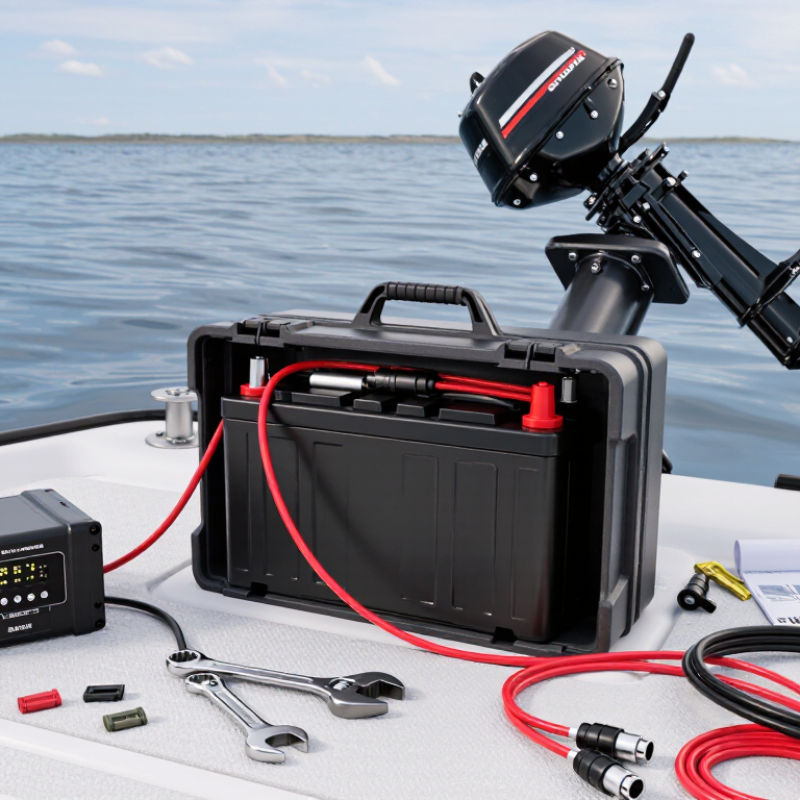
| 5. Check installation and secure mounting | Confirm the battery can be held firmly in an upright, protected position, with access to its terminals. | Allow room for the battery box, hold-downs, cable bends, and any clearance required by the battery instructions. Protect connections from water and corrosion. | A properly secured battery is less likely to shift during normal boat movement, and accessible terminals make inspection and maintenance easier. |
| 6. Choose a suitable battery type | Compare deep-cycle flooded lead-acid, AGM, and LiFePO₄ options against your use and installation conditions. | Flooded batteries require the maintenance and ventilation specified by their manufacturer. AGM batteries are sealed and maintenance-free. LiFePO₄ batteries are lighter but require compatible charging equipment and a suitable battery management system. | Battery chemistry affects weight, maintenance, charging requirements, and how much capacity may be usable. Follow the battery maker’s instructions. |
| 7. Verify terminals, cables, and charging compatibility | Check terminal type, cable size and length, fuse or circuit protection requirements, and charger compatibility. | Use the cable and protection specifications in the motor and battery manuals. For LiFePO₄, confirm the charger has a compatible charging profile. | Correct connections and charging equipment help the system operate as intended and reduce the risk of overheating or battery damage. |



 © Copyright 2020 Tianjin Tanghaidongyang Valve Co., Ltd. All Rights Reserved.