| 1 | Part envelope | Length, width, height, wall thickness, undercuts, inserts, and ejection direction. | Record the maximum molded-part envelope and the required mold-opening direction. Thin walls and long flow paths generally increase filling difficulty. | Confirm mold daylight, tie-bar spacing, platen dimensions, mold thickness range, and ejector stroke before comparing machine models. | Critical |
| 2 | Projected area | Projected area of all cavities plus runners, measured on the parting plane. | Clamp-force estimates are commonly based on projected area multiplied by a material- and geometry-dependent cavity-pressure factor. | Use the actual projected area from the mold design or CAD data; do not size the machine from part weight alone. | Critical |
| 3 | Clamp-force margin | Calculated clamp force and selected nominal machine capacity. | Recommended selection: calculated requirement × 1.01 to 1.05. The 1–5% margin is a sizing buffer, not a substitute for mold-flow validation. | Choose the next available clamp-force class above the calculated value while avoiding excessive force that may increase mold stress and flash risk. | Critical |
| 4 | Resin selection | Resin type, grade, melt-flow rate, glass or mineral content, shrinkage, drying requirements, and processing temperature. | Engineering and fiber-filled materials can require higher processing temperatures, greater wear resistance, or different venting and drying practices than general-purpose resins. | Match barrel temperature range, screw design, check ring, corrosion or abrasion resistance, and dryer capacity to the resin datasheet. | High |
| 5 | Shot size | Total shot weight: parts plus runners, including expected process variation. | A practical target is to keep the normal shot within approximately 20–80% of the machine's rated shot capacity; confirm the supplier's stated basis and resin density. | Select injection capacity that supports the required shot without routinely operating at the extreme ends of the barrel capacity. | High |
| 6 | Injection performance | Required fill time, injection speed, peak injection pressure, and pressure-holding profile. | Thin-wall, long-flow, or high-viscosity applications may need higher injection speed and pressure than short, thick-wall parts. | Compare available injection rate and pressure at the intended screw position, not only the machine's headline maximum. | High |
| 7 | Cycle time | Cooling time, mold-open time, ejection time, injection time, and expected cycles per hour. | Cooling is often the largest portion of the cycle for thermoplastic parts; actual time depends on wall thickness, resin, mold temperature, and cooling-channel design. | Evaluate platen motion, acceleration, dry-cycle time, controller repeatability, and the machine's ability to sustain the target cycle. | Medium |
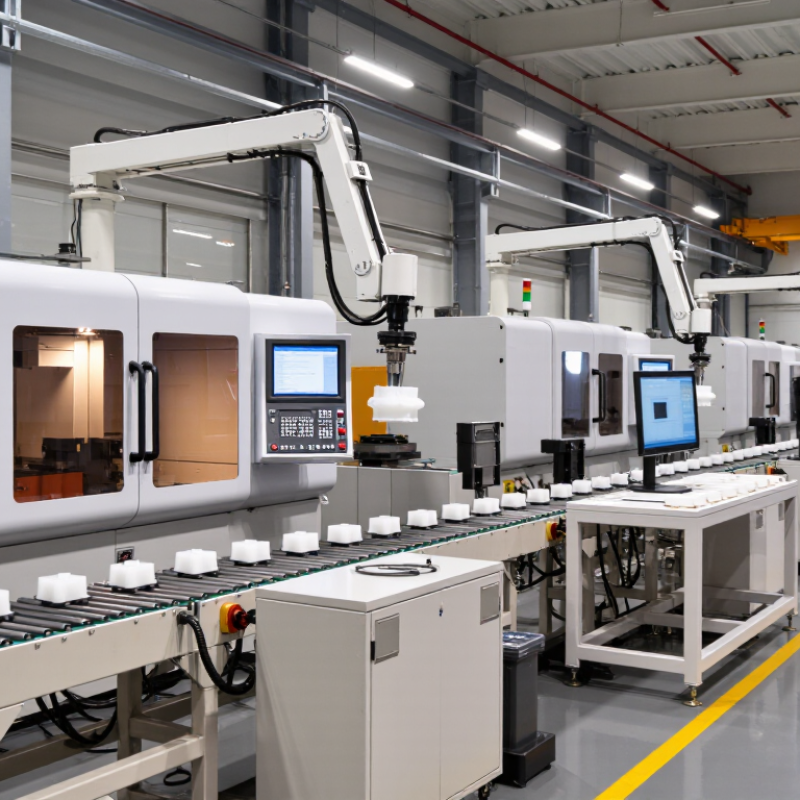
| 8 | Automation interface | Robot signals, mold-protection logic, part-present confirmation, conveyor interface, safety circuits, and recipe exchange. | Automated cells require coordinated handshakes for mold open, robot entry, part removal, mold close, and fault recovery. | Request the input/output list, communication protocol, safety-category documentation, and recovery sequence before installation. | High |
| 9 | Quality monitoring | Cushion, transfer position, injection pressure, filling time, mold-protection force, and alarm limits. | Stable process variables support repeatability, but acceptance limits should be established from validated production data rather than generic values. | Choose a controller that records trends, protects recipes, provides user access levels, and exports production data for traceability. | Medium |
| 10 | Utilities and total cost | Electrical load, cooling-water flow, compressed-air demand, floor space, maintenance access, and expected utilization. | Installed utility capacity must cover the machine, mold-temperature control, dryer, robot, and auxiliary equipment operating together. | Compare energy consumption per cycle or per kilogram, preventive-maintenance requirements, spare-parts availability, training, and commissioning support. | Medium |



 © Copyright 2020 Tianjin Tanghaidongyang Valve Co., Ltd. All Rights Reserved.