What Are the Top 10 Types of Compound Wall Lights?
Compound Wall Lights do more than brighten a boundary or entrance. They help people see steps, gates, and paths after sunset, while giving an exterior a more considered appearance. The right fixture depends on its location, the wall material, the desired light direction, and exposure to rain or dust. A compact light beside a narrow gate may be more useful than a dramatic fitting that creates glare.
This guide explores ten common types, including lantern-style sconces, up-and-down lights, cylinder fixtures, bulkhead lights, motion-sensor models, and integrated LED designs. It also considers farmhouse, contemporary, coastal, and smart options. Each type has practical trade-offs. For example, an up-and-down fitting can emphasize a textured wall, while a shielded lantern may provide softer light near an entry. Small details matter. Check the fixture’s weather rating, installation requirements, light output, and maintenance needs before choosing. Specifications vary by product, so verify them with the manufacturer rather than relying on appearance alone.
A polished image can be misleading. A fixture that looks bright online may feel harsh beside a real doorway, especially on a pale wall. Consider where shadows fall, whether neighbors or passersby could face glare, and how the light will look from inside the home. The best choice is not always the most decorative one. Use this overview to compare styles and find a suitable balance of visibility, durability, and design.
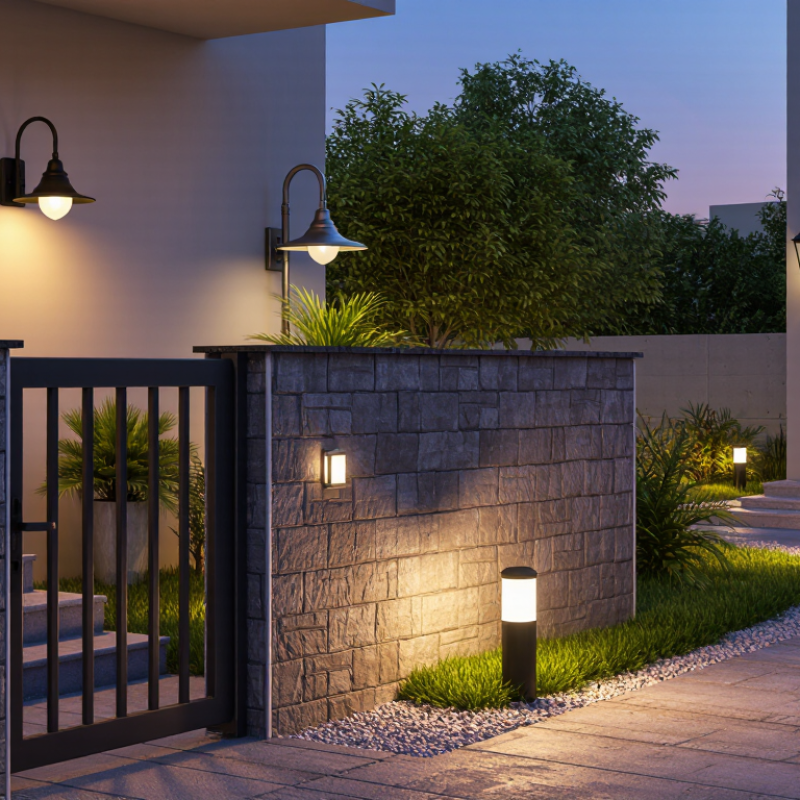
What Compound Wall Lights Are and How They Work
Compound wall lights are outdoor fixtures mounted on boundary walls around homes, gardens, or commercial properties. They illuminate entrances, paths, and wall edges, helping people see steps and changes in level after dark. Their role is both practical and visual. A warm beam can soften rough brick, while a downward-facing design can reduce glare near windows.
Most models use LEDs, which produce light when electrical current passes through them. A driver regulates that current and helps the lamp operate steadily. Wired fixtures connect to a household lighting circuit and may be controlled by a switch, timer, or daylight sensor. Solar models collect sunlight with a small panel, store energy in a battery, and use it after dusk. Some include motion sensors. Not magic—battery performance can fall during cloudy spells.
The term “compound wall light” can cover many shapes and control options, so check how each fixture works before choosing one. Look at its outdoor protection rating, beam direction, and mounting requirements. A light that appears bright in a shop may cast a harsh patch on pale stone. Test the placement at night if possible; even careful planning can miss how shadows land.
Key Features Used to Classify Compound Wall Lights
Key Features Used to Classify Compound Wall Lights
Compound wall lights are best classified by how they perform outdoors, not by shape alone. Common types include up-and-down, downward-shielded, lantern-style, recessed, and solar-powered fixtures. Compare light source, beam direction, brightness, power supply, housing material, and ingress protection. An IP rating indicates resistance to dust and water; IEC 60529 defines the rating system. Check the product’s stated rating rather than assuming every outdoor fixture handles heavy rain. Glare matters.
Energy use is another useful distinction. The International Energy Agency’s Energy Efficiency 2023 report identifies lighting as a significant electricity end use worldwide; its estimates put lighting at roughly 15% of global electricity consumption. That figure covers lighting broadly, not wall lights specifically. Still, it explains why efficient LEDs and sensible controls matter. A motion sensor can reduce operating hours, while warm-colored light and shielded optics can keep a narrow path visible without shining into bedroom windows. In practice, placement often matters as much as wattage.
Tips: Match the fixture to the wall material and exposure. Check drainage, cable entry, and mounting height before installation. For a short boundary wall, test one fixture at night first; the spread may look very different from the product image. I would not choose by brightness alone.
Ten Common Types of Compound Wall Lights: Designs 1–5
What Are the Top 10 Types of Compound Wall Lights?
Ten Common Types of Compound Wall Lights: Designs 1–5
A traditional lantern-style fixture adds a familiar look to a compound entrance. Choose a sheltered position where its glass panels are easy to clean. Up-and-down lights cast beams above and below the fitting, creating a defined pattern on a plain wall. Their effect depends on surface texture; rough plaster makes the light less even. Bulkhead lights have compact, sturdy housings and suit side passages or service areas. They are practical, though some designs look plain.
Recessed wall lights sit nearly flush with the surface, helping keep narrow walkways clear. They need planning before construction, since cutting into a finished wall can be difficult. Solar wall lights avoid wiring to a power supply, but performance can vary with shade, season, and battery condition. Check that the panel receives enough direct sun. A cloudy week may reveal a limitation you had not considered.
Tips: Match the light’s weather rating to its exposure, and check the manufacturer’s installation guidance. Aim beams away from windows and eye level. Test at dusk. A quick evening check can show whether the spacing leaves dark patches or creates unwanted glare.
Ten Common Types of Compound Wall Lights: Designs 6–10
For designs six to ten, consider how each light handles real compound-wall conditions: rain, dust, and long stretches without nearby power.
Up-and-down lights cast beams above and below the fitting, creating a clear rhythm along a plain wall.
Lantern-style fixtures add a softer, traditional look near gates or entrances, though their glass may need regular cleaning.
Bulkhead lights are compact and sturdy, making them practical beside narrow paths. Their appearance can feel utilitarian. That is not always a drawback.
Tips: Check the fixture’s outdoor rating and measure spacing before installation. Aim beams away from drivers’ eyes and neighboring windows. For wiring or mounting questions, consult a qualified electrician.
Recessed wall lights sit nearly flush with masonry and can guide footsteps along steps or walkways. They look tidy, but placement matters: too low or too widely spaced, and the path may still have dark patches.
Motion-sensor wall lights illuminate only when movement is detected, which can be useful at a side gate. Test the sensor’s range after fitting; passing branches or pets may trigger it unexpectedly.
These five designs serve different needs, so match brightness and beam direction to the wall, not just the fixture’s appearance.
How to Compare Types by Light Output, Materials, and Setting
Choosing among the top 10 types of compound wall lights means comparing beam shape, output, materials, and location. Up-and-down lights cast paired beams, while lanterns and classic sconces give a broader decorative glow. Bulkhead lights are practical for exposed walls. Barn and gooseneck styles direct light down toward gates or paths. Recessed fixtures sit flush with masonry, but need suitable wall construction. Motion-sensor lights respond to movement; solar lights depend on daylight. Integrated LED fixtures can be compact and efficient. Each type solves a different problem.
Check the lumen rating and beam angle, not just the wattage. A narrow beam can highlight a gate, yet leave nearby steps dim. Broad light suits entrances and shared paths better. Warm color temperatures often feel less harsh outdoors. Materials matter, too. Powder-coated aluminum is relatively light, while stainless steel and copper offer different finishes and maintenance needs. Glass can soften the beam; sealed polycarbonate is often a practical choice where knocks are likely. Check the finish.
Setting changes the comparison. Near the coast, salt and moisture can wear down unsuitable finishes, so look for clear corrosion-resistance guidance. On a narrow boundary wall, bulky lanterns may feel crowded. A low-profile bulkhead may fit better. For a dark path, use evenly spaced fixtures rather than one bright point. There is no universal lumen target; wall color, mounting height, and nearby windows all affect perceived brightness. I’d still test the beam at night before settling on spacing. Lights can look different once installed.
What Are the Top 10 Types of Compound Wall Lights?
Compare typical light output, common materials, and suitable settings. Lumen figures are indicative ranges; actual output varies by model and light source.
| Wall light type | Typical output | Common materials | Typical setting |
| Traditional lantern | 400–800 lm | Aluminum or steel, glass | Porches and entryways |
| Up-and-down light | 500–1,200 lm | Aluminum or stainless steel | Exterior walls and walkways |
| Bulkhead light | 600–1,500 lm | Polycarbonate or metal | Garages and utility areas |
| Decorative sconce | 300–800 lm | Metal, glass, or ceramic | Patios and entryways |
| Motion-sensor security light | 700–2,000 lm | Aluminum or impact-resistant plastic | Driveways and side entrances |
| Wall-mounted floodlight | 1,000–3,000 lm | Aluminum, tempered glass | Large yards and building perimeters |
| Solar wall light | 50–300 lm | Plastic or aluminum | Fences, sheds, and sunny paths |
| Integrated LED wall light | 500–1,500 lm | Aluminum, steel, or polycarbonate | General-purpose exterior lighting |
| Recessed step or wall light | 50–200 lm | Stainless steel or aluminum | Stairs and low-level pathways |
| Picture or accent light | 100–400 lm | Brass, steel, or aluminum | Artwork and architectural details |
Use higher-output fixtures for broad illumination and lower-output fixtures for accents or wayfinding. For exposed locations, check the fixture’s weather-resistance rating and choose materials suited to the environment.



 © Copyright 2020 Tianjin Tanghaidongyang Valve Co., Ltd. All Rights Reserved.