| Programmable Logic Controllers | Executes deterministic control logic for machines, production cells, and process equipment. | Millisecond-level scan cycles are common in machine-control applications; modular systems can support digital, analog, motion, and safety I/O. | IEC 61131-3 programming languages; industrial Ethernet and fieldbus interfaces. | Sequential control, interlocking, conveyor systems, packaging, assembly, and process control. | Check programming-language support, spare-part availability, environmental ratings, cybersecurity features, and local engineering capability. |
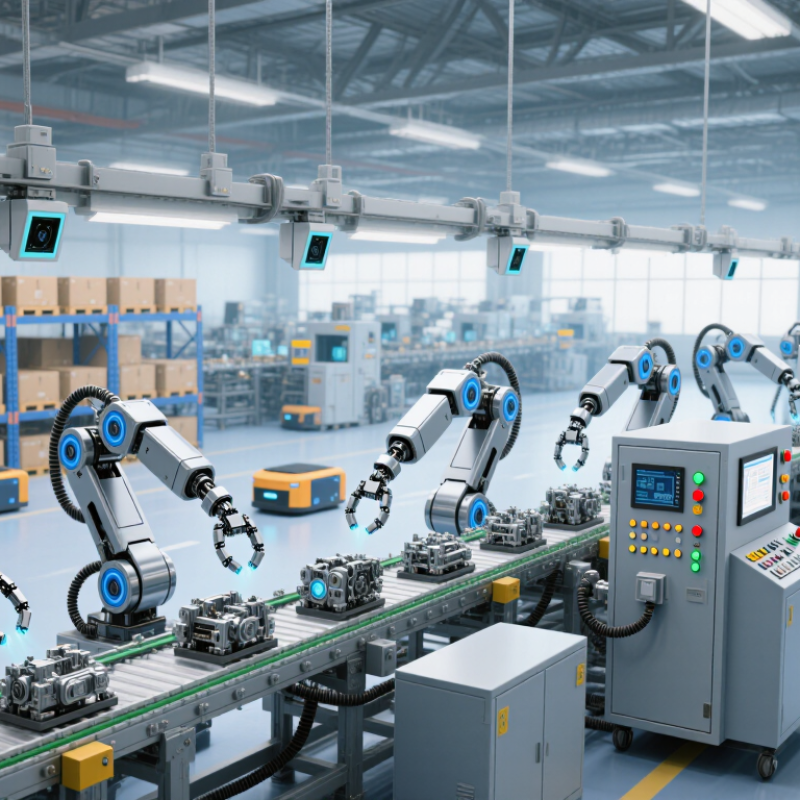
| Industrial Robots and Cobots | Performs repetitive, precise, or ergonomically difficult physical operations. | Industrial robots commonly provide 4 to 6 axes; collaborative systems typically support payloads from a few kilograms to several tens of kilograms, depending on the model. | ISO 10218 for industrial robot safety; ISO/TS 15066 provides guidance for collaborative robot applications. | Pick-and-place, welding, palletizing, machine tending, inspection, dispensing, and assembly. | Evaluate payload, reach, repeatability, safety-zone requirements, tooling compatibility, cycle time, and regional compliance documentation. |
| Servo Drives and Motion Control | Controls position, speed, torque, and synchronized movement of motors and mechanical axes. | Closed-loop systems use encoder feedback; positioning repeatability may reach approximately ±0.01 to ±0.1 mm in suitable mechanical systems, depending on load and calibration. | IEC 61800 for adjustable-speed electrical power-drive systems; real-time industrial Ethernet is widely used for synchronization. | CNC equipment, robotics, electronic assembly, converting, packaging, and high-speed indexing. | Compare motor-drive matching, regenerative braking, overload capacity, encoder interfaces, tuning tools, and power-grid compatibility. |
| Machine Vision | Captures and analyzes images for inspection, measurement, identification, and robot guidance. | System performance depends on camera resolution, optics, lighting, and processing; common industrial cameras range from 1 to more than 20 megapixels. | GigE Vision, USB3 Vision, CoaXPress, and industry-specific image-processing interfaces. | Defect detection, dimensional measurement, barcode reading, orientation, presence checks, and quality classification. | Assess lighting stability, lens availability, image-processing capacity, environmental protection, data-storage requirements, and false-rejection rates. |
| Industrial Sensors and IIoT Devices | Measures machine conditions and process variables for control, monitoring, and predictive maintenance. | Typical measurements include temperature, pressure, flow, vibration, proximity, position, and energy consumption; many devices offer IP65 or higher enclosure protection for industrial environments. | IO-Link, 4–20 mA, HART, industrial Ethernet, and wireless industrial protocols. | Condition monitoring, level detection, process feedback, energy management, and asset tracking. | Review measurement range, accuracy, response time, ingress protection, calibration requirements, wireless spectrum rules, and replacement compatibility. |
| Industrial Networking and Edge Connectivity | Connects controllers, drives, robots, sensors, supervisory systems, and enterprise platforms. | Industrial Ethernet commonly provides 100 Mbps or 1 Gbps links; time-sensitive applications require deterministic timing and suitable network design. | OPC UA for interoperable data exchange; MQTT is widely used for lightweight publish-subscribe messaging; IEC 62443 supports industrial cybersecurity practices. | Machine-to-machine communication, production monitoring, remote diagnostics, data collection, and system integration. | Check topology, redundancy, latency, protocol interoperability, certificate management, remote-access controls, and network segmentation. |
| Human-Machine Interfaces and SCADA | Provides operator visualization, alarms, recipe management, supervisory control, and production reporting. | Modern systems support role-based access, historical data, alarm logs, dashboards, and browser-based or thin-client access. | IEC 62443 cybersecurity principles; OPC UA and standard industrial database interfaces are commonly used for data integration. | Process visualization, alarm management, batch control, downtime analysis, and operator guidance. | Evaluate multilingual support, audit trails, user permissions, historian capacity, licensing structure, and compatibility with existing controllers. |
| Safety Control Systems | Reduces risk by monitoring emergency stops, guards, light curtains, enabling devices, and safe motion functions. | Safety performance is commonly specified using PL d or PL e under ISO 13849-1, or equivalent safety integrity levels under IEC 61508 and IEC 62061. | ISO 13849-1, IEC 62061, IEC 60204-1, and applicable regional machinery-safety requirements. | Emergency stopping, guard monitoring, safe torque off, safe speed, safe limited position, and access control. | Require documented risk assessment, validated safety circuits, diagnostic coverage, reset logic, inspection procedures, and local regulatory acceptance. |
| Automated Material Handling | Moves raw materials, work-in-process goods, pallets, and finished products through a facility. | Systems may use conveyors, automated storage and retrieval equipment, autonomous mobile robots, or guided vehicles; throughput is normally specified in units or pallets per hour. | Warehouse-control interfaces, industrial Ethernet, safety standards, and fleet-management APIs. | Warehousing, kitting, line feeding, pallet movement, sorting, and order fulfillment. | Analyze floor layout, traffic density, payload, battery strategy, charging infrastructure, scalability, integration with inventory software, and emergency procedures. |



 © Copyright 2020 Tianjin Tanghaidongyang Valve Co., Ltd. All Rights Reserved.