| Carbon Steel | Low-carbon structural steel, such as ASTM A36 or equivalent grades | Steel bars are cut to length, bearing bars are arranged at the specified spacing, and cross bars are welded or mechanically locked into the bearing bars. Panels are then trimmed and inspected. | Hot-dip galvanizing is widely used after fabrication. Black steel, painted, or powder-coated finishes may also be specified for controlled environments. | High strength, good weldability, broad availability, and generally lower initial material cost than stainless steel or aluminum. | Factory platforms, walkways, stair treads, equipment access areas, drainage covers, and industrial maintenance platforms. | ASTM A36 or equivalent structural steel specifications; NAAMM MBG 531 and local structural design codes may be used for grating selection and load evaluation. | Requires corrosion protection in humid, chemical, coastal, or outdoor environments. Load capacity depends on bearing-bar size, span, spacing, and support conditions. |
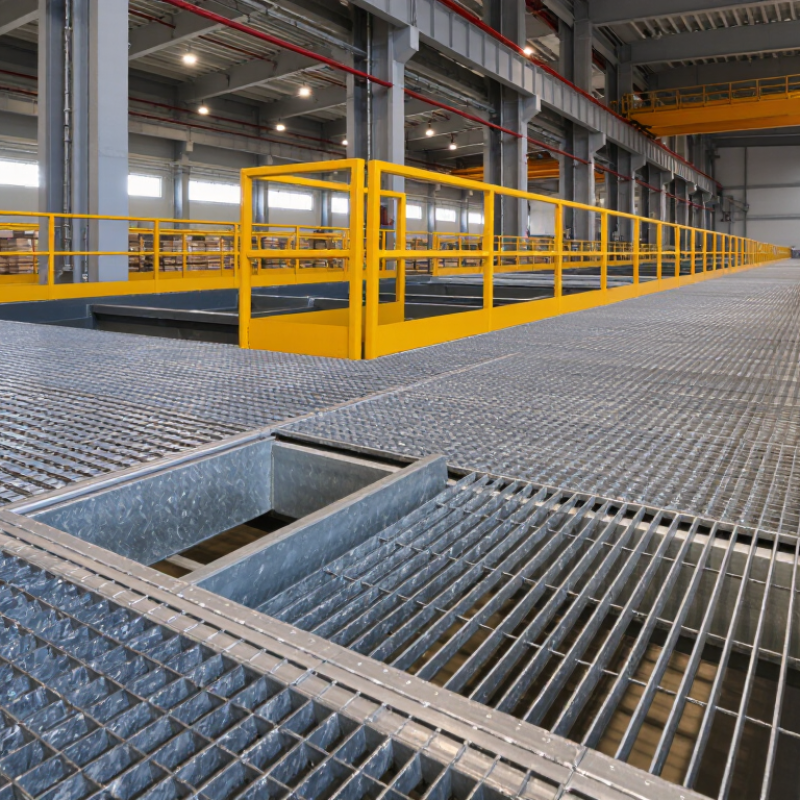
| Hot-Dip Galvanized Steel | Fabricated carbon-steel grating with a zinc coating | Grating is fabricated first, cleaned and chemically treated, then immersed in molten zinc. The zinc coating bonds metallurgically to the steel surface. | Hot-dip zinc coating; the coating thickness is controlled according to the applicable galvanizing specification and steel thickness. | Improved atmospheric corrosion resistance and good durability for outdoor and industrial service. Zinc also provides sacrificial protection to exposed steel. | Outdoor platforms, water-treatment facilities, plant walkways, utility structures, access covers, and areas exposed to rain or condensation. | ASTM A123/A123M is commonly referenced for zinc coatings on iron and steel products; ISO 1461 is also widely used internationally. | Welding, cutting, and drilling after galvanizing can expose bare steel and may require approved repair treatment. Drainage and venting are necessary for hollow or enclosed components during galvanizing. |
| Stainless Steel | AISI 304/304L or AISI 316/316L stainless steel | Bearing bars and cross bars are welded, press-locked, or fabricated using stainless-compatible tooling. The finished panels may be pickled and passivated. | Mill finish, pickled and passivated, mechanically polished, or electropolished, depending on hygiene and appearance requirements. | Excellent corrosion resistance, low maintenance, and good performance in wet or hygienic environments. Grade 316 generally offers better resistance to chlorides than grade 304. | Food-processing areas, chemical plants, marine facilities, pharmaceutical plants, wastewater plants, and cleanable service platforms. | ASTM A240/A240M for stainless plate and sheet chemistry references; ASTM A967/A967M may be used for chemical passivation treatments. | Material selection must consider chloride concentration, temperature, pH, chemical exposure, and crevice conditions. Stainless steel has a higher material cost than carbon steel. |
| Aluminum | 6061-T6 or comparable structural aluminum alloy | Aluminum bearing bars are assembled with cross bars by welding, swaging, or press-locking. Fabrication must account for aluminum’s lower melting temperature and thermal expansion. | Mill finish, anodized finish, or powder coating. Anodizing can improve surface durability and appearance. | Low density, good corrosion resistance in many atmospheric environments, and easier manual handling than steel. Its elastic modulus and strength are lower than those of steel. | Lightweight platforms, roof access walkways, transport equipment, architectural structures, and installations where lifting loads must be minimized. | ASTM B221/B221M is commonly used for extruded aluminum structural shapes; project-specific aluminum design standards should be applied for load calculations. | Deflection can govern design because aluminum is less stiff than steel. Avoid unsuitable contact with dissimilar metals unless galvanic corrosion is controlled. |
| Fiberglass-Reinforced Plastic | FRP grating using resin reinforced with glass fibers | Typically manufactured by pultrusion or molded compression processes. Pultruded panels use continuous load-bearing profiles, while molded panels use integrated resin-and-glass structures. | Resin-rich surface, grit broadcast surface, concave surface, or molded-in anti-slip texture. Resin systems may include polyester, vinyl ester, or phenolic formulations. | Electrical non-conductivity, corrosion resistance, low maintenance, and good slip resistance. Mechanical properties vary significantly with resin system and manufacturing method. | Chemical-processing areas, wastewater facilities, offshore access routes, electrical substations, and locations where spark or electrical conductivity is a concern. | ASTM F3059 and project-specific FRP design criteria may be referenced; manufacturer load tables must be used because properties are product-specific. | Check fire-smoke performance, UV resistance, resin chemical compatibility, temperature limits, and long-term deflection. Do not substitute FRP load data for steel load data. |
| Press-Locked Grating | Carbon steel, stainless steel, or aluminum press-locked construction | Cross bars are forced into pre-punched or pre-cut slots in the bearing bars and secured by pressure, mechanical deformation, or welding at selected intersections. | Common finishes include hot-dip galvanizing for carbon steel, passivation for stainless steel, and anodizing or powder coating for aluminum. | Clean appearance, smooth top surface, and suitability for applications requiring closely spaced cross bars or special visual patterns. | Architectural walkways, platforms, ventilation screens, drainage covers, and areas requiring a smooth or customized panel appearance. | Applicable material standards and project grating specifications; load ratings should be verified using the finished panel geometry. | Slot depth, cross-bar engagement, panel orientation, and weld or lock integrity affect performance. The bearing bars must run perpendicular to the primary support span. |
| Welded Grating | Usually carbon steel, galvanized steel, stainless steel, or aluminum | Cross bars are resistance-welded or otherwise welded to bearing bars at each intersection. Panels are then cut, edged, and fitted with accessories where required. | Hot-dip galvanizing, paint, powder coating, passivation, or untreated mill finish, according to the base material and service environment. | Strong and reliable intersection connections, good load transfer, and suitability for heavy-duty platforms and industrial access systems. | Heavy equipment platforms, plant floors, stair treads, trench covers, loading areas, and industrial walkways. | NAAMM MBG 531 and project structural requirements are commonly used to evaluate panel geometry, loads, and support conditions. | Specify bearing-bar depth and thickness, cross-bar spacing, clear span, concentrated loads, impact loads, and deflection limits rather than relying only on panel weight. |
| Serrated-Surface Grating | Steel, stainless steel, or aluminum grating with serrated bearing-bar tops | Teeth or serrations are formed on the top surface of bearing bars before or during panel fabrication. The bars are then assembled using welded or press-locked construction. | Galvanized, passivated, anodized, painted, or untreated according to the base material. | Improved traction compared with plain-top grating, particularly where water, oil, ice, or other contaminants may be present. | Outdoor stairs, ramps, process platforms, wet areas, drainage channels, and industrial walkways. | Slip-resistance requirements should be evaluated under the applicable local building, workplace safety, and project specifications. | Serration improves grip but does not eliminate the need for housekeeping, drainage, suitable footwear, or formal slip-resistance testing where required. |
| Heavy-Duty Structural Grating | Typically deeper and thicker carbon-steel, galvanized-steel, or stainless-steel bearing bars | Heavy bearing bars are cut and assembled with closely controlled cross-bar spacing. Welding, edge banding, lifting features, and support details are engineered for higher service loads. | Hot-dip galvanizing, industrial coating systems, or stainless-steel passivation depending on corrosion exposure. | Higher load capacity and improved resistance to concentrated wheel or equipment loads when properly designed and supported. | Forklift routes, vehicle access covers, heavy plant platforms, industrial floors, loading zones, and trench systems. | Load calculations should follow the project structural code, applicable grating standards, and verified manufacturer load tables. | Vehicle loads, impact, fatigue, support bearing length, panel deflection, edge reinforcement, and removable-panel lifting requirements must be considered. |
| Typical Design and Quality Checks | Applies to all structural grating material categories | Review drawings, verify material certificates, check bearing-bar orientation and spacing, inspect welds or mechanical locks, confirm dimensions, and examine coatings or surface treatments. | Coating thickness, adhesion, surface condition, passivation, paint coverage, and repair areas should be checked against the purchase specification. | Proper design and inspection help ensure load-carrying performance, dimensional fit, slip resistance, corrosion protection, and safe installation. | All platforms, walkways, stairs, covers, access structures, and maintenance areas using structural grating. | Project specifications may reference ASTM, ISO, EN, OSHA, local building codes, and recognized grating design manuals depending on the installation location. | Final selection should be based on clear span, support layout, design loads, service environment, allowable deflection, opening-size limits, accessibility, and maintenance requirements. |



 © Copyright 2020 Tianjin Tanghaidongyang Valve Co., Ltd. All Rights Reserved.