| Decorative style | Sculptural and organic forms | Curved silhouettes, textured surfaces, and indirect or diffused light make the fixture a visible design feature. | Living rooms, bedrooms, and feature walls | Check how far the fixture projects from the wall, especially in narrow passages. |
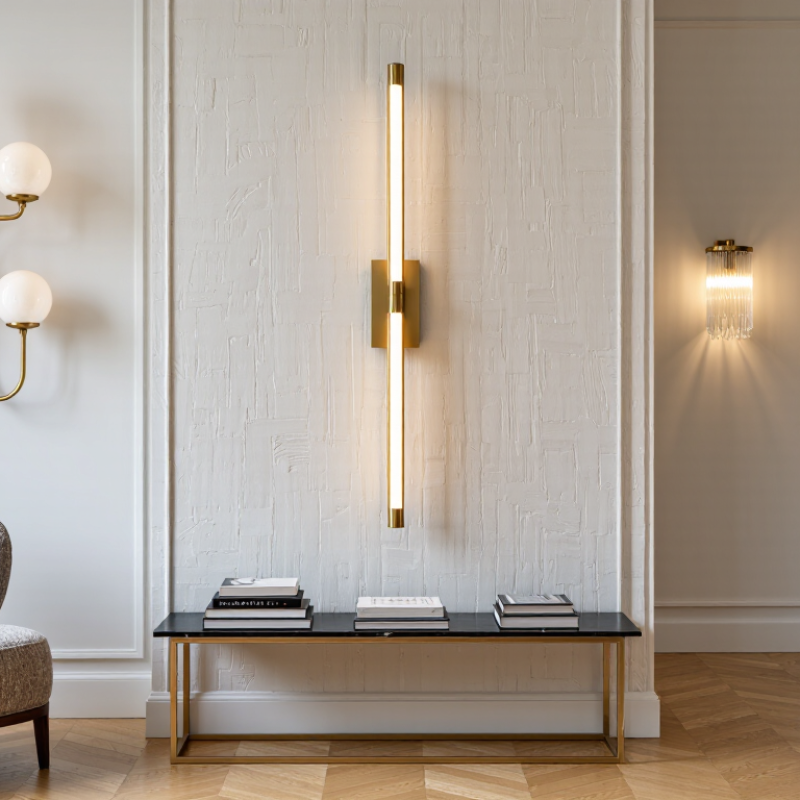
| Decorative style | Minimalist linear sconces | Simple vertical or horizontal forms often distribute light along a wall rather than focusing it on a small area. | Hallways, bathrooms, and contemporary interiors | Review the fixture’s light direction and mounting dimensions before choosing its position. |
| Decorative style | Glass and layered-light designs | Clear, frosted, or textured shades alter the appearance and spread of light; some designs combine ambient and accent lighting. | Entryways, bedside areas, and decorative focal points | Clear shades can make the lamp more visible, so consider glare and the bulb’s appearance. |
| Lighting technology | Integrated LED light sources | LEDs use a semiconductor light source and generally consume less electricity than incandescent lamps for comparable light output. | New installations and fixtures designed around a specific light shape | Check the rated lifetime, replaceability, warranty, and whether the light source is integrated or uses a replaceable lamp. |
| Lighting technology | Tunable white and dimming | Some fixtures allow users to adjust brightness and, when specified, shift the color temperature from warmer to cooler white. | Bedrooms, living spaces, and rooms used for different activities | Confirm that the fixture, dimmer, and control method are compatible; dimming capability is not universal. |
| Lighting technology | Smart controls | Depending on the model, controls may use an app, wireless network, voice assistant, or smart-home protocol for scheduling and adjustment. | Rooms where lighting scenes or remote control are useful | Verify the required hub, network, protocol support, and operation during an internet or power outage. |
| Lighting technology | Occupancy and daylight sensing | Available sensor-equipped models can switch or adjust light in response to detected movement or ambient brightness. | Utility areas, stairways, and spaces where automatic switching is helpful | Sensor coverage and placement affect performance; check whether the sensor can be adjusted or disabled. |
| Lighting technology | Improved color rendering | Color Rendering Index (CRI) indicates how faithfully a light source renders colors compared with a reference source; some LED fixtures are specified at CRI 90 or higher. | Bathrooms, dressing areas, and spaces with artwork or colorful finishes | Compare the published CRI rating and color temperature rather than relying on appearance alone. |



 © Copyright 2020 Tianjin Tanghaidongyang Valve Co., Ltd. All Rights Reserved.