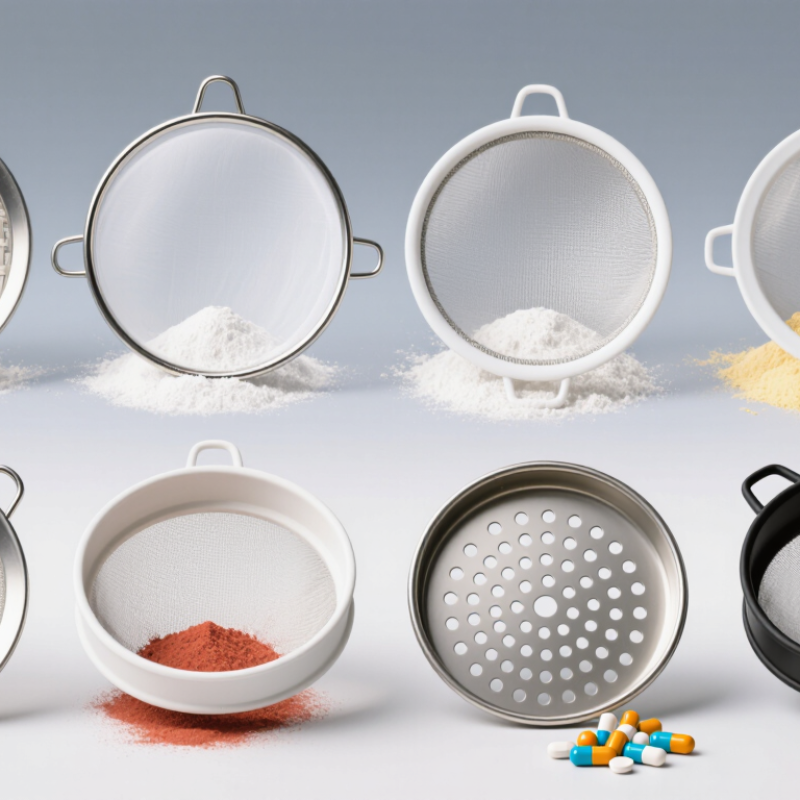
| 1 | Analytical Test Sieve | 20 µm–5 mm | Stainless steel or brass | Woven wire cloth mounted in a rigid circular frame | Designed for repeatable particle-size analysis; commonly available in standardized sieve diameters and aperture designations. | Pharmaceutical powders, food ingredients, minerals, chemicals and laboratory quality control | Check compliance with the required national or international sieve standard, frame diameter and certificate requirements. |
| 2 | Wet-Washing Test Sieve | 20 µm–4.75 mm | Stainless steel | Woven mesh with a deeper frame and drainage-compatible design | Permits water or other compatible liquid to disperse agglomerated particles and remove undersize material during sieving. | Soils, aggregates, pigments, ceramics and materials that cannot be separated effectively by dry sieving | Confirm resistance to the process liquid, frame depth, drain arrangement and whether a cover and receiver are included. |
| 3 | Air-Jet Sieve | 10 µm–4 mm | Stainless steel woven mesh | Fine sieve used with a controlled air stream and vacuum-assisted dispersion | Reduces blinding and helps separate very fine, dry powders without adding liquid. | Pharmaceutical excipients, toner, cement, mineral powders and other dry, dispersible materials | Best for dry powders; verify compatibility with the air-jet unit, vacuum system and electrostatic behavior of the sample. |
| 4 | Ultrasonic-Assisted Fine Sieve | 5 µm–150 µm | Stainless steel or nickel mesh | Fine mesh integrated with or coupled to an ultrasonic dispersion system | Uses high-frequency vibration to reduce mesh blockage and improve the recovery of fine particles. | Micronized powders, advanced ceramics, pharmaceutical ingredients and high-value laboratory samples | Confirm the operating frequency, maximum sample load, cleaning method and whether the mesh is replaceable. |
| 5 | Micro Test Sieve | 5 µm–100 µm | Electroformed nickel or precision stainless steel | Small-diameter sieve with tightly controlled micro-apertures | Provides high aperture uniformity for very small particle-size fractions and limited sample quantities. | Micropowders, inhalation products, catalysts, pigments and research-scale particle analysis | Because fine apertures are delicate, specify handling limits, inspection method, cleaning procedure and storage protection. |
| 6 | Nylon Monofilament Mesh Tamis | 20 µm–1 mm | Nylon monofilament | Flexible polymer mesh stretched over a frame or supplied as a mesh insert | Lightweight, corrosion-free and suitable where metal contamination or electrical conductivity is undesirable. | Food processing, biological samples, water testing, cosmetics and general laboratory filtration | Consider temperature, solvent compatibility, mesh tension, dimensional stability and possible static charge. |
| 7 | Polyester Monofilament Mesh Tamis | 20 µm–1 mm | Polyester monofilament | Precision synthetic mesh mounted on a frame, ring or filtration support | Good dimensional stability and resistance to many dilute acids and alkaline solutions at moderate temperatures. | Liquid filtration, food and beverage processing, ink preparation, laboratory work and particle classification | Check the exact chemical exposure, operating temperature, tensile strength and whether repeated cleaning is required. |
| 8 | Electroformed Nickel Micro-Mesh Tamis | 5 µm–150 µm | Electroformed nickel | Precisely formed, regularly shaped apertures produced by an electroforming process | Offers highly uniform openings and a smooth surface, which can improve reproducibility in micron-scale separation. | Precision powder classification, aerospace materials, electronics powders and scientific research | Verify nickel compatibility, aperture tolerance, mesh thickness, cleaning restrictions and the required inspection documentation. |
| 9 | Perforated Plate Fine Tamis | 100 µm–5 mm | Stainless steel or nickel-plated steel | Thin plate containing punched, drilled or chemically etched openings | Higher mechanical strength than very fine woven wire and better resistance to distortion under rough service. | Granules, abrasive materials, food particles, recycling streams and coarse-to-fine pre-classification | Compare open-area percentage, aperture shape, plate thickness, edge condition and resistance to wear. |
| 10 | Vibratory Sieve-Shaker Tamis | 20 µm–5 mm | Stainless steel woven wire | Standard test sieve designed for mechanical vibration or tapping equipment | Improves separation speed and repeatability compared with manual shaking, especially for multi-sieve stacks. | Aggregates, soil, pharmaceuticals, food powders, plastics and industrial process control | Match the sieve diameter, height, clamping system, vibration mode and sample capacity to the shaker specifications. |



 © Copyright 2020 Tianjin Tanghaidongyang Valve Co., Ltd. All Rights Reserved.