| Solid rubber wheel | Solid rubber tread or body; no air-filled chamber | Hand trucks, carts, and general-purpose equipment on relatively even surfaces | Load rating, wheel diameter, tread width, floor type, and whether the tread leaves marks |
| Pneumatic rubber wheel | Rubber tire containing an air-filled inner tube or designed for inflation | Outdoor carts and equipment used on uneven ground, where cushioning is useful | Tire size, inflation requirements, puncture risk, and rated load at the specified pressure |
| Semi-pneumatic rubber wheel | Rubber tire with a hollow or cellular construction, generally used without inflation | Garden equipment, utility carts, and some outdoor material-handling equipment | Confirm the wheel is non-inflatable, and check load rating, dimensions, and terrain suitability |
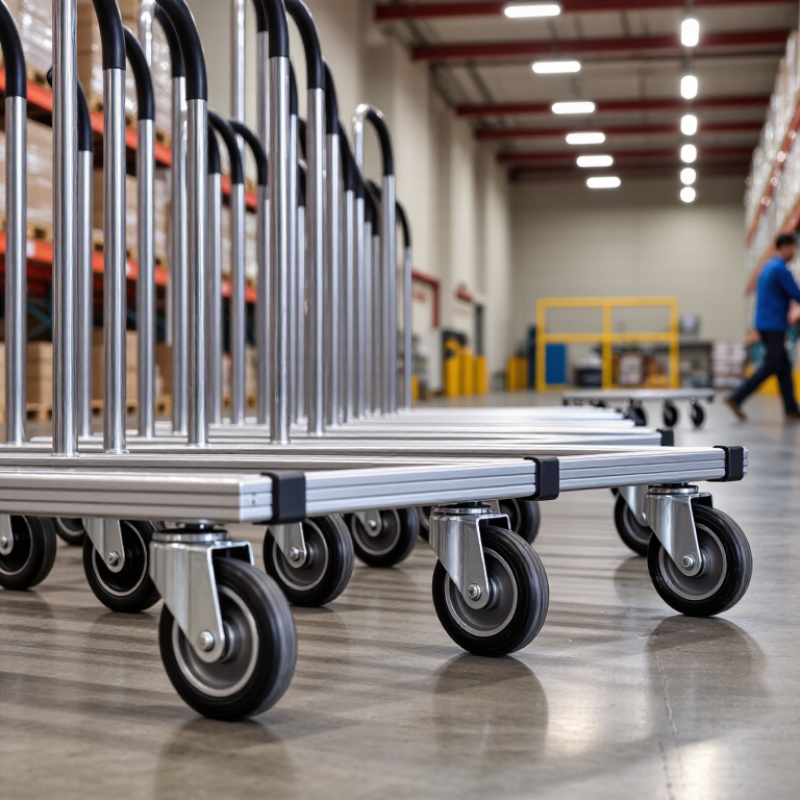
| Rubber-tread caster wheel | Rubber tread mounted on a wheel core and fitted to a swivel or fixed caster assembly | Shop carts, workstations, bins, and mobile equipment | Total caster capacity, mounting type, swivel or fixed configuration, and floor compatibility |
| Rubber-on-metal wheel | Rubber tread bonded to or fitted over a metal core | Industrial carts and equipment requiring a robust wheel core and a rubber running surface | Core material, tread attachment method, load rating, and exposure to oils or chemicals |
| Rubber-on-polyolefin wheel | Rubber tread combined with a lightweight plastic core | Light- to medium-duty carts and equipment on indoor floors | Core load limits, tread bonding, operating temperature, and the actual floor surface |
| Non-marking rubber wheel | Rubber compound formulated to reduce visible marks on floors | Indoor facilities where floor appearance is important, including offices and retail areas | Request confirmation of non-marking performance on the intended floor; check cleaning and chemical requirements |
| Conductive or static-dissipative rubber wheel | Wheel made with a conductive or dissipative compound intended to provide an electrical path | Equipment used in environments with electrostatic-control requirements | Obtain the specified electrical-resistance range and verify the complete wheel-and-floor system meets site requirements |
| Rubber buffer or shock-absorbing wheel | Rubber tread or body selected to provide cushioning and reduce transmitted vibration compared with a rigid wheel | Carts and equipment that travel over joints or moderately uneven surfaces | Balance cushioning against rolling resistance, load capacity, and the surface condition |
| Forklift press-on rubber tire | Solid rubber tire pressed onto a compatible wheel or rim | Forklift trucks and other specified industrial vehicles used on hard surfaces | Confirm vehicle compatibility, tire dimensions, rim fit, load rating, and operating conditions |



 © Copyright 2020 Tianjin Tanghaidongyang Valve Co., Ltd. All Rights Reserved.